ห่วงโซ่อุปทานทั่วโลกเผชิญกับแรงกดดันที่เพิ่มขึ้นจากการประเมินมูลค่าอสังหาริมทรัพย์ที่เพิ่มขึ้น, การขาดแคลนแรงงานอย่างต่อเนื่อง, and stringent fulfillment timelines. Traditional warehouse architectures—relying on selective pallet racking or single-axis automated storage and retrieval systems (เอเอส/อาร์เอส)—frequently fail to resolve these structural friction points. พวกเขาทั้งเสียสละจนถึง 60% of internal facility volume to wide operational aisles or introduce mechanical bottlenecks that restrict throughput velocity. To overcome these limitations, modern intralogistics engineering has shifted decisively toward theระบบรถรับส่งพาเลทสี่ทาง.
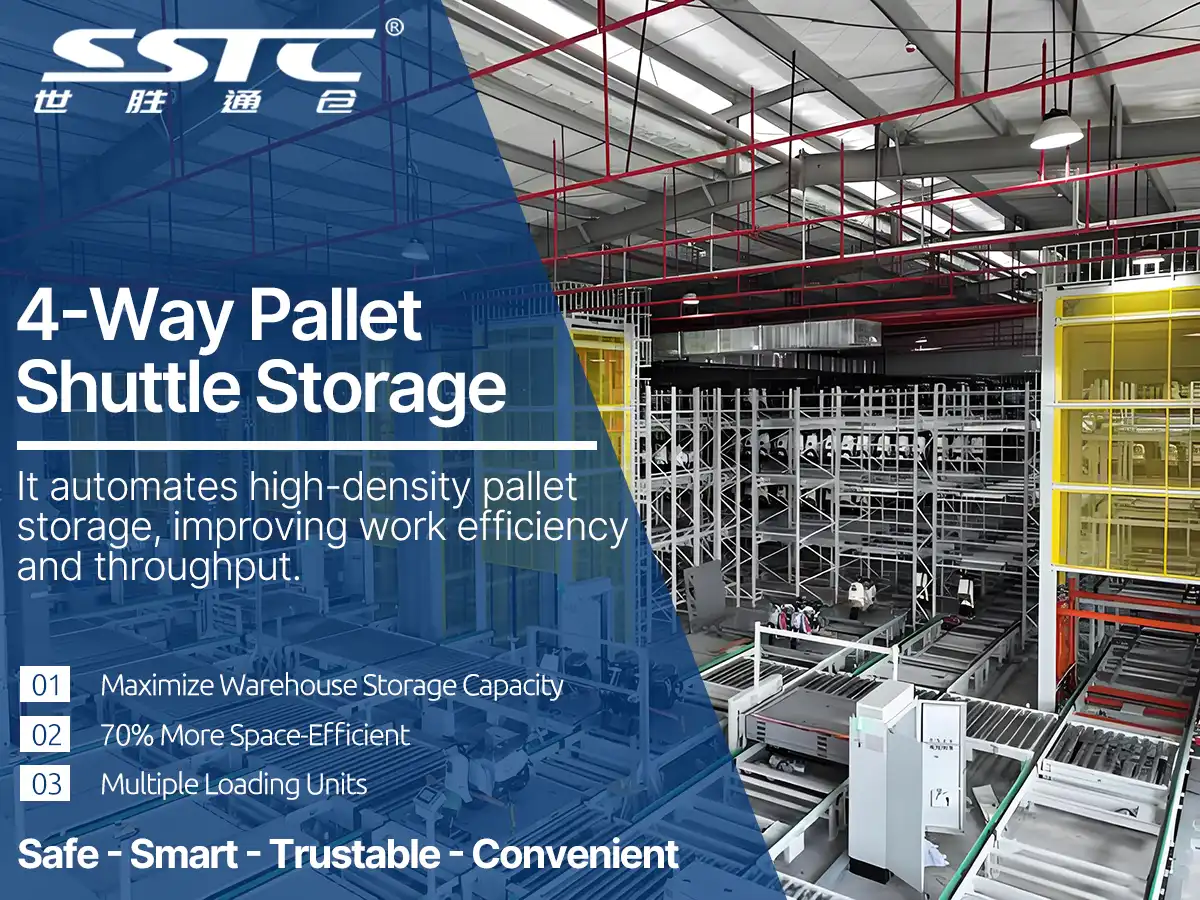
Designed for precise, high-density material handling, the SSTC Four-Way Pallet Shuttle System redefines how industrial facilities manage palletized inventory. By integrating omnidirectional robotic mobility, decentralized fleet management software, and high-speed vertical tier transfers, this technology resolves complex storage challenges across chemical processing, cold chain refrigeration, and heavy industrial manufacturing. This technical analysis examines the mechanical architecture, ขั้นตอนการดำเนินงาน, การเรียบเรียงซอฟต์แวร์, and economic impact of the Four-Way Pallet Shuttle System.
1. Architectural Evolution: Moving Beyond Linear Automation
To evaluate the operational superiority of the four-way shuttle, one must analyze the constraints of legacy storage typologies. Conventional selective racking guarantees 100% stock selectivity, but its spatial efficiency is critically compromised by the vast footprint allocated to forklift maneuvering lanes.
High-density alternatives such as Drive-In racking and traditional Radio Shuttle systems improved cubic utilization by deepening storage lanes. อย่างไรก็ตาม, conventional radio shuttles operate along a single linear axis. Transferring a shuttle between storage channels or across structural tiers requires external material handling equipment—typically forklifts or heavy crane hoists—introducing severe operational bottlenecks, cycle-time delays, และความเสี่ยงด้านความปลอดภัย.
The Four-Way Pallet Shuttle System eliminates these structural constraints. By deploying autonomous mobile robots (AMR) capable of traveling both longitudinally within storage channels and laterally across cross-aisles without human intervention, facilities achieve true multi-directional mobility. This capability successfully bridges the historical divide between ultra-dense bulk storage and flexible, random-access retrieval.
2. Core Engineering and Mechanical Principles
The SSTC Four-Way Pallet Shuttle System operates through a sophisticated synthesis of structural engineering, mechatronics, and power management.
Omnidirectional Drive Mechanics
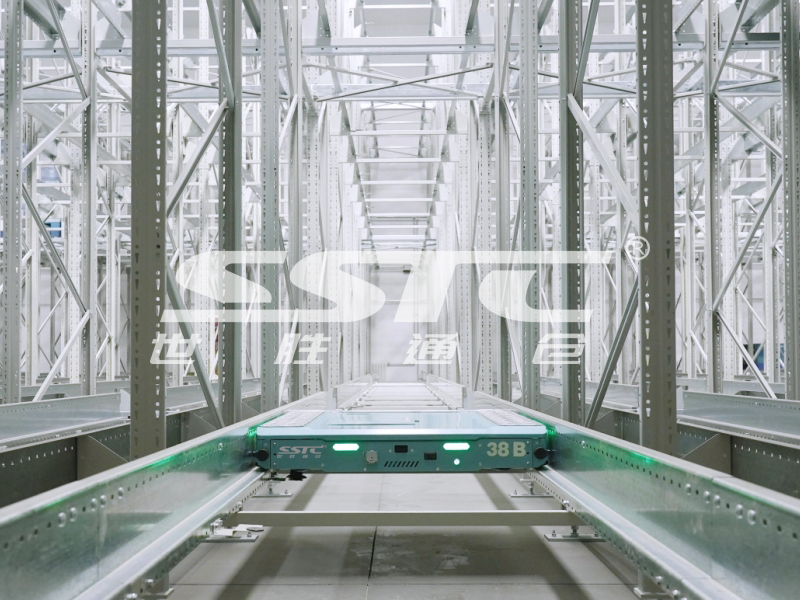
The shuttle achieves its signature directional versatility via an integrated dual-wheel architecture. Primary drive wheels propel the vehicle longitudinally along the storage rails, while secondary transverse wheels embedded within the chassis handle lateral movement. Upon reaching an intersection, an internal electro-mechanical lifting platform elevates the chassis slightly, disengaging the primary wheels and engaging the perpendicular transverse wheels. This frictionless 90-degree transition prevents mechanical wear and ensures continuous workflow momentum.
High-Speed Vertical Integration and Hoisting
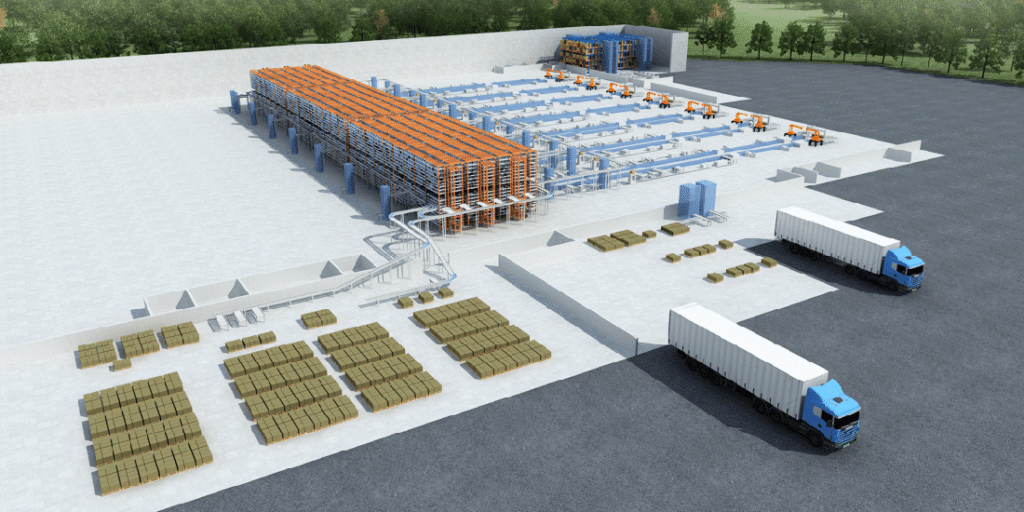
Multi-tier automated warehouses require seamless vertical transport to bridge storage levels. High-speed vertical lifts (ลิฟต์ขนย้ายชั้น) are positioned at the terminal ends of the racking blocks. The shuttle drives onto the elevator platform while bearing a pallet load, allowing the lift to transport the entire unit to the target tier in seconds. Once docked on the new level, the shuttle disembarks autonomously to execute storage or retrieval tasks. This synchronized interaction enables facilities to scale vertical storage heights exceeding 24 เมตร.
Energy Management and Thermal Resilience
ต่อเนื่อง 24/7 operations demand dependable power systems. The SSTC shuttle utilizes high-density lithium-ion battery modules managed by real-time Battery Management Systems (บีเอ็มเอส). When power reserves drop below optimal parameters, the shuttle autonomously navigates to designated charging bays during idle windows. นอกจากนี้, regenerative braking systems recover kinetic energy during deceleration and descent, feeding power back into the cells to maximize operational uptime. For comprehensive engineering specifications, เยี่ยม พื้นที่เก็บข้อมูล SSTC.
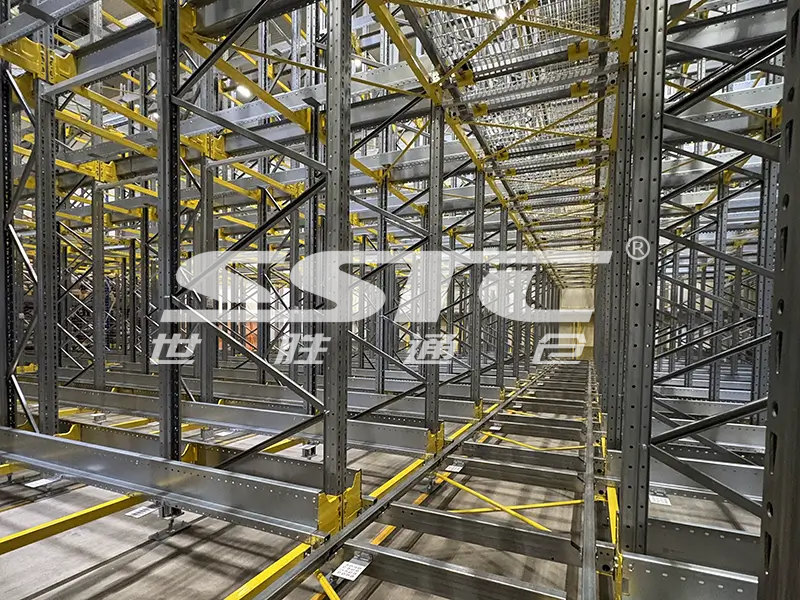
Real estate acquisition and warehouse construction represent massive capital expenditures. Traditional layouts waste substantial volume on clearance corridors. The Four-Way Pallet Shuttle System replaces wide aisles with dense blocks of specialized modular racking, elevating spatial utilization to between 80% และ 90% and effectively doubling storage capacity within an existing building envelope.
Mitigating Labor Dependency and Ergonomic Risks
Manual pallet handling inside deep storage lanes exposes personnel to hazardous working conditions, การชนกันของอุปกรณ์, and repetitive strain injuries. The SSTC Four-Way Pallet Shuttle System removes human operators from high-risk environments. Pallet movement from intake staging to deep storage is handled autonomously, transforming warehouse personnel from manual operators into system supervisors and significantly reducing operational liabilities.
Eliminating Intersection Gridlock
In high-throughput distribution networks, system congestion at transfer points severely degrades performance. The four-way routing capability of the SSTC system allows the control software to calculate alternative travel paths dynamically. If a primary aisle or hoist experiences temporary congestion, shuttles are automatically rerouted through adjacent channels, maintaining a steady, predictable throughput velocity. According to industry research published by organizations tracking global logistics innovation, เช่น อุตสาหกรรมการขนถ่ายวัสดุ (มหิ), software-driven dynamic routing is essential for achieving optimal efficiency in automated storage deployments.
4. การจัดวางซอฟต์แวร์: Fleet Management and WMS Integration
Hardware efficiency is fundamentally dependent on software intelligence. The SSTC Four-Way Pallet Shuttle System is governed by an advanced Warehouse Management System (WMS) และระบบควบคุมคลังสินค้า (สุขภัณฑ์) สถาปัตยกรรม.
The WMS analyzes historical SKU velocity, ฤดูกาล, and order frequency to optimize inventory placement. High-turnover goods are automatically assigned to storage locations adjacent to vertical hoists and outbound staging bays, while slow-moving stock is allocated to deep upper tiers, minimizing average transit times.
Real-Time Fleet Coordination
Operating multiple autonomous shuttles within a shared structural grid requires absolute positional accuracy. The WCS acts as the central traffic controller, monitoring the exact coordinates, battery status, and load state of every vehicle. It manages right-of-way protocols, enforces safety buffers, ดำเนินการอัลกอริธึมการหลีกเลี่ยงการชนกัน, and synchronizes handoffs with peripheral conveyor systems and Automated Guided Vehicles (AGV).
การจัดสรรเงินทุนไปสู่ระบบอัตโนมัติของคลังสินค้าจำเป็นต้องมีความชัดเจน, ผลตอบแทนจากการลงทุนเชิงปริมาณ (ผลตอบแทนการลงทุน). Decision-makers evaluating the SSTC Four-Way Pallet Shuttle System analyze total cost of ownership across three core vectors:
Spatial Efficiency: เฉือนพื้นที่เป็นตารางฟุตที่ต้องการได้ถึง 50% allows enterprises to avoid multimillion-dollar real estate expansion costs.
การเปลี่ยนจากคลังสินค้าแบบแมนนวลไปสู่ระบบอัจฉริยะ, ระบบอัตโนมัติที่มีความหนาแน่นสูงถือเป็นความจำเป็นเชิงกลยุทธ์ที่สำคัญสำหรับองค์กรที่มุ่งมั่นที่จะรักษาความได้เปรียบทางการแข่งขันในการค้าระดับโลก. The SSTC Four-Way Pallet Shuttle System delivers the precise synthesis of spatial engineering, robotic autonomy, and software intelligence required to achieve unmatched storage density and operational resilience.
ไตรมาสที่ 1: How does the Four-Way Pallet Shuttle System manage tier transfers across multi-level warehouse configurations?
A1: The system utilizes dedicated, ลิฟท์แนวตั้งความเร็วสูง (elevators) positioned at the terminal ends of racking blocks. The shuttle drives onto the lift platform with its pallet load, travels to the designated tier autonomously, and exits smoothly onto the new storage level.

 เทคโนโลยีข่าวกรอง SSTC - 4-Way Shuttle Racking & ผู้ผลิตระบบ AS/RS