
 AS/RS & Automatisierte Lagerlösungen | SSTC-Geheimdienst

Einführung: Chemical Warehousing Is Becoming a Logistics Control Challenge
4-Way Paletten-Shuttle-Lager für die Lagerung von Chemikalien is becoming an increasingly important solution for chemical manufacturers, distributors and industrial logistics operators that need to manage growing pallet volumes, limited warehouse space and increasingly complex inventory requirements. Unlike ordinary pallet storage applications, chemical warehousing is not only about storing more goods within a limited footprint. It requires a higher level of control over product identification, batch management, storage location, material movement and operational safety.
In many chemical companies, warehouse pressure does not come from a single problem. It usually develops from several factors happening at the same time: production capacity increases, raw material categories expand, finished goods require longer storage periods, customers demand faster delivery, and warehouse teams need better visibility of every pallet location. Traditional storage methods based mainly on forklifts and manual operations may continue to work at a certain scale, but as inventory complexity increases, companies often find that storage capacity alone is no longer the only limitation. The real challenge becomes how to manage pallet movement accurately and consistently while maintaining reliable inventory information.
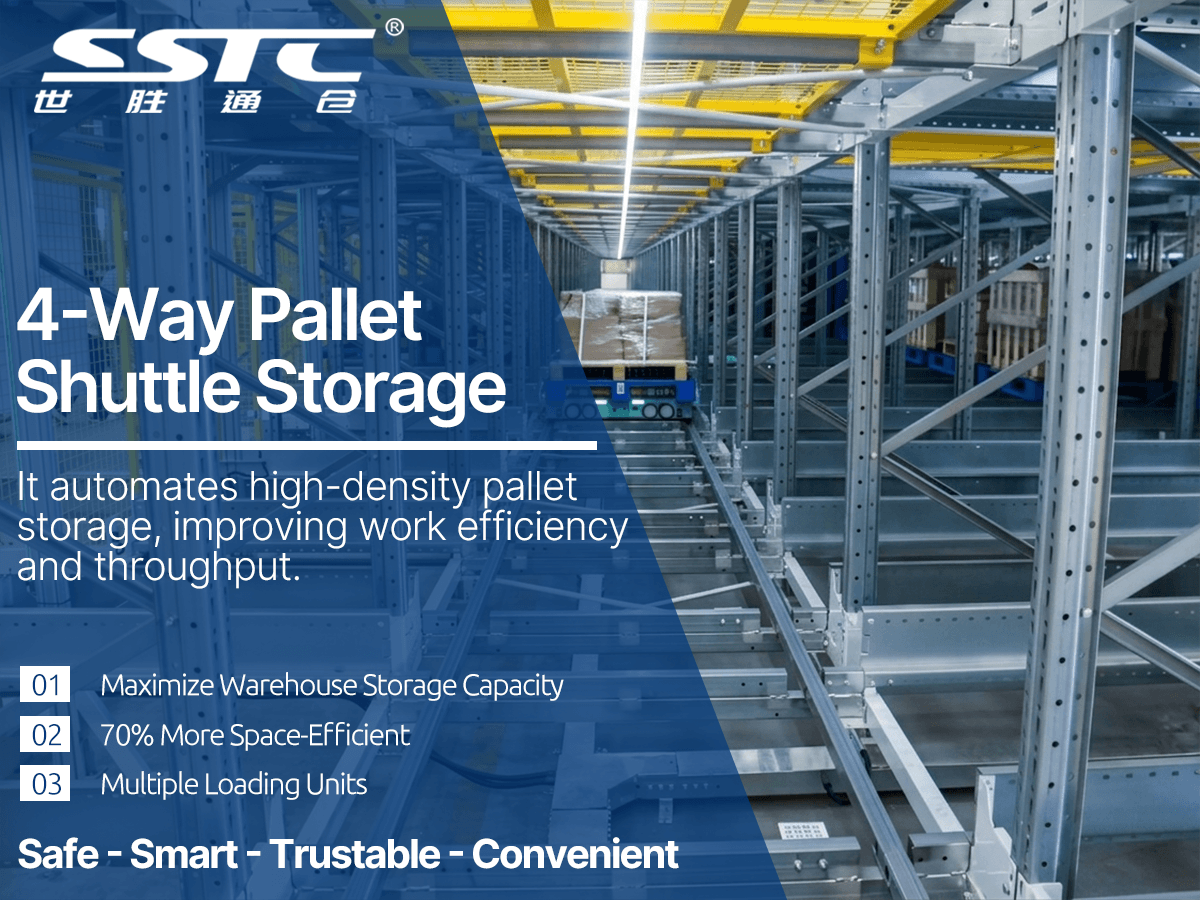
For this reason, modern chemical logistics is gradually moving from traditional storage thinking toward intelligent pallet flow management. Automated Storage and Retrieval Systems (AS/RS), especially high-density solutions such as SSTC’s Four-Way Pallet Shuttle Storage, provide a different approach by connecting physical pallet movement with warehouse management logic. SSTC’s Four-Way Pallet Shuttle Storage system is designed as a high-density automated warehouse solution that uses multi-directional shuttle robots, storage racks, lifts and WCS-based control technology to create a flexible pallet storage matrix.
The purpose of introducing such a system is not simply to replace human operators with machines. The more important objective is to create a warehouse environment where every pallet has a clear identity, every storage position is controlled, and every movement can be planned according to business requirements.
For chemical companies, this change is significant because warehouse performance directly influences production continuity, customer service levels and inventory reliability.
Why Chemical Warehousing Requires a Different Storage Strategy
Chemical products have characteristics that make warehouse management more demanding than many conventional industries. A pallet of chemical raw materials or finished products may look similar to pallets in other manufacturing sectors, but behind every pallet there can be important information that must be controlled.
This information may include product type, batch number, manufacturing date, quality status, packaging format, customer requirements and storage conditions. In einigen Fällen, different chemical products may require different handling procedures or separation rules depending on their characteristics and applicable regulations.
daher, a chemical warehouse cannot be evaluated only by the number of pallet positions available. A warehouse with 20,000 pallet locations may still face operational difficulties if employees cannot quickly identify the correct inventory, if storage locations are not optimized, or if pallet movements depend heavily on manual decisions.
This is why chemical logistics is increasingly moving toward a more integrated approach:
Product information → Warehouse management system → Storage decision → Automated pallet movement → Inventory update
The storage equipment becomes part of a larger information and logistics system rather than an isolated rack structure.
SSTC’s automated storage solutions are designed around this concept. The company provides integrated AS/RS solutions including Four-Way Pallet Shuttle Storage, Shuttle Carrier Storage, Shuttle Stacker Crane Storage and other intelligent warehouse systems.
The Limitations of Traditional Pallet Storage in Growing Chemical Operations
Traditional pallet warehouses have been widely used in chemical manufacturing and distribution because they are familiar, flexible and relatively easy to operate. Selective pallet racks, drive-in racks and other conventional systems remain suitable for many applications, especially when direct pallet access and lower investment requirements are the main priorities.
Jedoch, when chemical businesses expand, several operational challenges often become more visible.
One common issue is the increasing dependence on forklift movements. In a traditional deep-lane storage environment, forklifts may need to enter storage areas frequently to place or retrieve pallets. This creates additional travel distances and increases the complexity of warehouse traffic management.
Another challenge is storage density. Chemical companies often store large quantities of raw materials or finished goods, while warehouse expansion can be difficult because of land availability, construction costs or existing facility limitations. Simply adding more rack rows may increase capacity, but it may also consume valuable floor space and reduce operational flexibility.
Inventory visibility is another important factor. When warehouse operations rely heavily on manual handling, the connection between the physical pallet and digital inventory records becomes more dependent on operator accuracy. As SKU numbers and batch requirements increase, maintaining real-time visibility becomes more difficult.
These challenges explain why chemical companies are exploring automated pallet storage technologies. Jedoch, automation should not be selected only because it is advanced technology. The right system must match the actual warehouse operation, product characteristics and long-term business requirements.
A well-designed AS/RS solution should answer several practical questions:
- How many pallets need to be stored?
- How frequently are pallets received and shipped?
- How important is batch traceability?
- How much forklift movement should occur inside storage areas?
- How much future expansion capability is required?
- How should warehouse information systems communicate with equipment?
Only after these questions are clearly understood can the appropriate automation technology be selected.
How does 4-Way Pallet Shuttle Storage Change Chemical Pallet Flow ?
The key difference between a conventional pallet storage system and a Four-Way Pallet Shuttle Storage solution is the way pallet movement is organized.
In a traditional warehouse, the forklift is usually responsible for both transportation and positioning. The operator drives to the storage location, places the pallet and returns through the aisle. This approach works well for many applications, but as warehouse density increases, the forklift becomes responsible for too many tasks.
A Four-Way Pallet Shuttle system separates these activities.
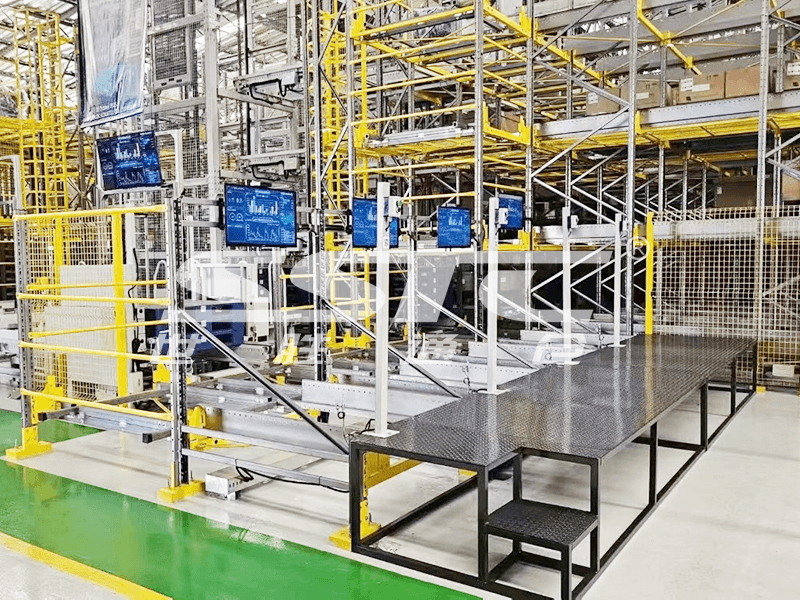
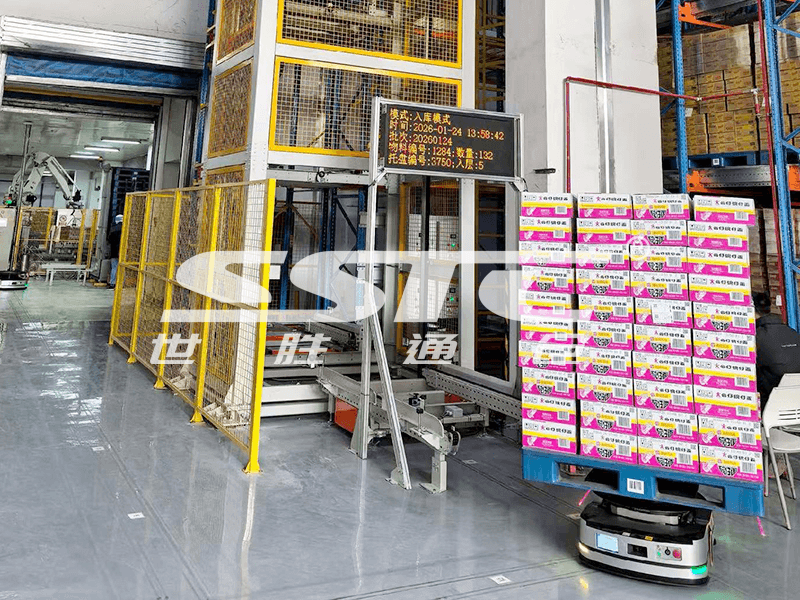
The forklift or conveyor delivers the pallet to a designated transfer point. After receiving the pallet, the shuttle robot moves inside the rack structure and transports the pallet to the assigned storage location. Because the shuttle can move in multiple directions, it is not limited to a single fixed lane movement. SSTC’s Four-Way Pallet Shuttle Storage system is designed to operate across longitudinal and transverse directions, creating a flexible three-dimensional storage structure controlled by warehouse software.
This approach changes the role of automation.
The system is no longer only a machine for moving pallets. It becomes a controlled pallet-flow platform.
For chemical warehouses, this provides several potential advantages:
Erste, pallet movement becomes more predictable because tasks are generated and managed through software rather than depending entirely on manual decisions.
Zweite, storage density can be improved because the rack layout can be designed around deep-lane storage rather than requiring every pallet position to have direct forklift access.
Dritte, warehouse traffic can be better organized because forklifts and automated equipment operate in clearly defined areas.
SSTC’s product information states that its Four-Way Pallet Shuttle solution integrates shuttle robots, storage racks, pallet lifts, conveyors and WCS management to support automated pallet handling and high-density storage operations.
For chemical companies, the value of this architecture is not simply higher automation. It is the ability to create a more controlled relationship between the physical warehouse and the information system managing it.
Reducing Manual Handling Risks Through Better Material Flow Control
In chemical logistics, improving warehouse performance is not only about increasing storage capacity. It is also about creating a more predictable and controlled material movement process. Forklifts, operators and storage equipment all play important roles in warehouse operations, but when warehouse volume increases, excessive manual movement can create additional operational complexity.
It is important to clarify that automation does not automatically make a chemical warehouse safe. Safety depends on many factors, including chemical classification, facility design, fire protection systems, ventilation, emergency procedures, operator training and regulatory compliance. Jedoch, a properly designed AS/RS solution can help reduce certain types of operational exposure by minimizing unnecessary manual movements inside storage areas and creating clearer separation between human activities and automated storage processes.
According to the Occupational Safety and Health Administration (OSHA), warehousing operations involving hazardous materials require careful management of chemical storage, powered industrial truck activities and workplace hazards. OSHA also emphasizes the importance of appropriate storage practices and controlling risks associated with material handling activities.
OSHA Warehousing: Hazards and Solutions
For a chemical warehouse, this principle is especially relevant because forklifts often need to operate close to stored products, rack structures and pedestrian working areas. In a traditional storage environment, the same forklift may repeatedly perform receiving, transportation, storage placement and retrieval activities. As warehouse activity increases, traffic management becomes more complicated.
A Four-Way Pallet Shuttle system changes this operating model by transferring repetitive internal storage movements from forklifts to automated shuttle equipment. The forklift still plays an important role at receiving and dispatch interfaces, but the shuttle robot performs the movement tasks inside the storage structure.
This does not eliminate human involvement, nor does it replace warehouse safety management. Instead, it creates a more organized operating environment where different activities are assigned to different zones.
Zum Beispiel, a chemical manufacturer may define:
- receiving and inspection areas managed by operators;
- transfer stations connected with conveyors;
- automated storage zones managed by shuttle robots;
- picking and dispatch areas controlled by warehouse systems.
This separation improves operational clarity. Workers know where manual activities happen, while automated equipment handles repetitive pallet movements within the storage matrix.
This approach is particularly valuable for chemical companies that handle large pallet volumes, because warehouse efficiency is often affected not by one single operation but by the accumulation of many repeated movements every day.
Improving Batch Traceability and Inventory Visibility
One of the most important requirements in chemical warehouse management is knowing exactly where every pallet is located and what information is associated with it.
Unlike some industries where products can be managed mainly by SKU quantity, chemical logistics often requires more detailed control. A warehouse may need to track:
- product batch number;
- manufacturing date;
- quality inspection status;
- customer allocation;
- expiration or retest information;
- storage requirements;
- release status.
When inventory information and physical storage operations are not closely connected, warehouse teams may spend additional time searching for products, confirming locations or manually updating records.
This is where AS/RS technology provides value beyond physical storage.
A modern automated warehouse connects the digital and physical sides of logistics:
The WMS manages inventory decisions.
The WCS coordinates equipment movements.
The shuttle robot executes pallet transportation.
The identification system confirms pallet information.
Together, these elements create a closed-loop warehouse operation.
SSTC’s Four-Way Pallet Shuttle solutions can integrate with warehouse control systems and identification technologies such as RFID and barcode systems, enabling automated pallet identification and movement management. (sstc-storage.com)
For chemical companies, this connection is especially useful because inventory accuracy directly affects production planning and customer service.
Consider a chemical distributor managing hundreds or thousands of pallet positions. A customer may request a specific batch of material. A production department may require a particular raw material lot. A quality department may place certain inventory under temporary hold.
In a manually managed warehouse, these situations can require additional searching and coordination.
In an automated warehouse, the system can associate each pallet with a defined digital identity and storage location, allowing operators to retrieve information quickly and accurately.
This does not mean software replaces warehouse management decisions. Instead, software provides the information structure that allows people and equipment to work together more effectively.
High-Density Storage Without Expanding Warehouse Footprint
Space utilization has become one of the most important considerations for chemical manufacturers and distributors. Many companies face a common situation: inventory requirements continue increasing, but expanding the warehouse building is expensive or physically difficult.
Land availability, construction costs, location restrictions and operational disruption can all make warehouse expansion challenging.
For this reason, high-density storage has become an important direction in modern pallet logistics.
Jedoch, high density should not simply mean adding more rack positions. A warehouse must balance storage capacity with accessibility, throughput, safety requirements and future flexibility.
A Four-Way Pallet Shuttle system creates higher storage density by allowing pallets to be stored in deeper lanes while automated shuttle vehicles handle internal transportation. Compared with conventional selective pallet storage, this type of architecture can reduce the amount of space required for aisles and increase the proportion of the building dedicated to storage.
For chemical applications, this can be particularly valuable because many chemical products are stored in pallet quantities with relatively stable inventory patterns. Raw materials, additives, packaging chemicals and finished chemical products often require significant buffer inventory to maintain continuous production and customer supply.
A high-density automated storage system allows companies to use available warehouse volume more effectively.
SSTC’s Four-Way Pallet Shuttle Storage solution is designed for high-density pallet storage applications and can be configured with multiple storage levels, shuttle robots, vertical lifting equipment and warehouse control systems. (sstc-storage.com)
Jedoch, the goal should not be maximum density at any cost.
A professional chemical warehouse design must consider:
- Palettenabmessungen;
- load weight;
- chemical characteristics;
- storage compatibility;
- emergency access;
- fire protection requirements;
- operational throughput.
The best warehouse is not necessarily the one with the most pallet positions. It is the one that provides the best balance between capacity, control and operational reliability.
Chemical Warehouse Design Considerations for AS/RS Projects
A common mistake in warehouse automation projects is selecting equipment before fully understanding the warehouse environment. Chemical applications require a more detailed engineering approach because the storage system must match both logistics requirements and product characteristics.
Before designing a Four-Way Pallet Shuttle system, chemical companies should evaluate several key areas.
The first is product information.
The automation system must understand the physical characteristics of the pallet. Weight, dimensions, packaging type and pallet condition all influence equipment design. SSTC’s published product information indicates that its Four-Way Pallet Shuttle configuration can support pallet loads up to 1,500 kg. Jedoch, actual project suitability must be verified according to pallet structure, load distribution and warehouse conditions. (sstc-storage.com)
The second is warehouse flow.
A chemical company should analyze:
- daily inbound pallet volume;
- daily outbound pallet volume;
- peak operation periods;
- production schedules;
- dispatch requirements;
- seasonal demand changes.
A warehouse designed only around average conditions may experience congestion during peak periods.
The third is building requirements.
An automated chemical warehouse may involve:
- floor load requirements;
- warehouse height;
- rack structure;
- fire protection systems;
- emergency access;
- environmental controls;
- equipment maintenance areas.
The Health and Safety Executive (HSE) in the United Kingdom highlights the importance of risk assessment, storage arrangements and emergency planning when dealing with dangerous substances.
HSE Guidance: Storage of Dangerous Substances
This reinforces an important engineering principle:
The automation system should be designed around the chemical warehouse requirements, not the other way around.
A successful AS/RS project begins with understanding the products, processes and risks before selecting the equipment.
Choosing Between Different AS/RS Technologies for Chemical Applications
Although Four-Way Pallet Shuttle Storage provides significant advantages for many pallet-intensive applications, it is not the only automated storage option available.
Different chemical warehouses may require different solutions depending on their operating characteristics.
A Stacker Crane AS/RS system may be suitable for facilities where vertical height utilization and precise pallet access are the main priorities. These systems are often selected for high-bay warehouses with clearly defined storage aisles and significant throughput requirements.
A Shuttle Carrier system may be appropriate where very high-density storage and flexible multi-lane operation are required.
A Radio Shuttle system may remain a practical choice for companies seeking improved storage density with a lower level of automation.
The important point is that technology selection should begin with warehouse requirements rather than equipment preference.
Zum Beispiel:
A chemical manufacturer storing large quantities of standardized raw materials may prioritize density and batch control.
A chemical distributor handling many customers and frequent order changes may prioritize flexibility and retrieval speed.
A specialty chemical producer may prioritize traceability and controlled inventory management.
Each situation requires a different balance.
SSTC provides a range of intelligent warehouse solutions, including Four-Way Pallet Shuttle Storage, AS/RS Warehouse Systems, Shuttle Carrier Storage and Shuttle Stacker Crane Solutions, allowing customers to evaluate different automation approaches based on their specific logistics requirements.
SSTC Intelligent Intralogistics Solutions
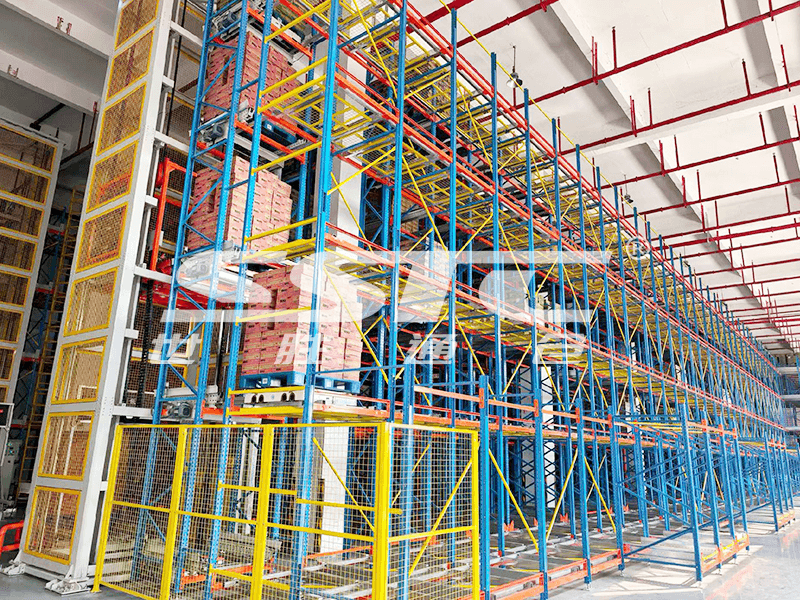
Why SSTC Four-Way Pallet Shuttle Storage Fits Chemical Industry Applications
For chemical companies considering warehouse automation, the most important question is not whether automation is necessary, but whether the selected technology can support their actual operational requirements over the long term.
A successful automated warehouse project must combine several elements: appropriate storage equipment, reliable control software, accurate warehouse data, professional engineering design and a clear understanding of the customer’s business process.
This is the approach SSTC follows when developing intelligent pallet storage solutions for industrial customers.
The chemical industry has many different warehouse scenarios. Some companies mainly store raw materials for internal production. Others operate regional distribution centers supplying multiple customers. Some manage finished chemical products that require strict batch tracking and reliable dispatch performance. Although the operational goals may differ, many chemical companies share similar expectations:
They need to store more pallets within existing facilities.
They need more accurate inventory information.
They need fewer unnecessary internal movements.
They need a warehouse system that can adapt to future growth.
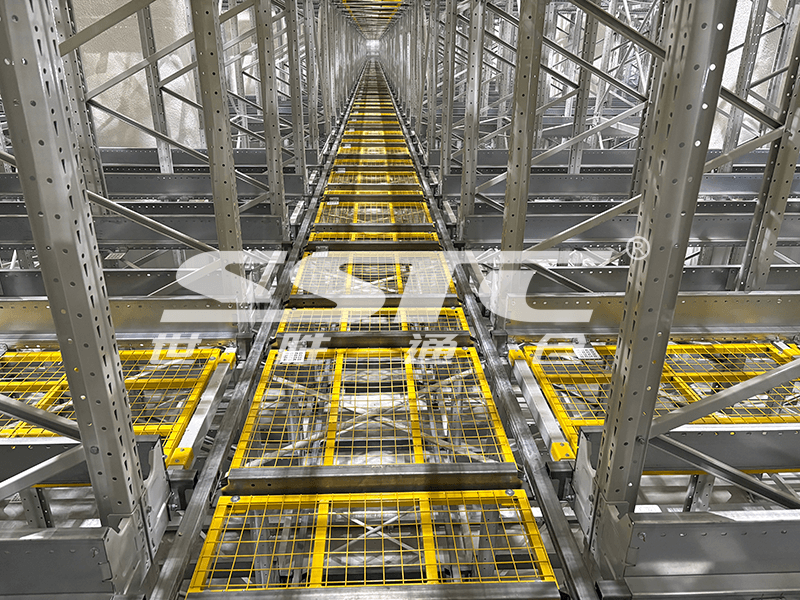
SSTC’s 4-Way Paletten-Shuttle-Lager für die Lagerung von Chemikalien is designed around these requirements by combining high-density rack structures, intelligent shuttle robots, lifting equipment, conveyors and warehouse control technology.
The advantage of a Four-Way Pallet Shuttle system is its flexibility in pallet movement. Unlike traditional shuttle systems that usually operate along a single fixed direction, four-way shuttle technology allows the shuttle robot to move horizontally and vertically through the storage structure according to operational requirements. This provides greater freedom in warehouse layout design and supports more efficient pallet allocation.
For chemical warehouses, this flexibility creates several practical benefits.
Erste, it allows companies to design storage areas according to product characteristics rather than simply following traditional rack layouts. Different product categories, batch requirements or inventory strategies can be managed within the same automated storage environment.
Zweite, it improves warehouse scalability. As business volumes increase, companies can evaluate expansion possibilities based on storage requirements and operational data instead of immediately increasing manual handling capacity.
Dritte, it supports more stable warehouse operations. Because pallet movement tasks are generated and executed through the warehouse control system, the warehouse can operate according to defined rules rather than depending entirely on individual operator experience.
This does not mean that every chemical warehouse should become fully automated. Automation level should always match actual business needs. Jedoch, for companies dealing with large pallet volumes, complex inventory structures and limited warehouse space, Four-Way Pallet Shuttle technology provides a practical pathway toward modern pallet logistics.
Creating a Modern Chemical Warehouse Through Intelligent Integration
A modern warehouse is not defined only by the equipment installed inside the building. The real value comes from the connection between equipment, software and operational processes.
In traditional warehouses, information flow and material flow are often managed separately.
An operator may check inventory information in a system, then physically search for the pallet location. A forklift driver may receive a task, travel through the warehouse and complete the movement manually. Although this process can function effectively in smaller operations, complexity increases as warehouse scale grows.
An intelligent AS/RS environment creates a stronger connection between information and physical movement.
A typical automated pallet storage process may include:
- Warehouse Management System (WMS) generating storage or retrieval tasks;
- Warehouse Control System (WCS) converting tasks into equipment instructions;
- Shuttle robot receiving movement commands;
- Pallet identification systems confirming product information;
- Inventory database updating pallet status automatically.
This integration helps create a more transparent warehouse operation.
For chemical companies, transparency is especially valuable because inventory decisions often involve more than quantity management. The warehouse may need to know:
Where is the pallet?
Which batch does it belong to?
Has it passed quality inspection?
Is it available for shipment?
Does it match customer requirements?
By connecting warehouse equipment with information systems, companies can reduce uncertainty in daily operations.
SSTC focuses on providing complete intelligent intralogistics solutions rather than individual storage equipment. Through engineering design, system integration and automation technologies, SSTC helps customers build warehouse solutions that fit their production and logistics processes.
More information about SSTC’s intelligent warehouse solutions can be found at:
SSTC Intelligent Warehouse Automation Solutions
Product information:
From Storage Capacity to Chemical Logistics Performance
The future of chemical warehousing is not simply about increasing the number of pallet positions. The competitive advantage comes from how effectively a company can manage materials, information and operational resources together.
A warehouse that stores more products but cannot provide accurate information may create additional management pressure.
A warehouse that uses advanced equipment but does not match business processes may fail to deliver expected results.
A successful automation project requires balance.
Storage density, throughput, Sicherheitsanforderungen, inventory control and future expansion all need to be considered together.
This is why Four-Way Pallet Shuttle Storage has become an attractive option for many chemical applications. It provides a foundation for building a more structured pallet logistics environment where storage decisions, equipment movements and inventory information work together.
For chemical manufacturers and distributors, this means moving beyond the traditional idea of a warehouse as a passive storage area.
The warehouse becomes an active logistics platform that supports production continuity, customer service and business growth.
About SSTC Intelligence
SSTC Intelligence specializes in intelligent warehouse automation and pallet logistics solutions, providing customers with advanced AS/RS systems designed for different industrial applications.
The company’s solutions include:
- Four-Way Pallet Shuttle Storage;
- Shuttle Carrier Storage Systems;
- Shuttle Stacker Crane AS/RS;
- Automated Pallet Storage Solutions;
- Intelligent Warehouse Integration.
With experience in industrial warehousing applications, SSTC focuses on helping customers improve pallet storage efficiency, inventory visibility and logistics performance through customized automation solutions.
Whether for chemical manufacturing, Essen und Trinken, pharmaceutical, automotive, FMCG or other pallet-intensive industries, SSTC works with customers to develop warehouse systems based on actual operational requirements.
For chemical companies looking to upgrade their pallet storage and logistics processes, SSTC provides professional consultation and intelligent warehouse solutions.
- Website: https://www.sstc-storage.com
- E-Mail: [email protected] | [email protected]
- WhatsApp: +86-13671613032
Conclusion: Building More Reliable Chemical Warehouses Through Intelligent Pallet Logistics
Chemical warehousing is entering a new stage where storage capacity alone is no longer enough to support business development. Companies need better control of inventory, more predictable pallet movement and stronger connections between warehouse operations and digital management systems.
The role of automation is not simply replacing manual operations. Its purpose is to create a more organized, visible and controllable logistics environment.
SSTC’s 4-Way Paletten-Shuttle-Lager für die Lagerung von Chemikalien provides chemical companies with a modern approach to pallet storage by combining high-density storage design, intelligent equipment control and flexible warehouse management.
For companies facing limited space, increasing pallet volumes and more complex inventory requirements, the right AS/RS solution can become an important foundation for future logistics development.
By transforming the warehouse from a storage location into an intelligent logistics platform, chemical companies can achieve better operational consistency and prepare for long-term growth.
Frequently Asked Questions About 4-Way Pallet Shuttle Storage for Chemical Warehousing
Q1. What is 4-Way Pallet Shuttle Storage for Chemical Warehousing?
Answer: 4-Way Pallet Shuttle Storage for Chemical Warehousing is an automated pallet storage solution designed for chemical manufacturers, distributors and industrial logistics operators that require high-density storage, accurate inventory control and reliable pallet movement management.
Unlike traditional pallet storage systems that mainly depend on forklift operations, a Four-Way Pallet Shuttle system uses intelligent shuttle robots, storage racks, lifting equipment and warehouse control systems to automatically transport pallets within the storage structure.
For chemical warehouses, the value of this technology is not only increasing storage capacity. It helps companies create a more controlled logistics environment where pallet locations, inventory information and material movements can be managed more accurately.
SSTC’s Four-Way Pallet Shuttle Storage solution integrates automated equipment and intelligent control technologies to support modern pallet logistics applications.
Q2. Why is Four-Way Pallet Shuttle suitable for chemical pallet storage?
Answer: Four-Way Pallet Shuttle technology is suitable for many chemical warehouse applications because chemical logistics often requires more than simple pallet storage.
Chemical companies usually need to manage:
- multiple product categories;
- different batches;
- large pallet quantities;
- strict inventory visibility requirements;
- limited warehouse space.
The Four-Way Pallet Shuttle system provides high-density storage while maintaining flexible pallet movement. Because shuttle robots can move in multiple directions, warehouse layouts can be designed more efficiently compared with traditional storage systems that require extensive forklift access.
For chemical companies, this means better space utilization, more predictable pallet handling and improved connection between warehouse operations and inventory management systems.
Q3. Can 4-Way Pallet Shuttle improve chemical warehouse safety?
Answer: A 4-Way Pallet Shuttle system can help improve operational control in chemical warehouses by reducing unnecessary manual pallet movements inside storage areas.
Jedoch, automation itself is not a replacement for chemical safety management. A safe chemical warehouse still requires proper facility design, fire protection systems, risk assessment procedures, employee training and compliance with applicable regulations.
The role of AS/RS technology is to create a more organized operating environment by separating automated storage activities from manual handling processes.
By reducing repetitive forklift movements inside storage lanes and improving material flow visibility, Four-Way Pallet Shuttle technology can support safer and more controlled warehouse operations.
Q4. How does SSTC Four-Way Pallet Shuttle support inventory management?
Answer: SSTC Four-Way Pallet Shuttle Storage supports inventory management by connecting warehouse equipment with digital control systems.
Through integration with WMS and WCS platforms, the system can coordinate:
- pallet identification;
- storage location assignment;
- automated retrieval tasks;
- inventory status updates;
- warehouse operation monitoring.
For chemical companies, this capability is especially valuable because inventory management often depends on more than quantity. Batch number, product status, quality inspection information and delivery requirements may all influence warehouse decisions.
By improving the connection between physical pallets and digital inventory information, automated storage systems help companies achieve better visibility and operational consistency.
Q5. How should chemical companies select an AS/RS solution?
Answer: Chemical companies should select an AS/RS solution based on actual operational requirements rather than choosing technology only because it is advanced.
Important factors include:
- pallet quantity and turnover rate;
- warehouse building conditions;
- product characteristics;
- storage requirements;
- inventory management strategy;
- future expansion plans.
Four-Way Pallet Shuttle Storage is an excellent option for companies that need high-density pallet storage combined with flexible automated movement.
Jedoch, every chemical warehouse has different requirements. A professional AS/RS supplier should first analyze the customer’s logistics process and then recommend the most suitable solution.
SSTC provides customized intelligent warehouse solutions according to customer applications, helping chemical companies build efficient and reliable pallet logistics systems.