
 Công nghệ thông minh SSTC - 4-Nhà sản xuất Giá đỡ Con thoi & Hệ thống AS/RS

Hệ thống lưu trữ và truy xuất tự động (ASRS) combines racking, machines, and software to place goods into storage and bring them back out without drivers entering aisle. Definition is simple. Selecting right configuration is harder, because Stacker Crane AS/RS, Giá đỡ tàu con thoi, Và Hệ thống đưa đón bốn chiều each solve different problems, and mismatch between technology and operation is costly to correct once construction has started.
Tình báo SSTC prepared this guide for operations managers, giám đốc hậu cần, plant engineers, and project owners who must select ASRS for pallets, building, và ngân sách. It explains how each pallet automation type works, where it performs best, what Hệ thống kiểm soát kho (WCS) software contributes, and how well-run project moves from first layout sketch to productive operation. Language is deliberately practical: every section is meant to help you ask better questions and reach defensible choice for high-density automated storage.
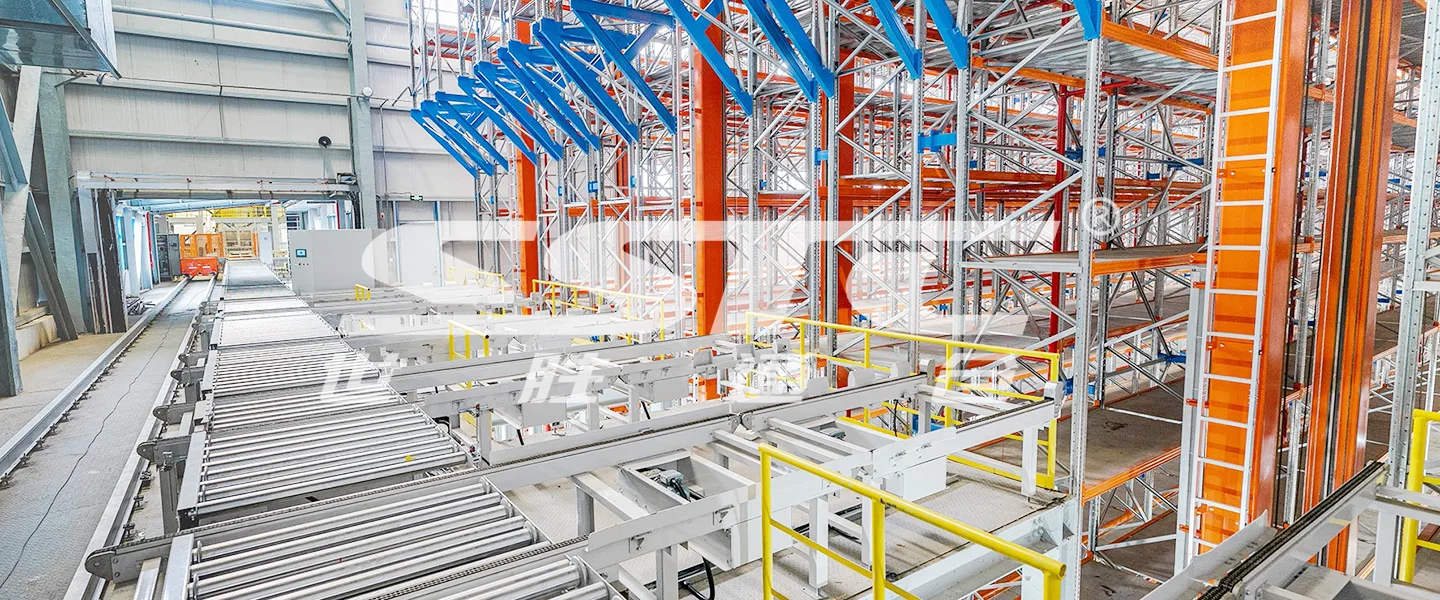
What ASRS Replaces in Daily Operations
Most warehouses that consider automation are not dissatisfied with forklifts as such. The frustration comes from what manual handling has gradually become: more aisles to maintain, fewer drivers to hire, congestion at shift changes, and inventory records that never quite match physical stock.
ASRS addresses each of these directly.
- Không gian: Machines travel in narrow, fixed aisles or inside rack lanes, so less floor area is lost to vehicle movement.
- Precision: Every move follows a program, so pallets are placed in the same position, at the same speed, every time. This reduces product damage and rack impact.
- Accuracy: Software issues each instruction, which means inventory location is always known. This is the real source of improved stock accuracy.
- Continuity: Automated equipment operates across long shifts without fatigue, which stabilizes output in markets where labor is scarce.
Academic research supports this broad picture. A widely cited review in Transportation Science traces how aisle-bound cranes formed the original generation of automated storage, and how shuttle-based designs later added flexibility and throughput (Azadeh, de Koster and Roy, 2019). An open-access review in Sustainability reaches comparable conclusions on space utilization and productivity for shuttle-based storage (MDPI, 2022). Technology is mature. What varies from project to project is fit.
Three Pallet ASRS Solutions from SSTC Intelligence
SSTC Intelligence designs and manufactures three main families of pallet automation. Their applications overlap in places and separate clearly in others.
Stacker Crane AS/RS: chiều cao, speed and precision
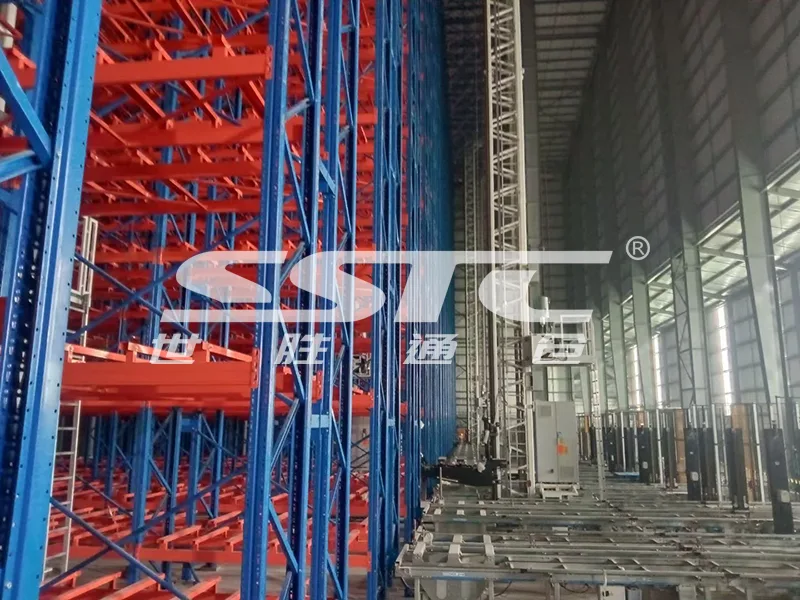
Stacker Crane AS/RS uses rail-guided cranes that run along narrow aisles, with racks standing on both sides. Each crane carries a vertical mast and load handler that places and retrieves pallets at any position in its aisle. Pallets enter and leave through input and output stations, usually connected to conveyors.
This architecture suits tall buildings, operations that need every pallet position individually accessible, and applications where throughput per aisle must be high and predictable. Because motion occurs in one plane, control logic is clean and travel profiles can be tuned tightly.
Kỹ sư tình báo SSTC AS/RS pallet warehouse systems as integrated packages: storage structure, storage and retrieval machines, and pick-and-deposit stations are designed together rather than sourced separately. For deeper coverage of high-bay design, read the SSTC Intelligence guide to Pallet Stacker Crane AS/RS storage solutions.
Best fit: food and beverage plants, pharmaceutical stores, finished-goods warehouses, and cold stores where minimizing human presence is valuable.
Giá đỡ tàu con thoi: density at low cost per pallet position
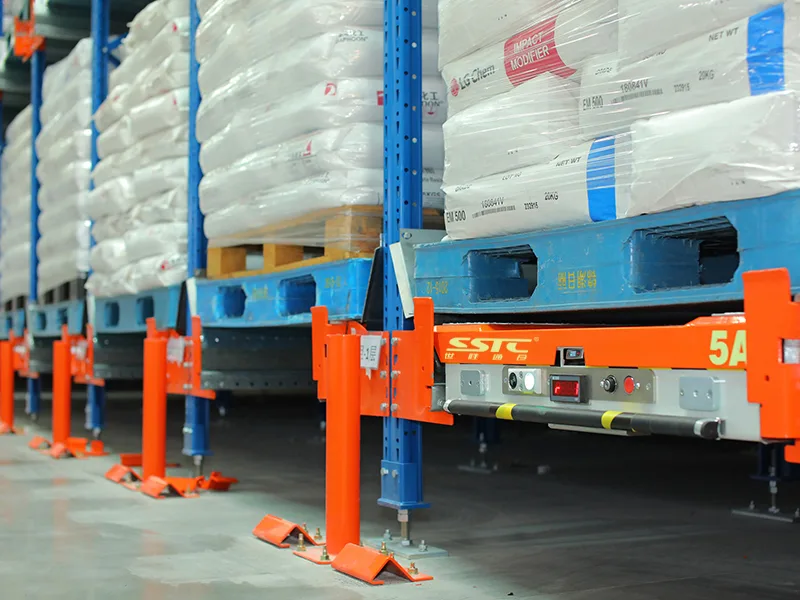
In Radio Shuttle Racking, storage is built as deep lanes. Each battery-powered shuttle travels inside its lane, carries pallets to their positions and returns for the next load. Forklifts only deliver pallets to lane entrances, never driving into the structure. Lanes can be many pallets deep, so few aisles serve large quantities.
The trade-off is selectivity. Each lane normally holds one product or batch, and stock rotates first-in-first-out or last-in-first-out depending on loading direction. This makes Radio Shuttle Racking well suited to high volume per SKU: đồ uống, frozen foods, bulk consumer goods, seasonal stock and production buffers.
SSTC Intelligence explains history, applications and design logic in its article on Radio Shuttle Racking systems. Double deep and multi-deep layouts follow the same lane-based principle.
Best fit: high-volume operations with moderate SKU counts and strong demand for storage density.
Hệ thống đưa đón bốn chiều: flexibility in demanding layouts
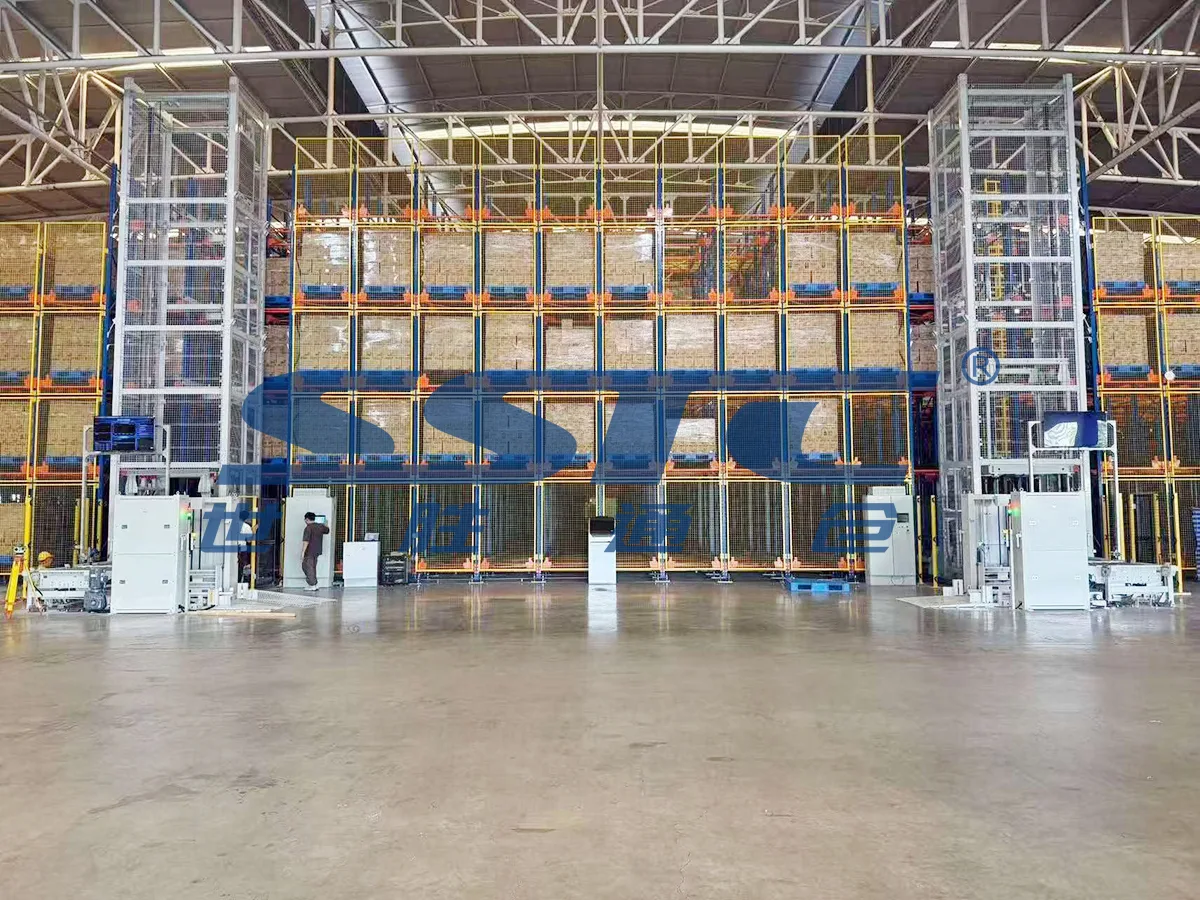
Four-Way Shuttle System uses robots that travel along rack lanes and also across them, so each unit can change aisles instead of remaining tied to one lane. Combined with lifts that move shuttles or pallets between levels, the entire fleet serves a shared storage grid.
SSTC Intelligence positions its Hệ thống đưa đón bốn chiều for irregular buildings, limited ceiling height and operations that expect to grow in stages. Fleet size can rise as throughput rises, so owners are not forced to buy peak capacity on day one.
Best fit: third-party logistics providers, manufacturers with several product families, pharmaceutical distributors and retailers with mixed pallet flows.
Side-by-Side Comparison
| Question | Stacker Crane AS/RS | Giá đỡ tàu con thoi | Hệ thống đưa đón bốn chiều |
|---|---|---|---|
| SKU variety supported | Cao; every position reachable | Low to moderate; usually one product per lane | Moderate to high; software controlled |
| Preferred building shape | Tall, regular | Regular, any height | Irregular or limited height |
| Throughput scaling | Add aisles or cranes | Add shuttles per lane | Add shuttles and lifts |
| Typical stock rotation | Any | FIFO or LIFO by lane | Any |
| Principal advantage | Height and precision | Density and cost efficiency | Flexibility and phased growth |
No single row decides the outcome. What matters is how your pallets actually move: arrivals per hour, departures per hour, thời gian dừng lại, and number of different products stored simultaneously.
Control Software: Half of Every ASRS
Machines attract attention during site visits. Software determines whether results match promises.
Hệ thống quản lý kho (WMS) holds inventory records, receives orders and decides which stock is required. Hệ thống kiểm soát kho (WCS) converts those decisions into machine tasks, sequences them, prevents conflicts between shuttles or cranes, and reports status. Interfaces connect both layers to ERP platforms, băng tải, sorters, scanners and labeling equipment.
Effective software performs five tasks consistently:
- Assigns storage locations by product class, turnover and weight.
- Enforces rotation rules, so first-in-first-out is guaranteed rather than hoped for.
- Balances workload across machines so no aisle becomes a bottleneck.
- Handles exceptions, such as oversize pallets or unreadable labels, without halting operations.
- Maintains complete audit trails, which regulated industries require.
When evaluating any proposal, ask who writes and supports control software. Suppliers that own both mechanical and control engineering resolve problems faster than organizations passing tickets among several vendors. SSTC Intelligence integrates equipment, WMS and WCS within one project team for this reason.
Industries Where SSTC Intelligence Delivers Most Value
Cold chain and frozen storage. Refrigerated volume is expensive to build and operate, so every aisle removed saves energy as well as space. Automation also reduces hours that employees spend in sub-zero conditions. SSTC Intelligence’s pallet racking alternatives guide compares deep-lane shuttle storage with drive-in and selective racking for temperature-controlled facilities.
Pharmaceutical and healthcare logistics. Truy xuất nguồn gốc, controlled access and consistent handling are priorities. Automated storage supports lot and expiry tracking and cuts touches per pallet.
Thực phẩm và đồ uống. High volumes, strict rotation and mixed ambient, chilled and frozen zones make Radio Shuttle Racking and Stacker Crane AS/RS natural choices.
E-commerce and retail distribution. Pallet ASRS typically serves reserve and replenishment storage, feeding picking areas at the pace that orders require.
Manufacturing, building materials and home appliances. Production buffers, raw materials and finished goods benefit from scheduled, reliable retrieval that matches line speed.
Effects on Workforce and Safety
Automation does not remove work; it changes work. Drivers who once spent shifts moving through aisles move into receiving, kiểm tra chất lượng, outbound consolidation and system supervision. Safety improves because the busiest hazard zone in most warehouses, narrow aisles with fast-moving trucks, no longer contains people.
Recruitment improves as well. Where warehouse labor is hard to find and harder to keep, particularly in cold or physically demanding roles, ASRS lets operations sustain output without depending on staffing levels every shift.
Looking Beyond Purchase Price
Quotations are often compared on equipment price alone, which is the least informative number in the file. Total cost of ownership over ten to fifteen years depends on several items that rarely appear on page one.
- Building cost. Storing more pallets per square meter, or per cubic meter of refrigerated space, can avoid extension or relocation. For many owners, avoided construction exceeds the automation budget.
- Energy. Modern drives can recover energy while braking. Fewer travel aisles also mean less lighting, ventilation and refrigeration load. Savings are modest in any single month but compound every year.
- Maintenance. Accessible components, standardized spare parts and clear diagnostics keep running costs low. Ask for recommended maintenance schedules and wear-part lists before signing, and ask how much work your own technicians can perform after training.
- Product loss and inventory accuracy. Reduced damage, fewer misplaced pallets and reliable rotation seldom appear as budget lines, yet they represent real money in food, pharmaceutical and high-value goods. Operators who measure these losses before a project usually discover that starting figures were higher than assumed.
- Cost of change. Volumes shift, product ranges evolve and customers renegotiate contracts. Systems that add shuttles, extend lanes or connect new conveyors without rebuilding protect original investment. Modular architecture, where machines, racking and software expand independently, deserves a place in every evaluation.
How SSTC Intelligence Delivers ASRS Projects
Strong projects share a recognizable sequence. Shortcuts in early stages show up as problems later.
1. Data and requirements. Everything begins with facts: kích thước và trọng lượng pallet, SKU count and profiles, hourly inbound and outbound volumes, seasonal peaks, building dimensions, fire protection rules, floor flatness and temperature zones. SSTC Intelligence engineers use this data to simulate the operation and test layout options before anyone commits to equipment.
2. Concept and layout. Several configurations are compared on capacity, thông lượng, cost and flexibility. This is where the choice among Stacker Crane AS/RS, Radio Shuttle Racking and Four-Way Shuttle System is settled, and where hybrid answers sometimes emerge, such as shuttles for fast-moving products and cranes for slow-moving reserve stock.
3. Detailed engineering. Structural calculations, thiết kế giá đỡ, machine specification, electrical and control design, and software architecture are completed. SSTC Intelligence applies recognized steel construction standards and performs engineering checks appropriate to each site, including seismic requirements where they apply.
4. Manufacturing and quality control. Racking, machines and electrical components are produced and tested before shipment, which shortens on-site work and reduces surprises.
5. Installation and commissioning. Mechanical installation is followed by software integration, dry runs, loaded tests and performance verification. In cold environments, commissioning is repeated at operating temperature, because ambient-condition behavior is not a reliable guide.
6. Training, handover and support. Operators and maintenance teams are trained, spare parts are agreed, and support arrangements are established. ASRS has a long working life, so the supplier relationship must match it.
Questions to Ask Any ASRS Supplier
Whichever supplier you meet, a few questions separate marketing from engineering.
- How were throughput figures calculated, and can simulation assumptions be reviewed?
- What happens to performance if peak volume exceeds plan by 20 phần trăm?
- Who writes control software, and who answers the phone when equipment stops at two in the morning?
- What pallet quality is required, and what happens when a poor pallet enters the system?
- How is structure designed for site-specific loads and conditions?
- What does phase two look like if capacity must double within five years?
Answers specific to your facility, rather than recycled brochure text, indicate that a supplier has done this work before.
Preparing Information Before First Contact
Good preparation shortens design time and improves the quality of first proposals. Before speaking with SSTC Intelligence or any other supplier, collect these items:
- Pallet type, dimensions and maximum weight, including the heaviest product you expect to store.
- Number of SKUs today and expected growth over five years.
- Peak hourly inbound and outbound pallet counts, plus seasonal variation.
- Building drawings showing clear height, column grid, floor loading and door positions.
- Temperature requirements for each storage zone.
- Existing WMS or ERP platform, and any integration constraints.
- Target budget range and desired go-live date.
Incomplete data is not a barrier to starting. SSTC Intelligence engineers can work with reasonable assumptions and refine them as information improves. Vẫn, accurate inputs remain the single most effective way to obtain a layout and quotation that reflect your real operation.
Why Customers Choose SSTC Intelligence
SSTC Intelligence brings planning consultancy, kỹ thuật, sản xuất thiết bị, logistics software and turnkey contracting into one organization. Layout, structure, machines and controls are therefore designed against identical assumptions. With more than twenty years of experience in intelligent storage, SSTC Intelligence serves pharmaceuticals, dây chuyền lạnh, thương mại điện tử, building materials and home appliance manufacturing, among other sectors.
Brand values are practical rather than decorative: An toàn, Thông minh, Trustable and Convenient. Safe systems protect people and product. Smart systems make good use of data and software. Trustable suppliers keep commitments on schedule and specification. Convenient solutions are easy to operate, maintain and expand.
If you are comparing technologies for new or existing warehouses, SSTC Intelligence can prepare preliminary layouts and option comparisons using your own pallet and throughput data. Browse the full range at www.sstc-storage.com, or begin with the overview of what ASRS is and how it is applied.
Three Decision Scenarios
Abstract comparisons help only so far. These simplified scenarios show how requirements point toward different solutions. They are illustrations of reasoning, not customer case studies.
Scenario one: tall building, many products. A distributor stores several thousand SKUs on pallets, ships mixed orders daily and owns a building with generous clear height. Every pallet must be reachable without moving others. Stacker Crane AS/RS is the natural starting point, because each position is individually accessible and height is converted directly into capacity.
Scenario two: few products, very large volumes. A beverage or frozen food producer handles a limited number of products in large batches, with strict first-in-first-out rotation. Storage cost per pallet position matters most. Radio Shuttle Racking fits, since each deep lane holds one batch and few aisles serve large quantities.
Scenario three: irregular building, growing business. A logistics provider leases a facility with uneven column spacing and limited ceiling height, and expects volumes to climb over three years. Four-Way Shuttle System fits, because layout follows the building and fleet size can increase in steps as demand grows.
Real projects often blend these logic patterns. SSTC Intelligence engineers frequently evaluate hybrid layouts, where fast-moving stock sits in shuttle lanes and slow-moving reserve stock sits in crane aisles, to balance cost, density and access.
Key Terms in Plain Language
Several terms appear in almost every ASRS proposal. Clear definitions prevent misunderstandings during evaluation.
- Thông lượng: number of pallets moved in or out per hour. Always ask for figures at peak, not average, âm lượng.
- SKU: stock keeping unit, meaning one distinct product or variant. SKU count strongly influences which ASRS type is suitable.
- FIFO and LIFO: first-in-first-out releases the oldest pallet first and protects shelf life. Last-in-first-out releases the newest pallet first and suits non-perishable bulk goods.
- Lane depth: number of pallets stored one behind another. Deeper lanes raise density but reduce selectivity.
- Selectivity: ability to reach any individual pallet without moving others.
- Pick-and-deposit station: point where pallets enter or leave automated storage, usually linked to conveyors.
- Commissioning: final testing phase in which equipment and software are verified under real operating conditions before handover.
Câu hỏi thường gặp
What is Automated Storage and Retrieval System (ASRS)? ASRS is a set of racks, machines and control software that stores and retrieves loads automatically at defined locations. For pallets, machines are usually Stacker Crane AS/RS or shuttle-based equipment, directed by warehouse software that tracks every movement.
What is the difference between Stacker Crane AS/RS and shuttle-based ASRS? Stacker Crane AS/RS serves one aisle at a time and reaches any pallet position within it, which suits tall buildings and high SKU variety. Shuttle-based ASRS moves inside rack lanes, which increases density and works best when each lane holds one product. Four-Way Shuttle System adds the ability to change lanes and levels for greater layout flexibility.
How much space can ASRS save? Results depend on the starting layout, but narrower or fewer aisles combined with greater use of building height commonly allow significantly more pallets in the same footprint. Only a layout study using your own data can size the gain reliably.
Is ASRS suitable for cold and frozen warehouses? Đúng, provided machines, batteries, sensors and structural components are specified for low temperatures and condensation. Cold stores are among the most common applications, since refrigerated volume is costly and fewer people in cold zones reduces both risk and staff turnover.
Can ASRS be added to an existing warehouse? Often, yes. Existing buildings can be retrofitted with crane or shuttle solutions, depending on ceiling height, column layout and floor condition. Four-Way Shuttle System adapts particularly well to irregular layouts.
How long does ASRS implementation take? Timelines vary with size and complexity, but projects typically move through planning, kỹ thuật, chế tạo, installation and commissioning over several months. Early agreement on data and requirements has the greatest influence on schedule.
Which industries use pallet ASRS most? Thực phẩm và đồ uống, dây chuyền lạnh, dược phẩm, e-commerce and retail distribution, manufacturing and building materials all use pallet ASRS widely, usually where volume, traceability or labor constraints make manual handling difficult to sustain.
Talk to SSTC Intelligence
Send pallet data, building dimensions and throughput targets. Our engineers will propose layouts and compare options for your operation.
- Trang web: www.sstc-storage.com
- E-mail: [email protected] / [email protected]
- WhatsApp: +86-13671613032