
 AS/RS & Automated Warehouse Solutions | SSTC Intelligence




Push Back Racking Architecture & Operation
Carts & Gravity Flow Mechanism
Push Back Racking is specifically designed to significantly enhance storage density and operational efficiency in industrial warehouses.
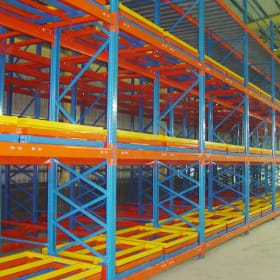
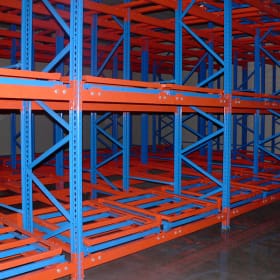
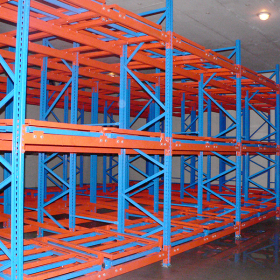
Pallets are positioned onto nested nested carts supported by inclined rails. When a front pallet is retrieved, gravity automatically causes the remaining rear pallets to flow forward smoothly to the pick face.
High-Density & High-Speed Access
Push Back Pallet Racking delivers exceptional space utilization by seamlessly combining high-density storage with high-speed accessibility.
The system provides safe, secure storage configurations spanning 2, 3, and 4 pallet deep channels, typically engineered up to 5 pallets high for optimal vertical airspace utilization.

Operational Workflow & Structural Advantages
Operational Workflow & Safety
Pallets are front-loaded and retrieved from the same aisle using standard handling equipment, keeping the pick face constantly full and accessible.
Because fork trucks never enter the racking lanes, it promotes a low-damage working environment. All lanes can be accessed independently at any storage level, making it exceptionally well-suited for high-density cold storage facilities.
Gravity Mechanics & Space Gain
Front and back beams are connected by inclined rails with nested carts placed on top. Stored pallets push preceding inventory backward, while gravity automatically slides inner carts forward during extraction.
Configured at depths of 2 to 4 pallets, push-back racking increases storage capacity by up to 30% compared to traditional selective racking systems.

Key Features & System Advantages
✓ Rapid Access & Lanes
Ensures rapid access to all storage lanes directly from the aisle, boosting daily picking efficiency.
✓ Space Optimization
Delivers maximized space utilization across warehouse zones with large storage capacity and high efficiency.
✓ Multi-SKU Flexibility
Supports the storage of multiple SKU types at different rack levels, ideal for multi-variety, high-volume products.
✓ FILO Principle
Operates on an efficient FILO (First In - Last Out) retrieval system for streamlined inventory management.
✓ High-Density Storage
Combines high-density layout design with robust structural performance to maximize overall cubic capacity.
✓ Cold Storage Ready
Engineered to be suitable for dense cold storage environments, maximizing expensive refrigerated footprints.


System Overview & LIFO Principle
Push Back racking is an advanced high-density storage system operating on the Last-In-First-Out (LIFO) inventory principle. Each lane consists of precision-engineered wheeled carts resting on slightly inclined rails.
During loading, the forklift pushes each incoming pallet backward, automatically shifting the nested carts further into the rack structure. During unloading, gravity takes over, allowing the front pallet to slide forward autonomously as preceding inventory is retrieved.
Engineering Mechanics & Cart System Architecture
Engineering Mechanics of Push Back Racking
SSTC’s Heavy-Duty Push-Back Racking is an engineered high-density solution utilizing nested carts riding on inclined rails. Operating under a FILO / LIFO logistics logic, this system allows storing pallets 2 to 4 deep, increasing warehouse capacity by up to 90% compared to standard selective setups.
Manufactured via our 9 automatic upright roll-forming lines, the heavy-gauge inclined steel tracks maintain unyielding profile consistency and structural alignment under continuous industrial cycles.
Multi-Tier Nested Cart System & Safety Controls
To eliminate operational friction, SSTC's nested carts feature precision-machined, heavy-duty bearings that prevent structural twisting and cart jamming. The inclination angle of our rail grid is mathematically optimized through Finite Element Analysis (FEA) based on specific pallet weights.
This precise configuration ensures that when the front pallet is retrieved, remaining inventory glides forward autonomously and safely to the pick face, utilizing guided gravity without requiring forklifts to enter the racking matrix.
Technical Specifications Matrix
| Technical Parameters | SSTC Push-Back Racking Specifications | Engineering Compliance & Standards |
|---|---|---|
| Storage Density Depth | 2, 3 and up to 4 pallets deep configurations | Optimized for high-volume, multi-pallet SKU profiles |
| Pallet Loading Capacity | Up to 1,500 kg per nested cart position | Heavy-gauge steel construction verified by FEA |
| Rail & Cart Technology | Multi-tier nested carts with precision-bearing wheels | Anti-derailment design & structural safety catches |
| Safety Certification | Fully compliant with EN 15512 and RMI specifications | Seismic resilient profile layout engineering |
| Finishing & Durability | Continuous multi-stage electrostatic powder coating | Wear-resistant finish (Ambient & -30°C Cold Storage) |
Frequently Asked Questions (FAQ)
Q1 How does Push Back Racking work and what is its inventory principle?
Push Back Racking operates on a LIFO (Last-In, First-Out) or FILO principle. Pallets are loaded onto nested carts on inclined rails; incoming pallets push existing inventory backward, while gravity automatically slides the carts forward during unloading.
Q2 What is the storage depth capacity of SSTC push back systems?
Our push back racking systems are engineered for high-density storage configurations spanning 2, 3, and up to 4 pallets deep, maximizing storage capacity significantly compared to standard selective setups.
Q3 Do forklifts need to enter the racking lanes during operation?
No. All loading and retrieval are performed from the front aisle using conventional handling equipment. Fork trucks never enter the racking matrix, which creates a safer environment and minimizes equipment damage.
Q4 Is push back racking suitable for cold storage environments?
Yes. Equipped with heavy-duty precision bearings, anti-derailment designs, and multi-stage powder coatings, SSTC push back systems are fully optimized and resilient for dense cold storage down to -30°C.