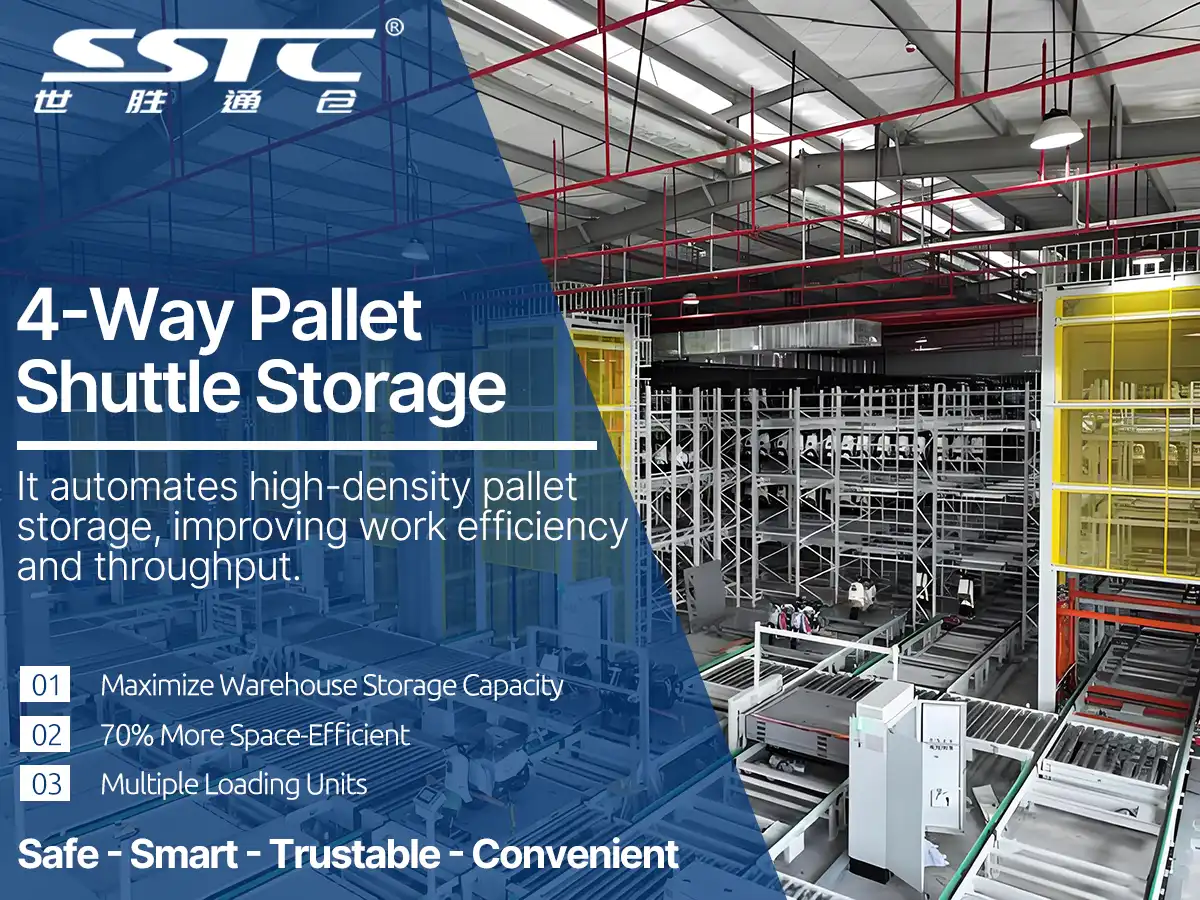
Globalne łańcuchy dostaw stoją w obliczu rosnącej presji charakteryzującej się rosnącymi wycenami nieruchomości, utrzymujące się niedobory siły roboczej, and stringent fulfillment timelines. Traditional warehouse architectures—relying on selective pallet racking or single-axis automated storage and retrieval systems (AS/RS)—frequently fail to resolve these structural friction points. Albo poświęcają się do 60% of internal facility volume to wide operational aisles or introduce mechanical bottlenecks that restrict throughput velocity. To overcome these limitations, modern intralogistics engineering has shifted decisively toward theCzterokierunkowy system transportu palet.
Designed for precise, high-density material handling, the SSTC Four-Way Pallet Shuttle System redefines how industrial facilities manage palletized inventory. By integrating omnidirectional robotic mobility, decentralized fleet management software, and high-speed vertical tier transfers, this technology resolves complex storage challenges across chemical processing, cold chain refrigeration, and heavy industrial manufacturing. This technical analysis examines the mechanical architecture, operational workflows, orkiestracja oprogramowania, and economic impact of the Four-Way Pallet Shuttle System.
1. Architectural Evolution: Moving Beyond Linear Automation
To evaluate the operational superiority of the four-way shuttle, one must analyze the constraints of legacy storage typologies. Conventional selective racking guarantees 100% stock selectivity, but its spatial efficiency is critically compromised by the vast footprint allocated to forklift maneuvering lanes.
High-density alternatives such as Drive-In racking and traditional Radio Shuttle systems improved cubic utilization by deepening storage lanes. Jednakże, conventional radio shuttles operate along a single linear axis. Transferring a shuttle between storage channels or across structural tiers requires external material handling equipment—typically forklifts or heavy crane hoists—introducing severe operational bottlenecks, cycle-time delays, i zagrożenia bezpieczeństwa.
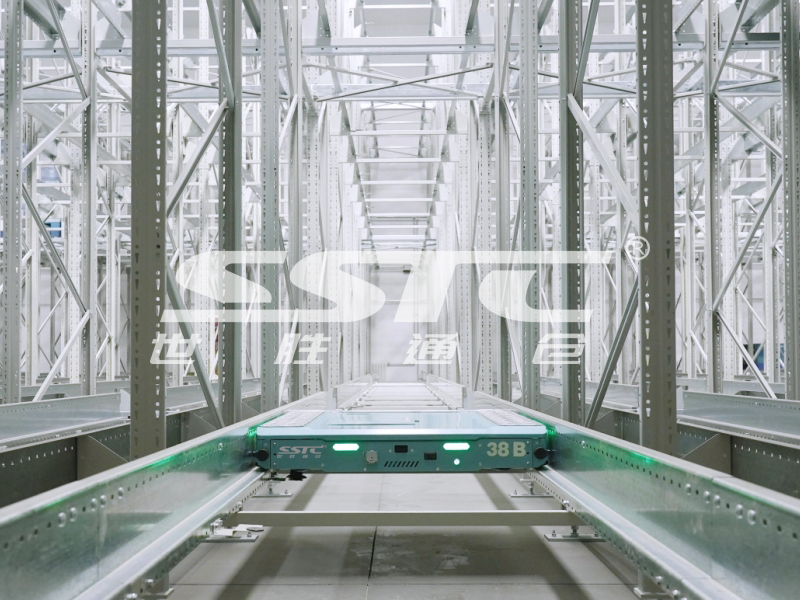
The Four-Way Pallet Shuttle System eliminates these structural constraints. By deploying autonomous mobile robots (AMR) capable of traveling both longitudinally within storage channels and laterally across cross-aisles without human intervention, facilities achieve true multi-directional mobility. This capability successfully bridges the historical divide between ultra-dense bulk storage and flexible, random-access retrieval.
2. Core Engineering and Mechanical Principles
The SSTC Four-Way Pallet Shuttle System operates through a sophisticated synthesis of structural engineering, mechatronics, and power management.
Omnidirectional Drive Mechanics
The shuttle achieves its signature directional versatility via an integrated dual-wheel architecture. Primary drive wheels propel the vehicle longitudinally along the storage rails, while secondary transverse wheels embedded within the chassis handle lateral movement. Upon reaching an intersection, an internal electro-mechanical lifting platform elevates the chassis slightly, disengaging the primary wheels and engaging the perpendicular transverse wheels. This frictionless 90-degree transition prevents mechanical wear and ensures continuous workflow momentum.
High-Speed Vertical Integration and Hoisting
Multi-tier automated warehouses require seamless vertical transport to bridge storage levels. High-speed vertical lifts (windy przeładunkowe) are positioned at the terminal ends of the racking blocks. The shuttle drives onto the elevator platform while bearing a pallet load, allowing the lift to transport the entire unit to the target tier in seconds. Once docked on the new level, the shuttle disembarks autonomously to execute storage or retrieval tasks. This synchronized interaction enables facilities to scale vertical storage heights exceeding 24 metrów.
Energy Management and Thermal Resilience
Continuous 24/7 operations demand dependable power systems. The SSTC shuttle utilizes high-density lithium-ion battery modules managed by real-time Battery Management Systems (BMS). When power reserves drop below optimal parameters, the shuttle autonomously navigates to designated charging bays during idle windows. Ponadto, regenerative braking systems recover kinetic energy during deceleration and descent, feeding power back into the cells to maximize operational uptime. For comprehensive engineering specifications, odwiedzać Magazyn SSTC.
3. Resolving Critical Warehouse Pain Points
Obiekty przemysłowe napotykają wyraźne przeszkody operacyjne, których konwencjonalne systemy transportu materiałów nie potrafią skutecznie wyeliminować.
Reclaiming Cubic Space and Eliminating Aisles
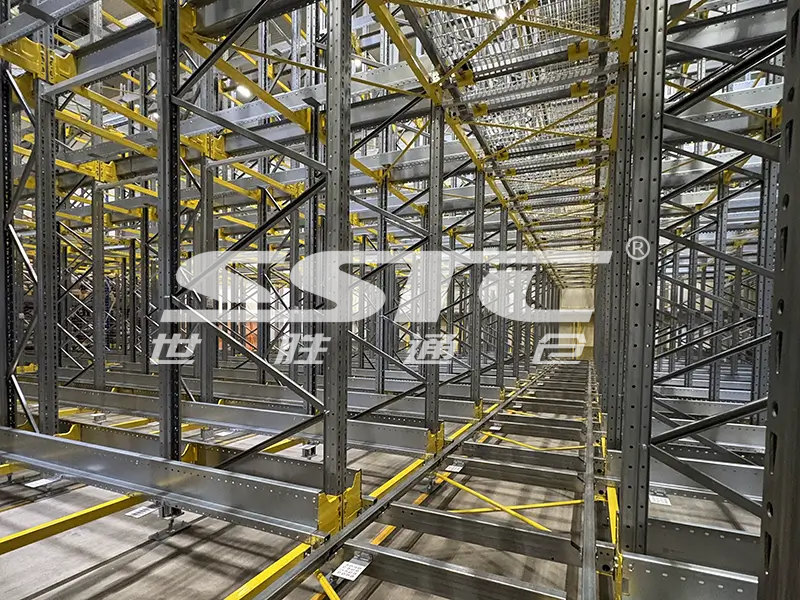
Real estate acquisition and warehouse construction represent massive capital expenditures. Traditional layouts waste substantial volume on clearance corridors. The Four-Way Pallet Shuttle System replaces wide aisles with dense blocks of specialized modular racking, elevating spatial utilization to between 80% I 90% and effectively doubling storage capacity within an existing building envelope.
Mitigating Labor Dependency and Ergonomic Risks
Manual pallet handling inside deep storage lanes exposes personnel to hazardous working conditions, equipment collisions, and repetitive strain injuries. The SSTC Four-Way Pallet Shuttle System removes human operators from high-risk environments. Pallet movement from intake staging to deep storage is handled autonomously, transforming warehouse personnel from manual operators into system supervisors and significantly reducing operational liabilities.
Eliminating Intersection Gridlock
In high-throughput distribution networks, system congestion at transfer points severely degrades performance. The four-way routing capability of the SSTC system allows the control software to calculate alternative travel paths dynamically. If a primary aisle or hoist experiences temporary congestion, shuttles are automatically rerouted through adjacent channels, maintaining a steady, predictable throughput velocity. According to industry research published by organizations tracking global logistics innovation, takie jak Przemysł przeładunku materiałów (MHI), software-driven dynamic routing is essential for achieving optimal efficiency in automated storage deployments.
4. Orkiestracja oprogramowania: Fleet Management and WMS Integration
Hardware efficiency is fundamentally dependent on software intelligence. The SSTC Four-Way Pallet Shuttle System is governed by an advanced Warehouse Management System (WMS-a) i System Kontroli Magazynu (WCS) architektura.
Dynamiczne slotowanie i profilowanie zapasów
The WMS analyzes historical SKU velocity, sezonowość, and order frequency to optimize inventory placement. High-turnover goods are automatically assigned to storage locations adjacent to vertical hoists and outbound staging bays, while slow-moving stock is allocated to deep upper tiers, minimizing average transit times.
Real-Time Fleet Coordination
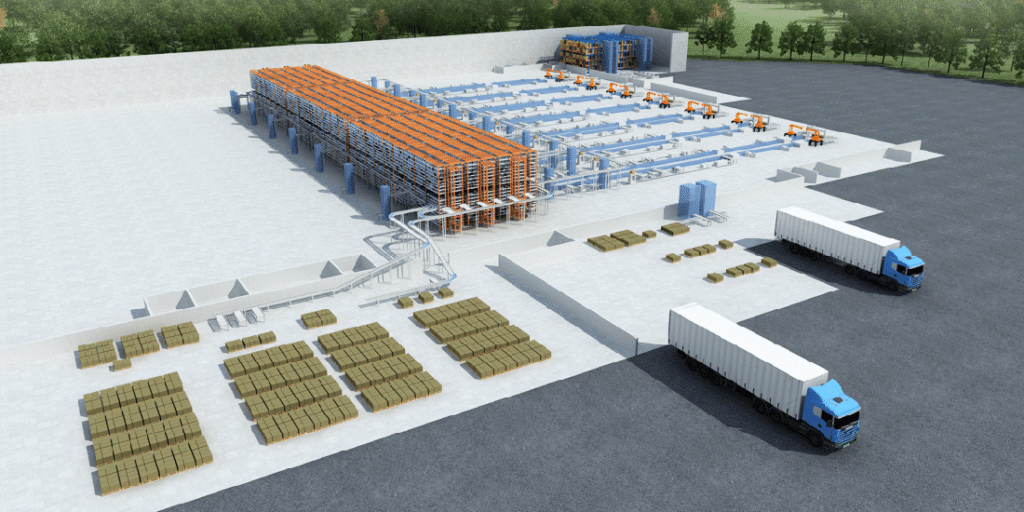
Operating multiple autonomous shuttles within a shared structural grid requires absolute positional accuracy. The WCS acts as the central traffic controller, monitoring the exact coordinates, battery status, and load state of every vehicle. It manages right-of-way protocols, enforces safety buffers, wykonuje algorytmy unikania kolizji, and synchronizes handoffs with peripheral conveyor systems and Automated Guided Vehicles (pojazdy AGV).
Do analiz akademickich i empirycznych dotyczących zautomatyzowanej synchronizacji floty i dokładności inwentaryzacji w złożonych obiektach przemysłowych, publikacje badawcze hostowane na platformach takich jak ScienceDirect dostarczyć obszerną dokumentację techniczną.
5. Sector-Specific Deployment: Cold Chain and Heavy Manufacturing
Różne branże przemysłowe nakładają surowe kryteria środowiskowe i operacyjne na urządzenia do transportu materiałów.
Optymalizacja łańcucha chłodniczego przy głębokim mrożeniu
Obsługa zautomatyzowanego sprzętu w środowiskach ujemnych (-25°C lub mniej) powoduje duże obciążenie elementów mechanicznych, smary, i ogniwa energetyczne. Ponadto, Chłodzenie pustej przestrzeni powietrznej w tradycyjnych obiektach chłodniczych wiąże się z ogromnymi nakładami na media.
Rozwiązanie SSTC: Czterokierunkowy system transportu palet został zaprojektowany ze specjalistycznych konstrukcji ze stopów niskotemperaturowych, elektronika przystosowana do zimy, and cold-resistant lithium battery chemistry. Ponieważ gęstość przechowywania jest podwojona, objętość chłodzona na przechowywaną paletę drastycznie się zmniejsza, yielding substantial reductions in HVAC energy expenditures.
Logistyka produkcji chemicznej i przemysłowej
Chemical processing plants and heavy industrial facilities manage uniform pallet loads, ścisłe przestrzeganie zasad bezpieczeństwa, i rygorystyczne FIFO (Pierwszy na wejściu, Pierwszy na wyjściu) mandaty dotyczące rotacji zapasów.
Rozwiązanie SSTC: Solidna integralność konstrukcyjna ramy regałowej SSTC i podwozia wahadłowego pozwala na obsługę dużych ładunków bez zmęczenia konstrukcji. Precyzyjne śledzenie zapasów zapewnia pełną identyfikowalność materiałów, eliminowanie przeterminowanych zapasów przy jednoczesnym zachowaniu ścisłego przestrzegania protokołów bezpieczeństwa przemysłowego.
6. Ocena ekonomiczna: Całkowity koszt posiadania i skalowalność
Alokacja kapitału w stronę automatyzacji magazynu wymaga jasnego określenia, wymierny zwrot z inwestycji (Zwrot z inwestycji). Decision-makers evaluating the SSTC Four-Way Pallet Shuttle System analyze total cost of ownership across three core vectors:
Spatial Efficiency: Zmniejszenie wymaganej powierzchni o maksymalnie 50% allows enterprises to avoid multimillion-dollar real estate expansion costs.
Labor Optimization: Minimalizacja zależności od floty ręcznych wózków widłowych zmniejsza bezpośrednie koszty operacyjne pracy o 50% Do 70%, insulating businesses from labor market volatility.
Ponadto, Modułowa natura systemu umożliwia bezproblemową skalowalność. Przedsiębiorstwa mogą zwiększać pojemność magazynu w poziomie, wydłużając ciągi regałów lub w pionie, dodając poziomy, i zwiększ przepustowość systemu, po prostu integrując dodatkowe jednostki wahadłowe z istniejącą siecią floty bez przerywania bieżących operacji obiektu.
Wniosek
Przejście od ręcznego magazynowania do inteligentnego, automatyzacja o dużej gęstości jest istotnym imperatywem strategicznym dla przedsiębiorstw dążących do utrzymania przewagi konkurencyjnej w handlu światowym. The SSTC Four-Way Pallet Shuttle System delivers the precise synthesis of spatial engineering, robotic autonomy, and software intelligence required to achieve unmatched storage density and operational resilience.
Współpraca z SSTC zapewnia przedsiębiorstwom dostęp do zaawansowanych rozwiązań intralogistycznych popartych wiedzą inżynierską i dedykowanym wsparciem technicznym. Niezależnie od tego, czy modernizujesz chłodnię, czy optymalizujesz sieć dystrybucyjną przedsiębiorstwa, SSTC zapewnia nowoczesną infrastrukturę wymaganą do przekształcenia złożoności łańcucha dostaw w zrównoważone korzyści strategiczne.
Często zadawane pytania (Często zadawane pytania)
Pytanie 1: How does the Four-Way Pallet Shuttle System manage tier transfers across multi-level warehouse configurations?
A1: The system utilizes dedicated, high-speed vertical lifts (elevators) positioned at the terminal ends of racking blocks. The shuttle drives onto the lift platform with its pallet load, travels to the designated tier autonomously, and exits smoothly onto the new storage level.
Pytanie 2: Jakie są parametry maksymalnej wysokości składowania i ładowności obsługiwanej przez system SSTC?
A2: Czterokierunkowy system transportu palet SSTC został zaprojektowany tak, aby umożliwiał skalowanie przekraczających wysokości w pionie 24 metrów, bezpiecznie utrzymuje standardowe ciężkie palety przemysłowe i handlowe dzięki solidnej konstrukcji i precyzyjnie skalibrowanym silnikom napędowym.
Pytanie 3: Czy czterokierunkowy wózek paletowy może działać niezawodnie w chłodniach, w których panuje temperatura poniżej zera??
A3: Tak. System integruje specjalistyczne komponenty ze stopów niskotemperaturowych, smary odporne na zimno, i kondycjonowane systemy zarządzania akumulatorami litowo-jonowymi, zaprojektowane tak, aby działać bez pogorszenia wydajności w środowiskach tak zimnych jak -25°C.

 Inteligentna technologia SSTC - 4-Producent regałów wahadłowych i systemów AS/RS