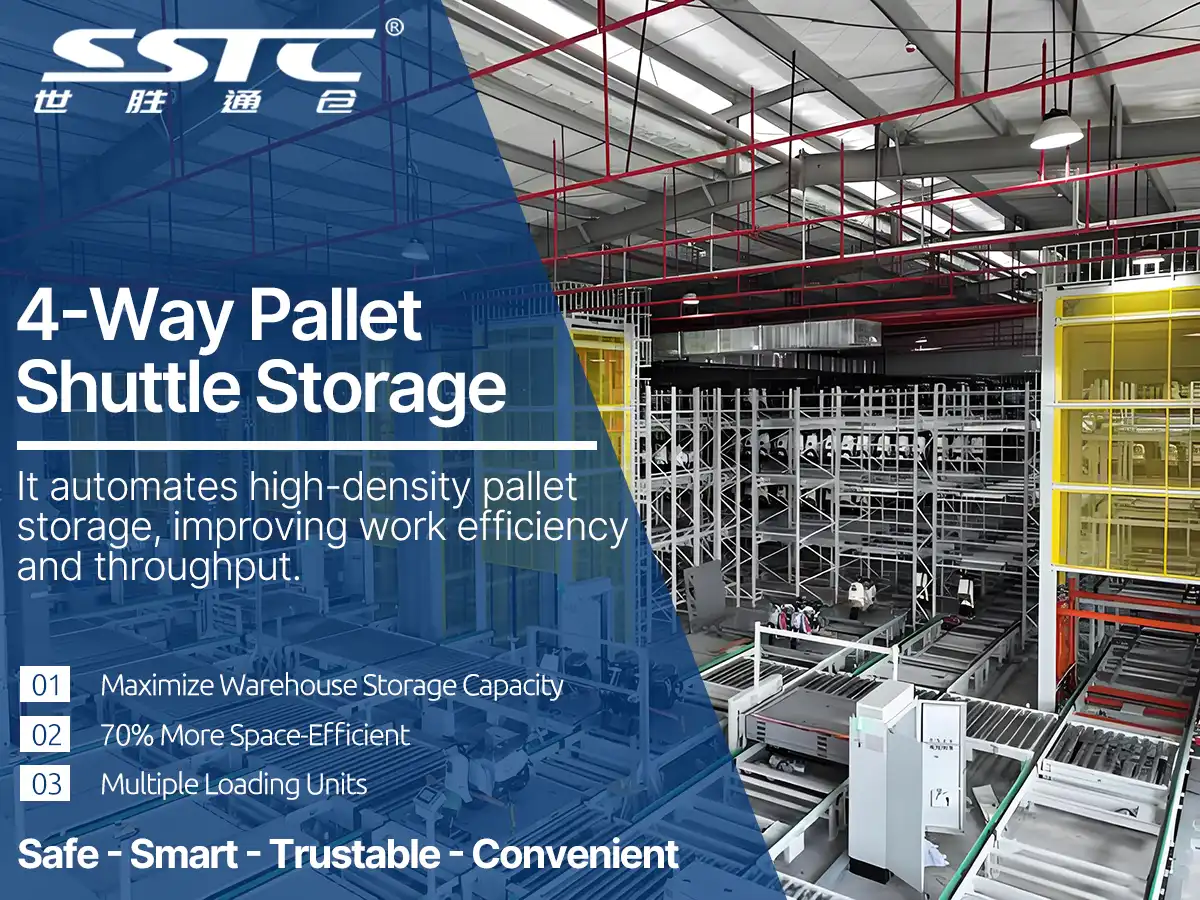
글로벌 공급망은 부동산 가치 상승으로 인한 복합적인 압력에 직면해 있습니다., 지속적인 노동력 부족, and stringent fulfillment timelines. Traditional warehouse architectures—relying on selective pallet racking or single-axis automated storage and retrieval systems (AS/RS)—frequently fail to resolve these structural friction points. They either sacrifice up to 60% of internal facility volume to wide operational aisles or introduce mechanical bottlenecks that restrict throughput velocity. To overcome these limitations, modern intralogistics engineering has shifted decisively toward the4방향 팔레트 셔틀 시스템.
Designed for precise, high-density material handling, the SSTC Four-Way Pallet Shuttle System redefines how industrial facilities manage palletized inventory. By integrating omnidirectional robotic mobility, decentralized fleet management software, and high-speed vertical tier transfers, this technology resolves complex storage challenges across chemical processing, cold chain refrigeration, and heavy industrial manufacturing. This technical analysis examines the mechanical architecture, 운영 워크플로, 소프트웨어 오케스트레이션, and economic impact of the Four-Way Pallet Shuttle System.
1. Architectural Evolution: Moving Beyond Linear Automation
To evaluate the operational superiority of the four-way shuttle, one must analyze the constraints of legacy storage typologies. Conventional selective racking guarantees 100% stock selectivity, but its spatial efficiency is critically compromised by the vast footprint allocated to forklift maneuvering lanes.
High-density alternatives such as Drive-In racking and traditional Radio Shuttle systems improved cubic utilization by deepening storage lanes. 하지만, conventional radio shuttles operate along a single linear axis. Transferring a shuttle between storage channels or across structural tiers requires external material handling equipment—typically forklifts or heavy crane hoists—introducing severe operational bottlenecks, cycle-time delays, 안전 위험.
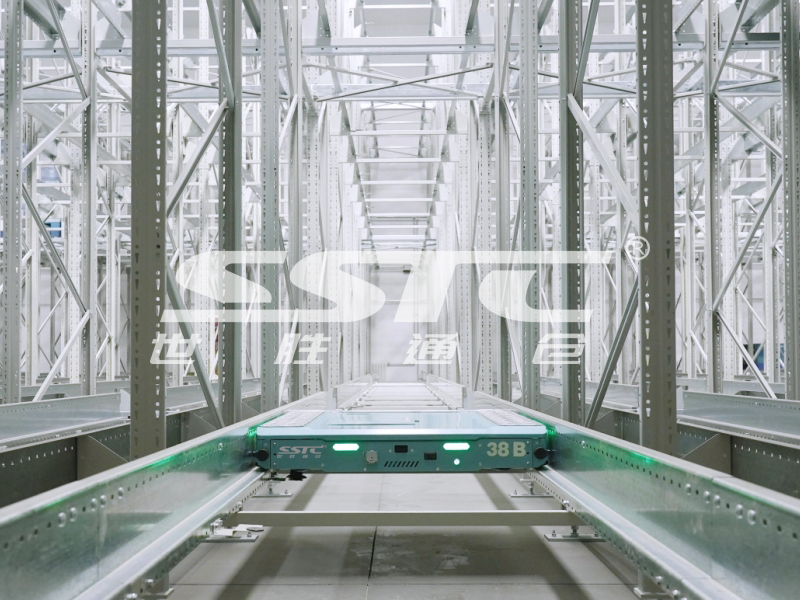
The Four-Way Pallet Shuttle System eliminates these structural constraints. By deploying autonomous mobile robots (AMR) capable of traveling both longitudinally within storage channels and laterally across cross-aisles without human intervention, facilities achieve true multi-directional mobility. This capability successfully bridges the historical divide between ultra-dense bulk storage and flexible, random-access retrieval.
2. Core Engineering and Mechanical Principles
The SSTC Four-Way Pallet Shuttle System operates through a sophisticated synthesis of structural engineering, mechatronics, and power management.
Omnidirectional Drive Mechanics
The shuttle achieves its signature directional versatility via an integrated dual-wheel architecture. Primary drive wheels propel the vehicle longitudinally along the storage rails, while secondary transverse wheels embedded within the chassis handle lateral movement. 교차로에 도달하면, an internal electro-mechanical lifting platform elevates the chassis slightly, disengaging the primary wheels and engaging the perpendicular transverse wheels. This frictionless 90-degree transition prevents mechanical wear and ensures continuous workflow momentum.
High-Speed Vertical Integration and Hoisting
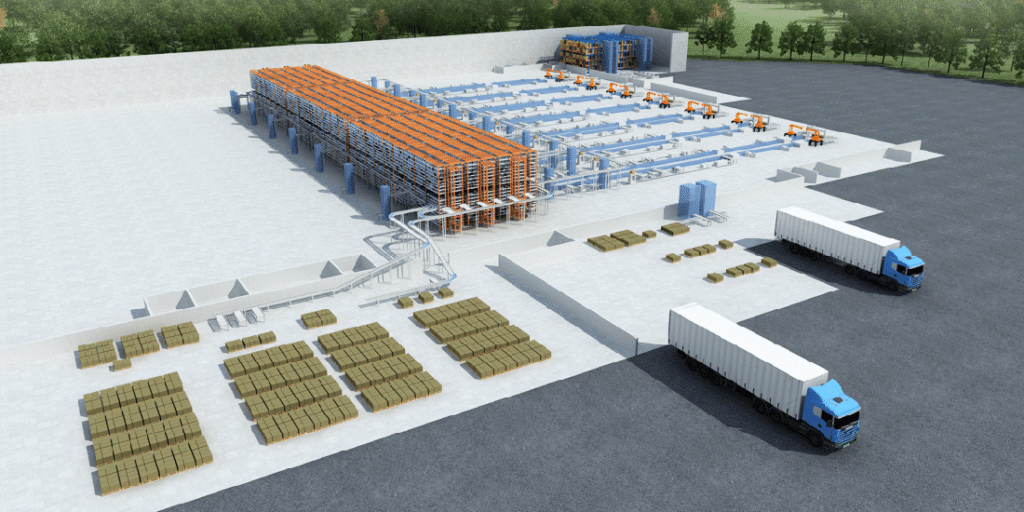
Multi-tier automated warehouses require seamless vertical transport to bridge storage levels. High-speed vertical lifts (tier-transfer elevators) are positioned at the terminal ends of the racking blocks. The shuttle drives onto the elevator platform while bearing a pallet load, allowing the lift to transport the entire unit to the target tier in seconds. Once docked on the new level, the shuttle disembarks autonomously to execute storage or retrieval tasks. This synchronized interaction enables facilities to scale vertical storage heights exceeding 24 미터.
Energy Management and Thermal Resilience
마디 없는 24/7 operations demand dependable power systems. The SSTC shuttle utilizes high-density lithium-ion battery modules managed by real-time Battery Management Systems (BMS). When power reserves drop below optimal parameters, the shuttle autonomously navigates to designated charging bays during idle windows. 뿐만 아니라, regenerative braking systems recover kinetic energy during deceleration and descent, feeding power back into the cells to maximize operational uptime. For comprehensive engineering specifications, 방문하다 SSTC 스토리지.
3. Resolving Critical Warehouse Pain Points
Industrial facilities encounter distinct operational obstacles that conventional material handling systems fail to mitigate effectively.
Reclaiming Cubic Space and Eliminating Aisles
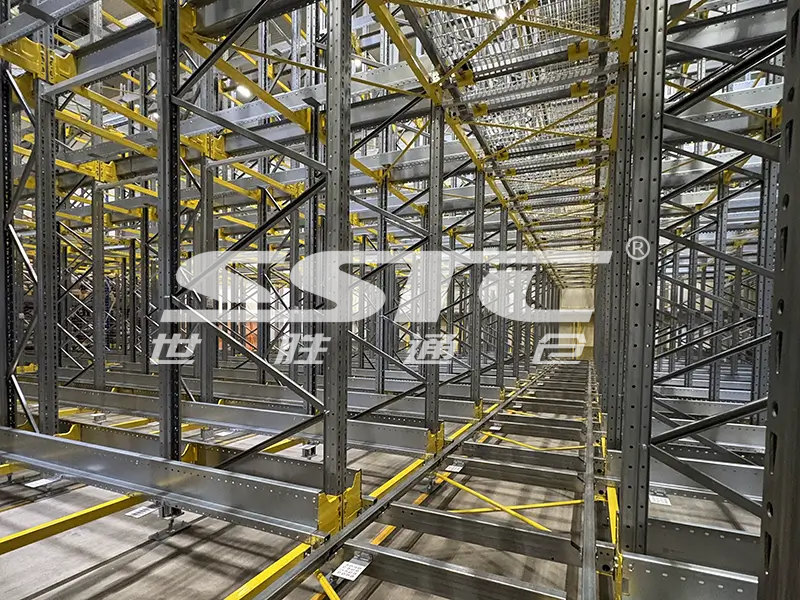
Real estate acquisition and warehouse construction represent massive capital expenditures. Traditional layouts waste substantial volume on clearance corridors. The Four-Way Pallet Shuttle System replaces wide aisles with dense blocks of specialized modular racking, elevating spatial utilization to between 80% 그리고 90% and effectively doubling storage capacity within an existing building envelope.
Mitigating Labor Dependency and Ergonomic Risks
Manual pallet handling inside deep storage lanes exposes personnel to hazardous working conditions, equipment collisions, and repetitive strain injuries. The SSTC Four-Way Pallet Shuttle System removes human operators from high-risk environments. Pallet movement from intake staging to deep storage is handled autonomously, transforming warehouse personnel from manual operators into system supervisors and significantly reducing operational liabilities.
Eliminating Intersection Gridlock
In high-throughput distribution networks, system congestion at transfer points severely degrades performance. The four-way routing capability of the SSTC system allows the control software to calculate alternative travel paths dynamically. If a primary aisle or hoist experiences temporary congestion, shuttles are automatically rerouted through adjacent channels, maintaining a steady, predictable throughput velocity. According to industry research published by organizations tracking global logistics innovation, such as the자재취급산업 (미하이), software-driven dynamic routing is essential for achieving optimal efficiency in automated storage deployments.
4. Software Orchestration: Fleet Management and WMS Integration
Hardware efficiency is fundamentally dependent on software intelligence. The SSTC Four-Way Pallet Shuttle System is governed by an advanced Warehouse Management System (WMS) 및 창고 제어 시스템 (WCS) architecture.
Dynamic Slotting and Inventory Profiling
The WMS analyzes historical SKU velocity, 계절성, and order frequency to optimize inventory placement. High-turnover goods are automatically assigned to storage locations adjacent to vertical hoists and outbound staging bays, while slow-moving stock is allocated to deep upper tiers, minimizing average transit times.
실시간 함대 조정
Operating multiple autonomous shuttles within a shared structural grid requires absolute positional accuracy. The WCS acts as the central traffic controller, monitoring the exact coordinates, battery status, and load state of every vehicle. It manages right-of-way protocols, enforces safety buffers, executes collision-avoidance algorithms, and synchronizes handoffs with peripheral conveyor systems and Automated Guided Vehicles (AGV).
For academic and empirical analyses regarding automated fleet synchronization and inventory accuracy in complex industrial facilities, 다음과 같은 플랫폼에서 호스팅되는 연구 출판물 ScienceDirect 광범위한 기술 문서 제공.
5. Sector-Specific Deployment: Cold Chain and Heavy Manufacturing
Different industrial verticals impose severe environmental and operational criteria on material handling assets.
Deep-Freeze Cold Chain Optimization
Operating automated equipment in sub-zero environments (-25°C or lower) induces severe stress on mechanical components, lubricants, and power cells. 뿐만 아니라, cooling empty airspace in traditional refrigerated facilities incurs massive utility overhead.
The SSTC Solution:The Four-Way Pallet Shuttle System is engineered with specialized low-temperature alloy structures, 방한용 전자제품, and cold-resistant lithium battery chemistry. Because storage density is doubled, the refrigerated volume per stored pallet shrinks dramatically, yielding substantial reductions in HVAC energy expenditures.
Chemical and Industrial Manufacturing Logistics
Chemical processing plants and heavy industrial facilities manage uniform pallet loads, strict safety compliance, and rigorous FIFO (선착순, 첫 번째 아웃) inventory rotation mandates.
The SSTC Solution:The robust structural integrity of the SSTC racking framework and shuttle chassis accommodates heavy payload capacities without structural fatigue. Precise inventory tracking ensures complete material traceability, eliminating expired stock while maintaining strict compliance with industrial safety protocols.
6. Economic Evaluation: Total Cost of Ownership and Scalability
Capital allocation toward warehouse automation requires a clear, quantifiable return on investment (ROI). Decision-makers evaluating the SSTC Four-Way Pallet Shuttle System analyze total cost of ownership across three core vectors:
Spatial Efficiency:Slashing required square footage by up to 50% allows enterprises to avoid multimillion-dollar real estate expansion costs.
노동 최적화:Minimizing reliance on manual forklift fleets reduces direct operational labor expenses by 50% 에게 70%, insulating businesses from labor market volatility.
자산 보호:Autonomous handling eliminates product damage, packaging tearing, and structural rack impacts caused by human error, significantly reducing inventory write-offs.
뿐만 아니라, the modular nature of the system enables seamless scalability. Enterprises can expand storage capacity horizontally by extending racking runs or vertically by adding tiers, and increase system throughput simply by integrating additional shuttle units into the existing fleet grid without interrupting ongoing facility operations.
결론
The transition from manual warehousing to intelligent, high-density automation is an essential strategic imperative for enterprises striving to maintain competitive advantage in global commerce. The SSTC Four-Way Pallet Shuttle System delivers the precise synthesis of spatial engineering, robotic autonomy, and software intelligence required to achieve unmatched storage density and operational resilience.
Partnering with SSTC grants enterprises access to advanced intralogistics solutions backed by engineering expertise and dedicated technical support. Whether modernizing a cold storage facility or optimizing an enterprise distribution network, SSTC provides the modern infrastructure required to transform supply chain complexities into sustainable strategic advantages.
자주 묻는 질문 (FAQ)
1분기: How does the Four-Way Pallet Shuttle System manage tier transfers across multi-level warehouse configurations?
A1: The system utilizes dedicated, 고속 수직 리프트 (elevators) positioned at the terminal ends of racking blocks. The shuttle drives onto the lift platform with its pallet load, travels to the designated tier autonomously, and exits smoothly onto the new storage level.
2분기: What are the maximum storage height and load capacity parameters supported by the SSTC system?
A2: The SSTC Four-Way Pallet Shuttle System is engineered to scale vertical heights exceeding 24 미터, securely accommodating standard heavy industrial and commercial pallet weights through robust structural design and precision-calibrated drive motors.
3분기: Can the Four-Way Pallet Shuttle operate reliably within sub-zero cold storage environments?
A3: 예. The system integrates specialized low-temperature alloy components, 내한성 윤활제, and conditioned lithium-ion battery management systems designed to perform without performance degradation in environments as cold as -25°C.

 SSTC 인텔리전스 기술 - 4-웨이 셔틀 랙킹 및 AS/RS 시스템 제조업체