


Introduction: Navigating the Crossroads of Warehouse Fulfillment Strategy
In the fast-evolving landscape of global supply chain management, warehousing has transcended its traditional role as a mere storage facility to become the ultimate battlefield for operational excellence. As global e-commerce booms, omnichannel retail expands, and consumer expectations for same-day delivery become the baseline, warehouse managers and supply chain directors face a critical strategic dilemma. How do we maximize storage density, accelerate order fulfillment velocity, mitigate chronic labor shortages, and control operational expenditures simultaneously?
At the heart of this operational transformation lies a fundamental architectural debate that every intralogistics engineer must address: Goods-to-Person (G2P) vs. Person-to-Goods (P2G). Choosing the right order fulfillment strategy can mean the difference between a thriving, agile distribution hub and a sluggish, cost-prohibitive bottleneck.
At បច្ចេកវិទ្យាស៊ើបការណ៍ SSTC, we have spent decades engineering cutting-edge warehousing automation ecosystems designed to solve these exact challenges. In this comprehensive industry report, we explore the mechanics, operational trade-offs, and economic impacts of Goods-to-Person versus Person-to-Goods strategies, while highlighting how our flagship FOUR-WAY PALLET SHUTTLE system redefines the boundaries of modern high-density fulfillment.
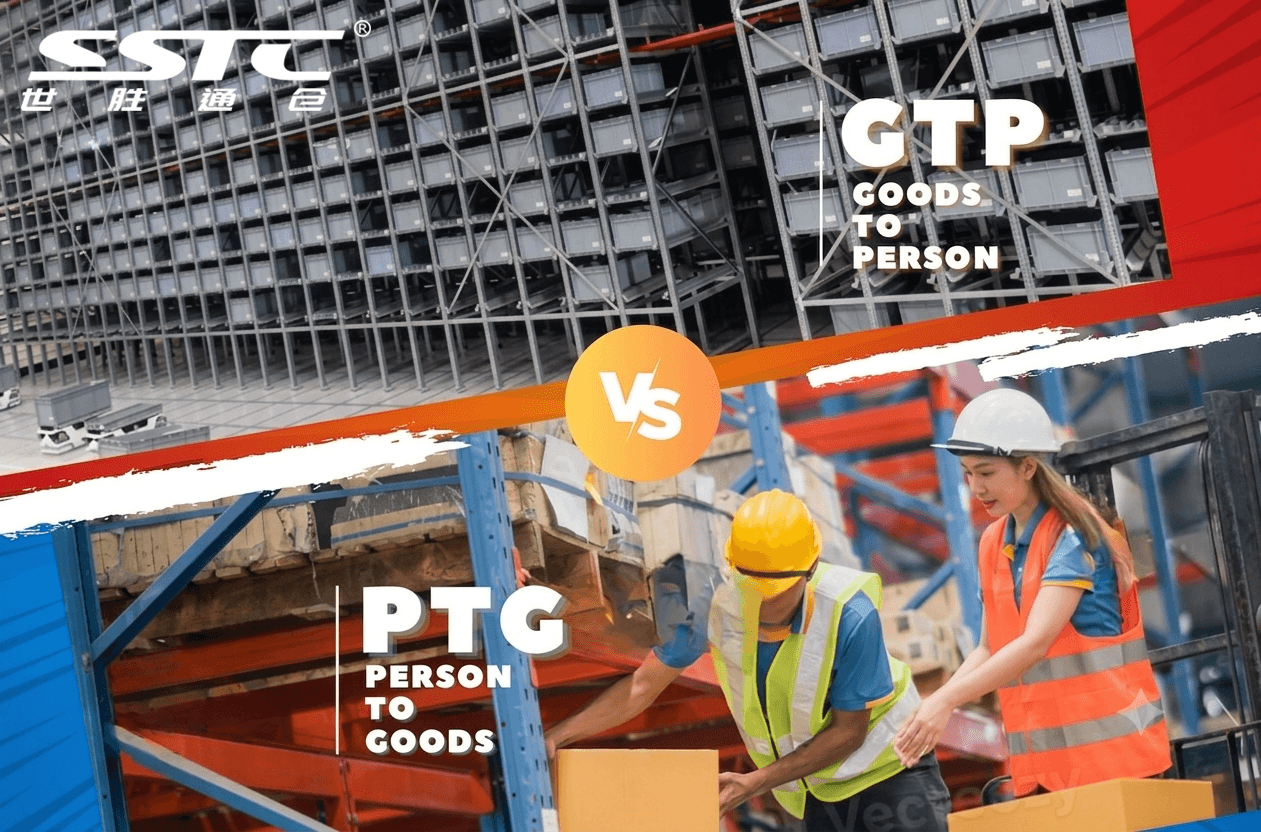
1. Deconstructing Person-to-Goods (P2G) Systems: The Traditional Baseline
What is Person-to-Goods?
In a traditional Person-to-Goods (P2G) fulfillment model—typified by conventional selective pallet racking, wide-aisle selective shelving, and standard reach trucks—the warehouse operator or picker travels physically to the location of the inventory items. Whether walking down aisles with a pick cart or operating a forklift to retrieve pallets from upper tiers, the human element drives the physical movement required for order picking.
Operational Characteristics of P2G
Low Initial CapEx: Setting up a standard selective racking warehouse requires minimal initial investment in complex automation technology, making it attractive for start-ups or low-throughput operations.
High Reliance on Manual Labor: P2G operations depend heavily on human labor for walking, searching, lifting, and verifying items.
Ergonomic Strain and Safety Risks: Operators spend significant portions of their shifts walking long distances, bending, reaching, or operating heavy machinery in cold or hazardous environments.
The Hidden Bottlenecks of P2G
While P2G systems offer simplicity and low initial setup costs, they scale poorly as a business grows. Studies indicate that in traditional P2G warehouses, pickers spend up to 50% to 60% of their working hours simply walking between storage locations. លើសពីនេះទៀត។, as SKUs proliferate, the “honeycomb effect” and wide aisle requirements lead to abysmal space utilization—often wasting up to 50% of the warehouse’s cubic capacity. In an era marked by severe labor shortages and soaring real estate costs, relying solely on traditional P2G models is increasingly unsustainable for global enterprises.
2. The Paradigm Shift: Understanding Goods-to-Person (G2P) Automation
What is Goods-to-Person?
In sharp contrast to traditional methods, the Goods-to-Person (G2P) automation paradigm reverses the workflow: instead of the worker traveling to the inventory, automated material handling equipment brings the required items, pallets, or totes directly to an ergonomic, stationary workstation.
Core Pillars of G2P Architecture
Automated Storage and Retrieval Systems (ASRS): Utilizing stacker cranes or multi-deep robotic shuttles to manage inventory in high-bay racking.
Autonomous Mobile Robots (AMRs) and Automated Guided Vehicles (AGVs): Transporting loads across the distribution center floor autonomously.
Software Orchestration (WMS & WCS): Integrating real-time inventory tracking and intelligent batching algorithms to queue items seamlessly.
Transformative Advantages of G2P
Exponential Productivity Multipliers: G2P systems eliminate non-value-added walking time, allowing operators to process significantly more order lines per hour.
Maximized Space Efficiency: By eliminating wide retrieval aisles, G2P solutions leverage vertical and horizontal cubic space to unprecedented degrees.
Enhanced Accuracy and Ergonomics: Presenting items directly to operators reduces picking errors, minimizes physical fatigue, and creates a safer work environment.
3. The Pinnacle of G2P Engineering: The SSTC Four-Way Pallet Shuttle System
When evaluating high-density Goods-to-Person automation for pallet-level storage, traditional ASRS stacker cranes often suffer from single points of failure and rigid aisle allocations. To overcome these limitations, បច្ចេកវិទ្យាស៊ើបការណ៍ SSTC has engineered an advanced, flexible G2P solution: នេះ។ FOUR-WAY PALLET SHUTTLE.
How the Four-Way Pallet Shuttle Powers G2P Excellence
នេះ។ FOUR-WAY PALLET SHUTTLE is an intelligent, multi-directional robotic vehicle capable of traveling autonomously in both longitudinal and lateral directions across high-density storage grids. Combined with vertical lift hoists, this system forms a fully automated G2P matrix:
Cross-Aisle Mobility: Unlike traditional radio shuttles restricted to a single lane, our four-way shuttle executes 90-degree directional shifts. If a shuttle completes its task in Lane A, it can seamlessly transition via lift mechanisms to Lane B or change levels entirely.
រហូតដល់ 95% Cubic Space Utilization: By compressing storage channels and eliminating unnecessary aisle space, facilities utilizing the SSTC FOUR-WAY PALLET SHUTTLE achieve maximum storage density, drastically lowering cost-per-square-meter overhead.
Built-In System Redundancy: Traditional stacker crane breakdowns halt entire aisles. In an SSTC multi-shuttle G2P setup, if one unit requires maintenance, neighboring shuttles dynamically reroute and take over workloads, ensuring zero operational downtime.
Seamless WMS/WCS Integration: Guided by our enterprise-grade Warehouse Control System, inventory is retrieved and delivered to staging stations with lightning speed, perfectly embodying the ultimate G2P workflow.
Explore our comprehensive automated storage solutions on our official SSTC Storage Solutions Portal.
4. Comprehensive Comparative Analysis: P2G vs. G2P vs. SSTC Four-Way Shuttle
To assist facility planners, logistics engineers, and supply chain executives in making an informed infrastructure choice, the matrix below compares traditional Person-to-Goods systems against standard automated G2P and SSTC’s advanced shuttle technology:
| Evaluation Metric | Person-to-Goods (P2G) | Standard ASRS (G2P) | SSTC Four-Way Pallet Shuttle (G2P) |
| Space Utilization | Low (40% – 50% capacity) | High (70% – 80% capacity) | Ultra-High (រហូតដល់ 95% capacity) |
| Picking Productivity | Very Low (High walking time) | High (Automated retrieval) | Extremely High (Multi-shuttle synergy) |
| Labor Dependency | Heavy (Requires large pick crew) | Low (Optimized workstation staffing) | Minimal & Ergonomic (Stationary picking) |
| System Scalability | Rigid (Limited by floor space) | Moderate (Fixed crane infrastructure) | Infinite & Modular (Add shuttles as needed) |
| Fault Tolerance | High (Manual workarounds exist) | Low (Single-point aisle failure) | High (Dynamic fleet redundancy) |
5. Strategic Decision Framework: Which Strategy Fits Your Enterprise?
Transitioning from Person-to-Goods to a Goods-to-Person model is a transformative strategic step. While G2P solutions require a higher initial capital expenditure (CapEx) than basic P2G shelving, the long-term Return on Investment (ROI) is compelling.
When to Maintain P2G:
Extremely low SKU inventory with very slow-moving turnover.
Minimal capital availability and low order throughput requirements.
When to Transition to G2P (SSTC Four-Way Pallet Shuttle):
High labor costs or chronic staffing shortages in your region.
Rapidly escalating real estate and warehousing rental expenses.
High-density storage needs across cold storage chains (-30°C environments), e-commerce fulfillment centers, automotive manufacturing, and food & beverage distribution.
The necessity to future-proof operations with scalable, modular automation that expands as your business grows.
6. Conclusion: Partner with SSTC for the Future of Smart Intralogistics
The debate between Goods-to-Person and Person-to-Goods ultimately points toward a clear industry trajectory: intelligent automation is no longer a luxury reserved for mega-corporations; it is an operational imperative for sustained global competitiveness. By replacing labor-intensive walking with intelligent robotic orchestration, forward-thinking enterprises can unlock unprecedented efficiency, សុវត្ថិភាព, and profitability.
Ready to elevate your warehouse performance and transition to a world-class Goods-to-Person automation strategy? Contact our global engineering consultants today to discuss your next project:
Contact SSTC Global Engineering Team
Primary Corporate Website: www.sstc-storage.com
International Corporate Email: [email protected]
Alternative Global Support Email: [email protected]
Direct WhatsApp Consultation: +86-13671613032
SSTC Intelligence Technology — Empowering Global Supply Chains Through Intelligent Automation.