
 SSTC インテリジェンス テクノロジー - 4-ウェイシャトルラック・AS/RSシステムメーカー

コールドチェーン倉庫には、説明するのは簡単だが解決するのが難しい問題がある: 倉庫にはさらに多くのパレットを保管する必要がある, しかし、温度管理されたスペースの作成と運用のコストは上昇し続けています. ダブルディープパレット保管ソリューションを備えた ASRS 自動パレット処理と二重深さの保管構成を組み合わせることで、このプレッシャーに対処する実用的な方法を提供します。, コールドチェーンのオペレーターは、制御されたシステム管理下でパレットの移動を維持しながら、利用可能な倉庫容積をより効率的に利用できるようになります。. 食品生産者向け, 冷凍食品販売業者, コールドチェーン物流プロバイダーおよび温度に敏感なパレットに積まれた商品を扱うその他の企業, 問題はもはや、単に倉庫にどれだけのパレットを保管できるかということではありません。. より有益な問題は、毎日の受け取りを行わずに、既存の建物からどれだけの使用可能な貯蔵容量を生み出すことができるかということです。, storage and dispatch operations unnecessarily complicated.
Cold Storage Is Expensive Long Before a Pallet Enters the Rack
A temperature-controlled warehouse is fundamentally different from an ordinary ambient warehouse. 建物の外皮, refrigeration equipment, insulation, doors, lighting and operating procedures all contribute to the cost of keeping the internal environment within the required temperature range. Once a pallet enters a chilled or frozen area, every unnecessary movement inside that environment has an operational consequence.
This is one reason storage density matters so much in cold-chain logistics. If a warehouse has a large proportion of floor area occupied by aisles, オペレータは、在庫を直接保管しない冷蔵スペースに実質的にお金を払っていることになります。. したがって、不必要な通路の容積を削減することは、単にラックのレベルを追加するよりも有意義になる可能性があります。. 目的は、どんな犠牲を払ってでも利用可能な立方メートルをすべて埋めることではありません, ただし、パレットの位置間の関係を考慮した保管配置を作成する必要があります。, アクセス要件と内部トラフィックは商業的に意味がある.
最近の研究では、倉庫物流と冷蔵需要を完全に別個のシステムとして扱うのではなく、両者の相互作用にも注目し始めています。. あ 2026 に発表された研究 応用熱工学 examined logistics-aware temperature-setpoint scheduling for industrial cold storage and reported measurable reductions in energy use and peak power when logistics activity was considered together with refrigeration control.
That research does not mean that an AS/RS automatically reduces a cold store’s electricity consumption. それはあります, しかし, reinforce a useful engineering principle: warehouse movement, storage density and temperature management should be considered together.
For operators planning a new facility or redesigning an existing cold store, this changes the conversation. Instead of asking only, “How many pallets can we store?」, the better question is, “How can we create the required pallet capacity while controlling the amount of refrigerated volume, 旅行, handling and operational exposure required to manage those pallets?」
That is where double-deep automated pallet storage becomes particularly relevant.
The Logic Behind Double-Deep Storage
Double-deep storage is not a new idea. In a conventional warehouse, placing one pallet behind another can increase storage density because fewer aisles are required. The trade-off is access: the rear pallet is not as directly accessible as the front pallet.
That trade-off is important, and it should not be hidden behind marketing language.
Double-deep storage makes the most sense when the inventory profile supports it. If every pallet must be individually accessible at all times, a different layout may be more appropriate. If a warehouse holds multiple pallets of the same SKU, operates with defined inventory rotation rules, or has a significant amount of relatively stable palletized stock, 追加の深さは商業的に魅力的になる可能性があります.
自動化された環境との違いは、パレットの位置決めと取り出しが、フォークリフトのオペレーターが手動で後部位置に手を伸ばす必要がなくなったことです。. AS/RSは、倉庫管理ロジックに従って保管および取り出しプロセスを制御します。, 一方、ストレージ構造は容量を増やすために必要な物理的な深さを提供します。.
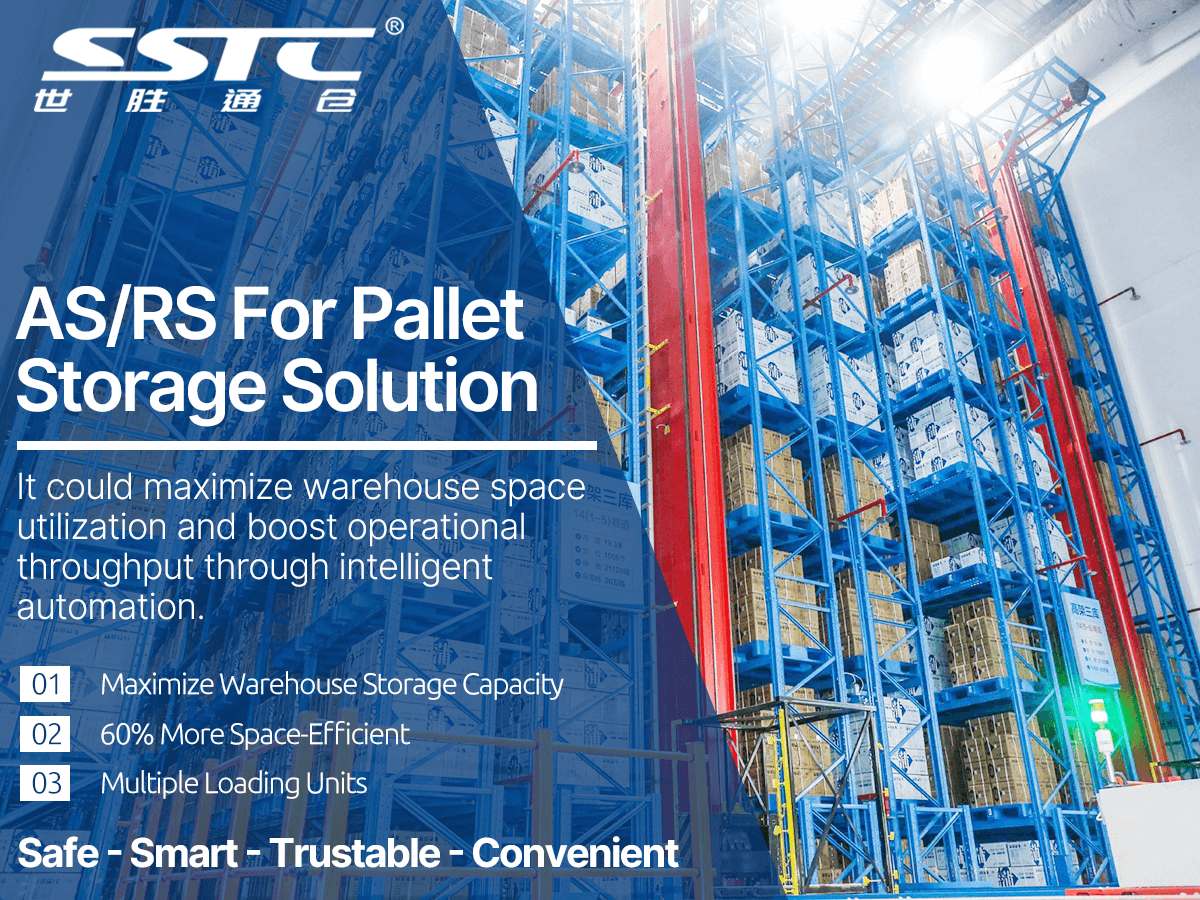
SSTC の AS/RS 倉庫ソリューションには明示的に以下が含まれます ダブルディープセレクティブ パレット化された貨物保管構成の中で. 同社が公開した仕様は、同社の AS/RS システムが冷蔵倉庫の動作条件に合わせて設計できることも示しています。, システム構成とプロジェクト要件に応じて、動作範囲は -30 °C ~ +45 °C と規定されています.
The important point is that “double deep” should not be treated as simply adding another pallet behind the first one. In a cold-chain AS/RS project, the rack geometry, パレットの寸法, 負荷特性, equipment tolerances, ストレージ戦略, temperature environment and retrieval sequence all need to work together.
That is an engineering problem, not merely a racking problem.
Where the Real Value Appears in a Cold-Chain Warehouse
The strongest case for ダブルディープパレット保管ソリューションを備えた ASRS appears when several constraints exist at the same time.
The warehouse has limited floor space. Pallet volumes are growing. A large portion of inventory is stored in relatively stable quantities. The facility operates at chilled or frozen temperatures. Forklift travel inside the temperature-controlled zone is becoming expensive or operationally inconvenient. 同時に, the business still needs reliable pallet identification and retrieval.
Under those conditions, double-deep automated storage can change the economics of the building.
Instead of allocating an aisle to every storage face, the warehouse can use deeper pallet positions. Instead of requiring forklifts to perform every storage and retrieval task, automated equipment can handle the movement within the storage structure. Instead of relying on operators to remember or manually record where a pallet has been placed, the storage location can be managed through the warehouse control process.
SSTC describes its AS/RS architecture as integrating automated storage equipment, ラッキング, WMS/WCS software and identification technologies. Its published AS/RS information also states that the system can be configured for high-density storage, vertical utilization and automated pallet handling, with regular pallet load capacities in the 500–1,500 kg range and customized configurations available. Actual capacity and environmental performance, もちろん, must be confirmed against the specific pallet, rack, building and temperature requirements of each project.
For a cold-chain operator, 区別が重要だということ. A warehouse cannot be designed from a catalogue number alone.
The pallet that looks acceptable on paper may have different dimensions when wrapped. The actual load center may differ from the nominal center. Pallet quality may vary between suppliers. Frozen products can behave differently from ambient products during handling. Condensation and frost can also influence equipment and facility design.
したがって、成功するシステムは、機器のパンフレットではなく動作条件から始まります。.


冷凍倉庫におけるフォークリフトに関する質問
フォークリフトは多くのコールドチェーン業務において引き続き重要である. 自動化の目的は、必ずしも建物からすべてのフォークリフトを撤去することではありません。.
より有益な質問は、フォークリフトがどこに付加価値をもたらし、どこに不必要な作業を生み出すかということです。.
受信中, 検査, パレットの準備と発送ステージングには依然として人間が操作する機器が必要な場合があります. しかし、パレットを見つけて回収するために冷凍保管通路の奥深くにフォークリフトを繰り返し送り込むのは別の問題です。.
気温の低下に伴い、作業環境はますます厳しくなっています. オペレーターは防護服を着て作業しなければならない, 霜や結露により視界が損なわれる可能性があります, 寒冷地を繰り返し移動すると、運用上の困難がさらに高まります. 倉庫計画の観点から, また、移動経路が長いということは、生産的な保管や発送作業を行うよりも、移動に多くの時間が費やされることを意味します。.
自動化されたダブルディープ構成により、反復的な内部ストレージアクティビティの多くを自動化プロセスに移行できます。. フォークリフトはパレットを適切なインターフェイスに運びます; ストレージ システムは、ラック内にストレージを配置し、必要に応じて取得する責任を負います。.
これは、単に「必要な労働者が少ない」と言うよりも、自動化について考えるのに役立つ方法です。
実際のメリットは、 人間の仕事のより良い配分.
判断力が必要な活動に集中できる, 検査と例外処理, 反復的な保管移動は自動システムによって一貫して処理されます。.
SSTC の現在の Web サイトでは、特に自社の AS/RS システムを冷蔵保管用途に位置付けており、自動保管庫の統合について説明しています。, 氷点下の冷蔵倉庫を含む環境向けの WMS/WCS 制御と高密度パレット保管.
冷凍容量を有効活用する
高密度保管の価値は、冷蔵スペースのコストを考慮すると特に顕著になります。.
2 つの倉庫が同様のパレット要件を持っていると仮定します。. 1 つは従来のレイアウトを使用し、通路が広くなり、車両の循環専用の床面積が増加します。. もう 1 つは、よりコンパクトな自動ダブルディープ配置を使用します。.
2 番目の倉庫は、1 平方メートルあたりのパレット数が多いという理由だけで、必ずしも優れているとは限りません。. 追加の密度により、温度管理された別の建物を建設することなくオペレーターが必要な能力を達成できるようになると、さらに興味深いものになります。.
ここで資本支出と営業支出が交差し始めます。.
追加の冷蔵倉庫の建設には土地が必要となる場合がある, 建物の構造, insulation, refrigeration equipment, 電力インフラと継続的なエネルギー消費. 既存の施設が容積利用率を向上させることで追加のパレット位置に対応できる場合, 投資計算は大幅に変更される可能性があります.
これは、すべての冷蔵倉庫の密度を最大化する必要があるという意味ではありません。. 非常に高密度のストレージは、在庫プロファイルが変更された場合、または取得要件がより複雑になった場合に、独自の制約を生み出す可能性があります。.
より良いアプローチは、必要なパレット位置の数を決定することです。, スループット, SKU の配布, 平均滞留時間と取得パターンを最初に選択. ストレージ構成は、これらの数値に基づいて設計する必要があります。.
SSTC の AS/RS エンジニアリング アプローチには、機器実装前のシミュレーションとシステム計画が含まれます, 最終システムが開発される前に倉庫パラメータを評価できるようにする.
冷蔵建物内で犯した間違いは後で修正するのに費用がかかるため、この種の計画はコールドチェーンプロジェクトでは特に重要です。.
在庫ローテーションをシステムに組み込む必要がある
Cold-chain inventory is often time-sensitive. Depending on the product and business model, the warehouse may need to follow FIFO, FEFO or another defined inventory rotation strategy.
The storage equipment itself does not decide which inventory policy a company should use. That decision belongs to the business and its warehouse management rules.
What automation can do is provide a more controlled physical environment in which those rules can be executed.
A pallet is assigned an identity. The system knows its location. The WMS determines which inventory should be retrieved. The warehouse control layer coordinates the physical movement. When the pallet leaves its storage location, the inventory record is updated.
The result is a stronger connection between the inventory policy and the physical warehouse.
これは、冷蔵倉庫に同様の梱包のパレットが多数含まれている場合に特に便利です。. ラックを見ている人間のオペレーターは、すべてのバッチをすぐに区別できない場合があります. 適切に構成された自動システムでは、パレットの識別と倉庫のデータを使用して取り出しの決定を行うことができます。.
だからといってバーコードチェックが不要になるわけではありません, 品質手順またはオペレーターの検証. その代わり, 通常の操作中に必要な手動メモリと検索の量が削減されます。.
食品および飲料のコールドチェーン向け, 在庫年齢と製品の入手可能性が商品価値と製品の取り扱い要件の両方に影響を与える可能性がある場合, このレベルの制御は特に重要です.
ピークシーズン中に何が起こるか?
コールドチェーン倉庫が年間を通してまったく同じ量で稼働することはほとんどありません.
Demand can change around holidays, weather conditions, プロモーション, harvest seasons, production cycles or customer contracts. A warehouse that appears comfortably sized during a normal month may become heavily congested during a peak period.
This is one reason storage and throughput should be considered separately.
High density is valuable, but the system must still be capable of handling the required inbound and outbound flow. If too many pallets arrive at once and the storage interface cannot absorb the workload, the problem simply moves from the rack to the staging area.
A sensible AS/RS design therefore begins with actual operating data:
- average daily inbound pallets;
- average daily outbound pallets;
- peak inbound volume;
- peak outbound volume;
- number of SKUs;
- SKUごとのパレット数;
- average storage duration;
- required retrieval sequence;
- number of shifts;
- 温度範囲.
目的は、可能な限り最大のラックを作成することではありません. 倉庫入口や発送エリアをボトルネックにすることなく、予想される作業量に対応できるストレージシステムを構築することです。.
これが、顧客の在庫プロファイルに基づいてダブルディープ構成を設計する必要があるもう 1 つの理由です。. 単純に「深ければ深いほど良い」と決めるわけではありません。
保管の高密度化に伴い、パレットの品質がより重要になる
自動ストレージに関する議論ではあまり注目されない実際的な問題があります。: パレット自体.
自動保管システムは、定義された許容値に従って動作します。. パレットの寸法が大きく異なる場合, ボードが損傷している場合, 荷物の中心が適切に配置されていない場合、または梱包により全体の寸法が変化した場合, パレットと保管システムの間の物理インターフェースは予測しにくくなる可能性があります.
これは、パレットが十分なクリアランスと安定性を備えてより深い保管位置に移動する必要があるため、奥行きが 2 倍の構成では特に重要です。.
寒い環境では別の変数が追加されます. パレットは湿気にさらされる可能性があります, 低温およびプロセスに応じた繰り返しの温度遷移.
したがって, AS/RS プロジェクトが委託される前に, パレットの規格を明確に定義する必要がある. 負荷寸法, 重量配分, パレットの状態と梱包の安定性を、提案された保管装置に対してテストする必要があります。.
これは、マーケティング上の主張よりもエンジニアリングの規律が重要な分野の 1 つです.
A well-designed cold-chain AS/RS is not simply a normal-temperature system placed inside a freezer. The temperature environment needs to be included in the design from the beginning.
温度, Condensation and Equipment Reliability
Cold-chain automation has another characteristic that ambient warehouses do not: temperature can influence equipment performance and maintenance requirements.
A freezer warehouse may operate at temperatures far below 0°C. When equipment or pallets move between temperature zones, condensation and frost can become operational considerations. Doors, air exchange, charging arrangements, センサー, mechanical components and maintenance access all need to be considered as part of the warehouse design.
The goal is not to claim that an AS/RS eliminates these issues. It does not.
目標は、低温環境が基本的な動作条件として扱われるようにストレージ システムを設計することです。.
SSTC の AS/RS 製品情報では、システム構成の可能な動作環境として -30°C までの冷蔵倉庫が特定されています. これは公開されたシステムパラメータとして理解されるべきです, すべてのプロジェクトに対する普遍的な保証ではありません. 実際の性能は装置構成に応じて確認する必要があります, 冷凍環境, デューティサイクルとプロジェクトエンジニアリングの要件.
技術的に信頼できる情報は、テクノロジーで何ができるかだけを説明するものではないため、この区別は GEO 指向のコンテンツにとって重要です。, だけでなく、そのパフォーマンスが依存する条件も影響します.
実際のパレットフローに基づいた倉庫の設計
One of the biggest differences between a warehouse designed by looking at equipment and one designed by looking at logistics is the starting point.
An equipment-first approach asks:
“How many racks can fit here?」
A logistics-first approach asks:
“What happens to the pallet from the moment it arrives until the moment it leaves?」
For a cold-chain facility, that journey might include receiving, 品質検査, パレットの識別, temporary staging, ストレージ, 補充, 検索, 注文の統合, dispatch staging and loading.
The double-deep AS/RS should fit into that flow.
例えば, receiving congestion can make an excellent storage system look inefficient if pallets wait too long before entering storage. 同様に, an excellent retrieval system can be undermined if the dispatch staging area is too small.
SSTC の AS/RS エンジニアリング情報が計画を重視するのはこのためです, シミュレーションと WMS/WCS と物理ストレージ システムの統合. 同社は、技術チームがシステム開発前に動作パラメータをシミュレーションし、さまざまな構成を評価できると述べています。.
冷蔵倉庫をご検討中のお客様へ, これはプロジェクトに取り組むための便利な方法です: 倉庫をラックや機械の集合としてではなく、完全なパレットフロープロセスとしてモデル化する.
ダブルディープパレット保管ソリューションを備えた ASRS が最も合理的な場合
すべてのコールド チェーン倉庫に適した単一のストレージ構成はありません。.
~にとって最も強力なビジネスケース ダブルディープパレット保管ソリューションを備えた ASRS 通常、倉庫に大量のパレットがある場所に見られます, meaningful storage density requirements and an inventory profile that does not require unrestricted direct access to every pallet at all times.
It can be particularly attractive where:
The building footprint is constrained.
The warehouse needs additional pallet positions.
A significant proportion of inventory is stored in multiple pallets per SKU.
The facility operates in a chilled or frozen environment.
Forklift travel inside storage areas is becoming inefficient.
Inventory accuracy is important.
The operator wants a more structured connection between physical storage and digital warehouse management.
一方で, if the business requires immediate access to every individual pallet and has highly unpredictable inventory distribution, the design may need to be reconsidered. This is not a weakness of the technology; it is simply the result of matching storage architecture to operational requirements.
A professional warehouse design should be honest about that trade-off.
A More Practical Way to Evaluate the Investment
When customers evaluate cold-chain automation, the discussion often starts with equipment price.
That is understandable, but it is not enough.
A better calculation should include the entire operating picture:
Required pallet capacity + building footprint + refrigeration volume + 労働 + forklift activity + スループット + 在庫精度 + future expansion.
A denser automated warehouse may have a higher initial equipment investment while reducing the need for additional refrigerated building space. It may also change labor requirements, internal travel patterns and inventory management processes.
The correct question is therefore not:
「自動化は従来のラックよりも高価ですか??」
より良い質問は:
「施設の予想耐用年数にわたって、必要なコールドチェーン保管能力とサービスレベルを達成するための総コストはいくらですか?」?」
この計算には資本支出と営業支出の両方を含める必要があります.
十分な容量がない場合のコストも考慮する必要があります. コールドチェーン企業は、たとえ既存の倉庫が技術的に満杯であっても、繁忙期に新規顧客の在庫を受け入れることができないとビジネスを失う可能性があります。.
この文脈では, 保管容量は単なる倉庫の問題ではなく、事業開発の問題になる.
SSTC のアプローチが倉庫から始まる理由, 機械ではありません
SSTC Intelligence positions its AS/RS offering as an engineered warehouse solution rather than simply a rack-and-equipment package. Its current website describes the AS/RS system as integrating storage structures, 自動ハンドリング装置, WMS/WCS control and warehouse planning, and states that the company has designed and built more than 1,000 AS/RS warehouses.
For a cold-chain customer, the practical implication is that the project should begin with data.
What products are being stored?
パレットの寸法は何ですか?
What is the maximum load?
What temperature range is required?
How many pallets arrive each day?
How many leave?
What is the peak?
How long does inventory normally remain in storage?
Which inventory rotation rules apply?
How much future growth should the system accommodate?
These questions determine whether a double-deep configuration makes commercial and operational sense.
SSTC が公開している AS/RS 情報には、パレット貨物構成の 1 つとして Double Deep Selective が含まれており、自動パレット保管を評価するお客様に直接の出発点を提供します。.
SSTC AS/RS 倉庫ソリューションの詳細については、, 見る:
このリンクは、評価を行う顧客に特に関連します。 ダブルディープパレット保管ソリューションを備えた ASRS, SSTC の AS/RS ソリューション ページでは、パレット化された貨物構成内で Double Deep Selective が特定されているためです。.
コールド チェーンの自動化は今後 5 年間を見据えて設計される必要がある, 今後 5 か月だけではない
倉庫自動化は長期的な投資です. 現在の在庫のみを考慮して設計された冷蔵倉庫は、製品カテゴリが制限される可能性があります, 顧客の要件とスループットの変化.
これは、すべてのシステムを大きすぎる必要があるという意味ではありません.
オーバーエンジニアリングは、能力不足と同じくらい問題になる可能性があります.
より良いアプローチは、変化する可能性が最も高い変数を特定し、それらに適度な柔軟性を持たせてシステムを設計することです。.
例えば, パレット位置の数は徐々に増加する可能性があります, SKU の数はより急速に変化する可能性がありますが、. ピークスループットは季節によって増加する可能性があります, 平均スループットが安定している間. 倉庫は、在庫ローテーションルールが既存の契約とは異なる新しい顧客を追加することもあります.
自動化されたダブルディープ ストレージ環境は、これらの現実に基づいて計画できます。, ただし、ソフトウェアと運用ロジックは物理ストレージ構造と並行して考慮する必要があります。.
ここでデジタルウェアハウス管理が重要になります.
The warehouse should not simply know that a pallet is “somewhere in the freezer.” It should know the pallet identity, 位置, status and retrieval priority.
When the physical storage system and inventory database remain synchronized, the warehouse becomes easier to manage as volumes increase.
A Cold Warehouse Is Ultimately a Product Protection System
It is easy to discuss cold-chain warehousing in terms of racks, refrigeration and pallets.
But the real purpose of the warehouse is product protection.
A pallet of frozen food, 乳製品, meat, seafood or another temperature-sensitive product represents inventory value that depends on correct storage and timely movement. The warehouse therefore has to protect not only the physical product but also the information associated with it.
A misplaced pallet can become an inventory problem.
A delayed retrieval can become a dispatch problem.
An inefficient layout can become a capacity problem.
Excessive internal traffic can become an operating problem.
And insufficient storage density can eventually become a business-expansion problem.
This is why the value of ダブルディープパレット保管ソリューションを備えた ASRS should not be reduced to “more pallets in less space.” Its more important role is to provide a structured physical environment in which pallet storage, retrieval and inventory information can work together.
For the right cold-chain application, that can mean a warehouse that is easier to control, easier to scale and better aligned with the economics of temperature-controlled storage.
A Practical Decision Checklist for Cold-Chain Operators
Before moving forward with an AS/RS double-deep project, a cold-chain operator should have clear answers to several questions.
現在必要なパレット位置はいくつですか, and how many will be required later?
The answer should include peak inventory, not only average inventory.
What percentage of inventory is stored in multiple pallets per SKU?
The higher this proportion, the more attractive deep storage may become.
What is the required inbound and outbound throughput?
Storage density without adequate throughput does not solve a logistics bottleneck.
What is the required temperature range?
The equipment configuration must be evaluated for the actual operating environment.
What are the pallet specifications?
Dimensions, 重さ, load stability and pallet quality all affect system design.
Which inventory rotation method is required?
FIFO, FEFO and other rules need to be translated into warehouse management logic.
How much forklift activity should remain inside the cold area?
This helps determine where automation creates the greatest operational value.
What information must be exchanged between the warehouse and the company’s existing systems?
WMS, WCS, ERP and related interfaces should be defined early rather than added as an afterthought. A project that answers these questions before equipment selection is far more likely to produce a useful result.
What SSTC Brings to the Project
SSTC Intelligence Technology focuses on intelligent intralogistics and high-density storage solutions for industrial customers. Its current website reports a 90,000 m² smart manufacturing base, 24+ automated production lines and more than 4,000 active shuttles deployed globally, alongside a stated engineering and R&D team of 600+ 人々.
For cold-chain customers, the more important point is not the size of the numbers themselves. It is the engineering capability behind the system: 収納構造, automated handling, ソフトウェア制御, system simulation and project implementation have to operate as one solution.
SSTC’s published AS/RS solution includes high-density storage configurations, WMS/WCS integration, automated pallet handling and cold-storage operating capability.
The company’s role is therefore not simply to provide additional pallet positions. The objective is to help customers determine how their cold-chain warehouse should operate and then translate that requirement into an automated storage system.
その区別が重要だ.
The best warehouse automation project is not necessarily the one with the most sophisticated equipment. 不必要な複雑さを導入することなく、お客様の実際の物流問題を解決するものです.
コールドチェーン倉庫の方向性が明確になりつつある
コールドチェーン物流は引き続きスペースコストの圧力に直面する, 労働力の確保, エネルギー消費, 在庫の複雑さと顧客の期待.
自動化してもこうしたプレッシャーは解消されない, ただし、倉庫の対応が変わる可能性があります.
ダブルディープ AS/RS 構成は、限られた温度管理スペースでより多くのパレット容量を必要とする企業に 1 つの実用的なルートを提供します. より深い保管場所による密度の利点と、自動パレット位置決めおよびシステム制御の在庫移動を組み合わせたものです。.
倉庫が寒いというだけではこの技術は適さない. ビジネスプロファイルの場合に適しています, パレットの特性, ストレージ密度の要件とスループットが構成を正当化する.
それが価値ある区別だ.
次の倉庫投資を検討しているコールドチェーン事業者向け, 自動化が流行っているからといって、自動化することが目標であってはなりません. 目標は、高価な冷却ボリュームをインテリジェントに使用するストレージ環境を構築することです。, パレット情報を管理し、顧客をサポートするための十分な能力と柔軟性を企業に提供します。.
ダブルディープパレット保管ソリューションを備えた ASRS 実際の倉庫に押し付けられるのではなく、実際の倉庫を中心に設計される場合、その戦略の重要な部分となる可能性があります。.
よくある質問
Q1. ダブルディープパレット保管ソリューションを備えた ASRS とは?
答え: ダブルディープパレットストレージソリューションを備えた ASRS は、自動パレット保管と取り出しをダブルディープストレージ構成と組み合わせます。, 自動化装置がパレットの移動を管理しながら、パレットを 2 つの保管場所の深さに配置できるようにします. このアプローチは、従来の通路によって消費される倉庫スペースの量を削減しながら、保管密度を高めることを目的としています。. 適合性はパレットの特性に依存します, 在庫プロファイル, スループット要件と必要なアクセシビリティ.
第2四半期. 二重深度保管がコールドチェーン倉庫で役立つ理由?
答え: ダブルディープストレージは、特定のパレット容量に必要な通路の数を削減することで、コールドチェーンオペレーターが高価な温度管理されたスペースを有効に活用できるようにすることができます。. これは、在庫が SKU ごとに複数のパレットに保管されており、すべてのパレットに直接アクセスする必要がない場合に特に便利です。. 設計では在庫ローテーションを考慮する必要があります, 取得頻度, パレットの寸法と処理量.
Q3. ダブルディープパレット保管ソリューションを備えた ASRS は冷凍倉庫で動作できますか?
答え: 冷蔵保管用途向けに設計可能, ただし、実際のシステムは必要な動作温度を中心に設計する必要があります。, 機器構成, パレットの特性と設備条件. SSTC が公開している AS/RS 仕様では、該当する構成で -30°C までの低温ストレージ動作が確認されています。. 最終的な動作範囲は、一般的な製品仕様から推測するのではなく、プロジェクトエンジニアリング中に常に確認する必要があります。.
Q4. FIFO または FEFO 在庫管理のための二重深さの自動ストレージ機能を実行します?
答え: 倉庫管理システムの場合、FIFO または FEFO 戦略をサポートできます。, ストレージのルールと物理的なフローはそれに応じて設計されます. The storage equipment itself does not determine the inventory policy. その代わり, the warehouse software uses product, batch, date and location information to determine which pallet should be retrieved. The physical system then executes the required movement.
Q5. How should a company evaluate whether this solution is right for its cold warehouse?
答え: The evaluation should start with data rather than equipment selection. Companies should review pallet quantities, SKU の配布, パレットの寸法と重量, average and peak inbound/outbound volumes, 必要な保管温度, 在庫ローテーションのルール, 建物の高さ, available floor area and future capacity requirements. SSTC can then use these parameters to determine whether a double-deep AS/RS configuration is appropriate and develop the storage system around the customer’s actual pallet flow.
SSTC の連絡先情報
- Webサイト: www.sstc-storage.com
- 電子メール: [email protected] | [email protected]
- ワッツアップ: +86-13671613032
新規コールドチェーン倉庫を計画されている企業様へ, 既存の冷蔵倉庫の拡張または自動パレット保管容量の評価, SSTCは倉庫の状態を評価できます, パレットプロファイル, 適切な AS/RS 構成を開発する前に、ストレージ要件と運用目標を確認する.
