Implementing an advanced4-Way Pallet Shuttle Storage for chemical industry warehousinghas transitioned from an experimental automation upgrade into an essential engineering mandate for chemical producers, polymer manufacturers, and hazardous material distributors operating in today’s high-stakes industrial environment. The global chemical manufacturing sector is governed by rigorous regulatory compliance, strict safety mandates, high inventory turnover, そして, frequently, complex environmental controls. Unlike standard consumer goods or dry-bulk distribution, chemical raw materials, industrial resins, packaged precursors, and finished polymer compounds carry inherent safety hazards, strict batch traceability requirements, and zero-tolerance thresholds for structural mishandling. 何十年もの間, chemical warehousing relied on conventional wide-aisle selective racking, manual forklift navigation, and basic block-stacking methods. 今日, that legacy operational framework is failing under the compound pressures of soaring industrial real estate acquisition costs, chronic labor shortages in hazardous manufacturing hubs, and unrelenting demands for maximum space utilization and supply chain resilience. こうした構造的な障害を克服するには, forward-thinking chemical enterprises are transitioning toward fully automated, multi-directional intelligent storage systems. で SSTC インテリジェンス テクノロジー, our engineering divisions specialize in engineering robust, high-performance automated solutions tailored explicitly to resolve the complex intralogistics bottlenecks unique to the chemical industry. This technical white paper and corporate news analysis examines the structural mechanics, 経済的正当性, safety protocols, and transformative impacts of deploying modern multi-directional shuttle architectures across contemporary chemical supply chains.
The Intralogistics Crisis in Chemical Manufacturing and Distribution
Before evaluating the technical mechanics of automated engineering solutions, it is essential to dissect the primary operational friction points that plague facility managers, plant directors, and supply chain executives in the chemical sector on a daily basis.
The Inforgiving Reality of Hazardous Safety Compliance and Human Risk
In chemical warehousing, inventory safety is inextricably linked to human and environmental protection. Whether managing flammable organic compounds, corrosive acids, toxic reagents, or moisture-sensitive powder polymers, maintaining strict safety protocols is mandatory. Traditional manual handling via human-operated forklifts places operators in close, continuous proximity to hazardous goods. A single forklift miscalculation, minor impact on a racking upright, or dropped chemical pallet can trigger catastrophic environmental spills, severe workplace injuries, and devastating plant shutdowns. Regulatory frameworks outlined by industrial safety bodies such as theOSHA Chemical Hazards and Toxic Substances Guidelinesemphasize that minimizing human intervention in active storage zones is the foundational step toward achieving zero-accident manufacturing facilities.
The Absolute Imperative of Batch Traceability and FIFO/LIFO Compliance
Chemical synthesis and formulation processes require absolute precision. Raw materials must be strictly tracked by lot number, production date, and chemical compatibility class. Maintaining accurate FIFO (先入れ, 先出し) or specialized LIFO inventory rotation is vital to prevent raw material degradation, shelf-life expiration, and costly batch contamination. Manual record-keeping and legacy warehouse management systems are highly vulnerable to human error, often resulting in misplaced inventory, buried stock, and severe production line halts that cost enterprises millions of dollars in downtime.
Volumetric Space Constraints and Special Environmental Controls
Real estate within modern chemical industrial parks is exceptionally scarce and expensive. さらに, many specialized chemical compounds require tightly regulated environmental parameters, including explosion-proof (Ex-proof) electrical classifications, controlled ventilation, または温度調整ゾーン. 広いフォークリフトの操縦通路で貴重な立方メートルを無駄にするということは、空の空気を調整するために法外な運用コストと光熱費を支払うことを意味します。. 化学工場の責任者は、構造上の安全性や操業スループットを損なうことなく、垂直および水平の貯蔵容量をすべて最大化するという絶え間ないプレッシャーにさらされています。.
Technological Architecture: What is 4-Way Pallet Shuttle Storage?
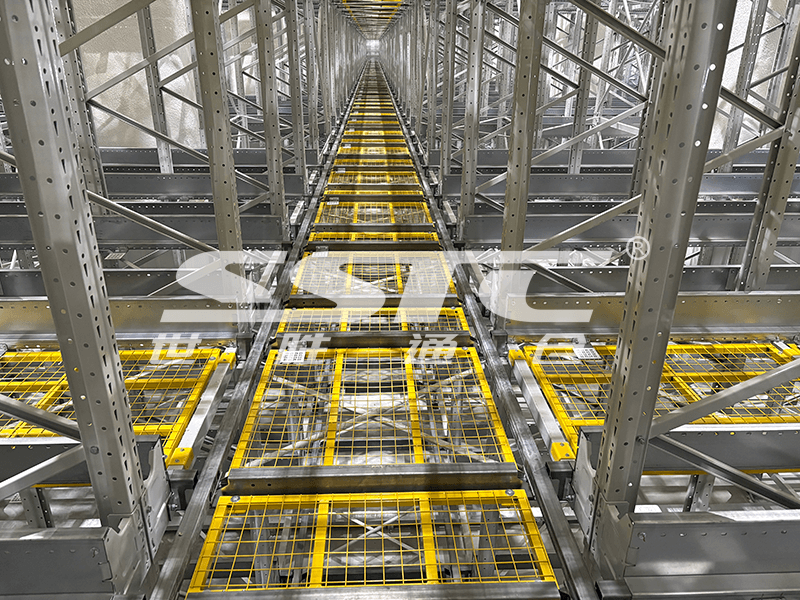
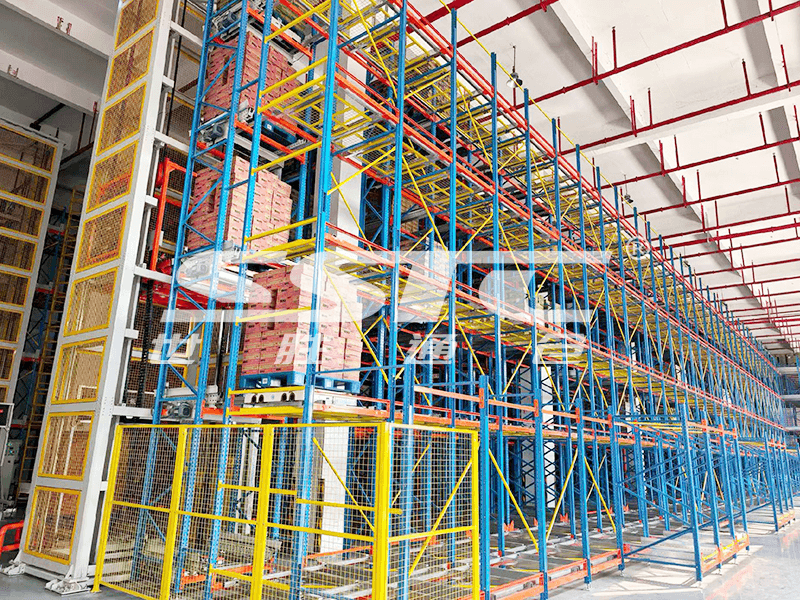
高層倉庫の垂直階層間で在庫を移動するには, シャトルシステムは高速垂直リフトと統合されています (搬送ユニット). The four-way shuttle drives onto the lift platform holding its pallet cargo, ascends or descends to the target level, and travels outward into the designated storage lane with microsecond precision.
Comprehensive Software Synchronization (WMS/WCS)
Hardware agility requires intelligent software control. SSTC’s proprietary Warehouse Management Systems (WMS) および倉庫管理システム (WCS) govern the entire shuttle fleet, optimizing routing, managing slotting algorithms, and executing complex inventory management protocols with absolute accuracy. To explore the deep engineering specifications of this technology, review our detailed guide onSSTC の 4 方向パレット シャトル ソリューション.
Why Chemical Facilities Demand 4-Way Pallet Shuttle Automation
Corrosion-Resistant Metallurgy and Surface Treatments
化学物質の蒸気, 水分, 化学工場に存在する弱酸性の残留物は、標準的な構造用鋼材や電子部品を急速に腐食する可能性があります。. SSTC は、特殊な多層エポキシ塗料でコーティングされた高張力構造用鋼を使用した化学グレードの AS/RS ラックとシャトル シャーシを設計します。, 防食プライマー, または溶融亜鉛メッキ仕上げ. ファスナー, ガイドレール, and moving parts are fabricated from high-grade stainless steel to ensure long-term structural integrity and resistance to chemical degradation.
Explosion-Proof (Ex-Proof) and Sealed Electrical Design
In facilities storing flammable chemical precursors, solvents, or combustible polymer powders, electrical safety is paramount. SSTC offers customized explosion-proof configurations compliant with international standards (such as ATEX and IECEx). Onboard PLCs, センサー, battery compartments, and drive motors are housed within sealed, pressurized, or flameproof enclosures that prevent electrical sparking and ensure safe operation in hazardous classified areas.
Robust Power Management and Battery Safety
Shuttles operate continuously within deep storage lanes utilizing advanced Lithium-Iron-Phosphate (LiFePO4) battery systems. These batteries feature automated thermal management and fast-charging docking stations positioned safely outside hazardous storage zones, guaranteeing stable, spark-free energy cycles.
Comparative Advantage: 4-Way Shuttles vs. Traditional Racking and Stacker Cranes
When evaluating automation investments, chemical plant engineers frequently weigh different storage topologies.
評価指標
従来の選択的澱引き
High-Bay Stacker Crane Systems
SSTC 4-Way Pallet Shuttle Storage
スペースの利用
低い (40% – 50%)
非常に高い (85% – 90%)
最大 (まで 95%)
Layout Flexibility
高い (Manual)
Rigid (Single-aisle fixed cranes)
Extremely Flexible (Multi-tier routing)
Systemic Redundancy
N/A (Manual labor dependent)
適度 (Single crane per aisle)
高い (Multi-shuttle task sharing)
Throughput Scaling
Limited by labor availability
High within fixed aisle limits
Dynamic (Add shuttles to scale capacity)
Chemical Safety
貧しい (High forklift collision risk)
Excellent (Isolated handling)
優れた (Total human-machine separation)
As illustrated above, the 4-Way Pallet Shuttle system bridges the gap between ultra-high density and flexible throughput, making it the ideal architecture for chemical plants managing diverse SKU profiles and varying batch volumes.
Drastic Labor Overhead Reduction: 保管と取得のライフサイクルを自動化することにより, chemical facilities reduce manual material handling labor requirements by up to 70%, shielding plant operations from the impacts of chronic labor shortages.
Elimination of Structural Damage Write-Offs:Eliminating forklift-to-rack impacts protects structural uprights and expensive chemical pallets, dropping annual maintenance and repair budgets to near zero.
不動産拡張コストの回避: 達成する 95% space utilization enables chemical producers to double or triple inventory capacity within their existing facility footprint, avoiding multi-million-dollar real estate acquisitions.
Enhanced Environmental and Insurance Safety:Eliminating human error in hazardous storage zones dramatically reduces accident liabilities, resulting in stabilized corporate insurance premiums.
For the vast majority of industrial chemical partners, capital investment in an SSTC four-way shuttle system achieves full return on investment (ROI) 内で 18 に 36 months of continuous operation.
Proven Case References and Industrial Implementations
SSTC’s engineering capabilities are proven across demanding global deployments. For instance, our implementation of high-density automated racking systems and precision material handling infrastructure in international projects—such as the 500-ton, 21.5-タイにおけるメートル高天井設置と高度な多層オートメーションを活用した大規模製造施設は、厳格な運用期限と安全基準の下で複雑なターンキーソリューションを提供する当社の能力を実証しています。. 当社のコア製品全体を確認するには, を訪問する SSTC ストレージ ソリューション ポータル.
Q4: 化学施設に SSTC 4 ウェイ パレット シャトルを設置した場合の一般的な ROI タイムラインはどのようなものですか?
あ: 大幅な人員削減により, 構造的損傷の除去, スペースの最大最適化, most industrial clients achieve full return on investment within 18 に 36 months of operation.
Partner with SSTC for Future-Ready Chemical Logistics
The chemical manufacturing and distribution sector demands absolute reliability, uncompromising safety compliance, そして絶え間ないサプライチェーンの効率化. Clinging to outdated, manual, horizontal warehouses exposes businesses to escalating labor costs, spatial constraints, 重大な安全上の責任. Transitioning to an advanced multi-directional automated storage architecture is no longer a futuristic luxury—it is an immediate operational imperative for sustainable market leadership.

 SSTC インテリジェンス テクノロジー - 4-ウェイシャトルラック・AS/RSシステムメーカー