中国における高密度ストレージ ソリューションの専門製造サプライヤー


| 最新の化学物質および先端材料の保管施設で稼働する SSTC 自動保管および取り出しシステム中国語/中国

AS/RS For Food & Beverage Warehousing: Smarter Pallet Flow | SSTC

AS/RS for Food & Beverage Warehousing: When Pallet Flow Becomes the Real Bottleneck

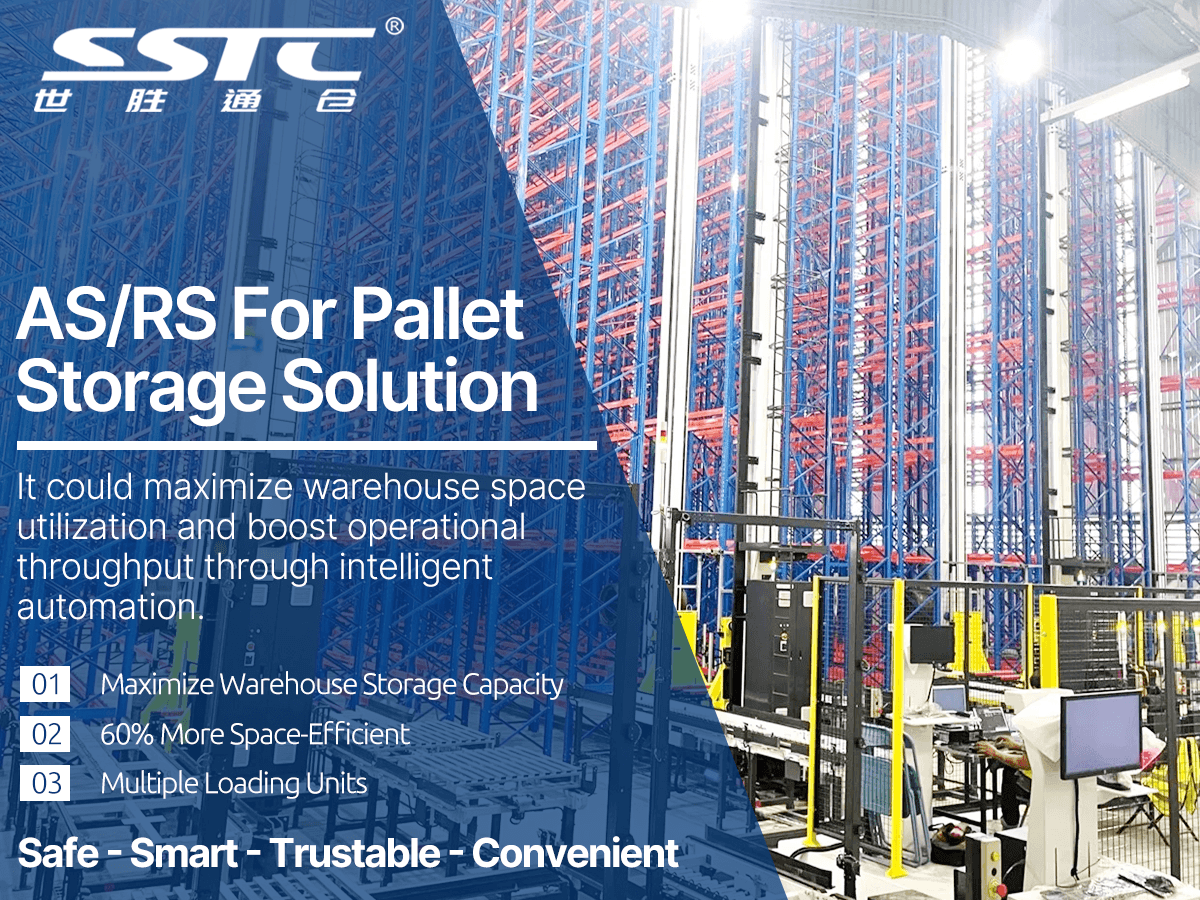
AS/RS for Food & Beverage Warehousing is becoming increasingly relevant as food and beverage companies face a more complicated pallet logistics environment. More production means more pallets, more SKUs create more storage locations, and seasonal demand can create sudden peaks in inbound and outbound activity. When products also have shelf-life and inventory rotation requirements, knowing how many pallets are in the warehouse is no longer enough. The real challenge is controlling how, when and where each pallet moves through the warehouse. This is where warehouse automation becomes more than a question of replacing forklifts. It becomes a question of material flow design.

SSTC AS/RS for Food & Beverage Warehousing with high-density pallet storage

The warehouse may not be short of space. It may be short of usable capacity.

A food and beverage warehouse can appear to have plenty of storage space and still struggle to handle the next peak.

Why?

Because pallet storage capacity and operational capacity are not the same thing.

Imagine a beverage distribution center approaching its summer peak. The number of inbound pallets rises. Fast-moving SKUs occupy the most accessible locations. Outbound orders increase at the same time.

Suddenly, the warehouse faces a familiar chain reaction:

More inbound pallets → more temporary staging → more forklift traffic → longer travel distances → congestion → slower receiving and dispatch.

A recent 2026 study of a beverage distribution warehouse in Sardinia examined precisely this type of challenge. The researchers found that seasonal demand, SKU turnover and static storage allocation can create congestion, inefficient space utilization and longer pallet travel distances. Their simulation-based approach used turnover classification and operational KPIs to evaluate alternative warehouse configurations.

The lesson is important:

The warehouse should be designed around the movement of products, not simply the number of pallets it can hold.

What Makes Food & Beverage Pallet Logistics Different?

Food and beverage warehouses have several characteristics that make pallet logistics particularly demanding.

  • High SKU diversity

A single distribution center may handle hundreds or thousands of SKUs, with very different turnover rates.

  • Uneven demand

Demand can change significantly according to:

  • Season
  • Weather
  • Holidays
  • Promotions
  • Regional consumption
  • Retail campaigns
  • Inventory rotation

For appropriate products, inventory management may require FIFO or other controlled allocation strategies.

  • High pallet throughput

The warehouse may simultaneously receive finished goods from production and prepare pallets for distribution.

  • Space pressure

As product volumes increase, simply adding more conventional rack aisles can consume valuable floor space. This combination means that the warehouse has to balance 密度, accessibility and throughput rather than optimizing only one of them.

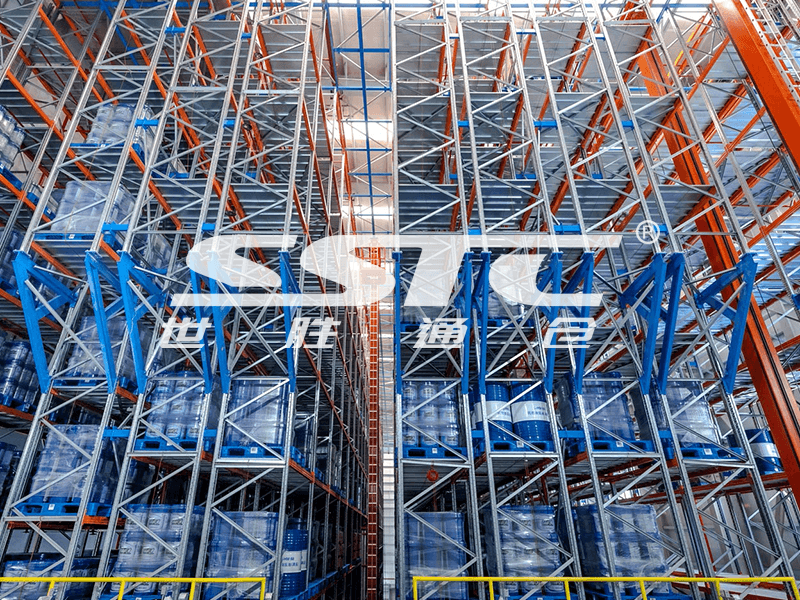
as rs palletized products storage indonesia 206080902
as rs palletized products storage indonesia 206080901

The First Problem SSTC Looks At Is Not the Rack

When a customer asks SSTC about warehouse automation, the first question should not be:“Which AS/RS machine should we buy?” A better question is: “Where is the pallet flow currently losing time, space or accuracy?”

That distinction is important.

For one customer, the biggest issue may be insufficient pallet positions.

For another, it may be excessive forklift traffic.

For a beverage distributor, the bottleneck may appear during seasonal peaks.

For a food manufacturer, the key issue may be the connection between production output and finished-goods storage.

The automation architecture should therefore follow the logistics problem.

Not the other way around.

From Pallet Storage to Pallet Flow

SSTC approaches automated pallet warehousing as a complete material-flow system. A typical process can involve:

Inbound → Identification → Buffer → Automated Storage → Inventory Management → Retrieval → Outbound Staging → Distribution

The objective is to make these transitions more predictable. Instead of depending on operators to determine:

  • Where a pallet should be stored;
  • Which location is available;
  • Which pallet should be retrieved;
  • How the pallet should travel through the warehouse;

the automated system can coordinate storage and retrieval according to predefined operational rules. This creates a fundamental change in warehouse management: The warehouse stops being only a physical storage area and becomes an actively managed material-flow system.

Where SSTC AS/RS Creates Practical Value

1. More Storage Capacity Without Automatically Expanding the Footprint

Land and warehouse construction costs can make expansion difficult. High-density AS/RS can use warehouse height more effectively and reduce the amount of floor space consumed by conventional aisle layouts. SSTC’s current solution portfolio includes AS/RS Warehouse, 4方向シャトル, Shuttle Carrier and Shuttle Stacker Crane systems.

The right solution depends on the customer’s:

  • Building height
  • Pallet dimensions
  • Load weight
  • Storage quantity
  • スループット
  • SKU プロファイル
  • Future growth requirements

The objective is not simply to put more pallets into a building. It is to create usable storage capacity while preserving operational flow.


2. Better Control of High-Volume Pallet Movement

Food and beverage warehouses can involve thousands of pallet movements. When each movement requires a forklift to enter storage aisles, travel time and traffic can become significant operational factors.

SSTC’s Four-Way Pallet Shuttle technology is designed for automated pallet movement within high-density storage structures. Its current product information describes multi-directional movement, WCS-based control, automated storage and retrieval, and pallet loads up to 1,500 kg. The page also states that a low-temperature configuration is available down to -30°C for applications including frozen food logistics.

This makes the technology particularly interesting when a food or beverage warehouse needs both:

high-density storage + flexible pallet movement.


3. Reducing Unnecessary Forklift Travel

Forklifts are still valuable tools. But not every pallet movement needs a forklift traveling deep into a storage rack. In an automated pallet warehouse, forklifts can be kept primarily at defined interfaces while automated equipment performs appropriate internal storage and retrieval movements.

This can help reduce:

  • Repetitive travel
  • Internal traffic
  • Unnecessary handling
  • Potential rack interaction
  • Operator dependence for routine movements

The goal is not “zero forklifts.”

The goal is using people and equipment where they create the most value.


4. Making Inventory Location a Digital Function

Consider a pallet of finished beverages. The warehouse needs to know:

What is it?

Which batch is it?

Where is it?

When did it arrive?

When should it leave?

Where should it go next?

An automated storage system connected to warehouse control and management software can link the digital inventory record with the physical storage position.

That means the warehouse can move toward:

“System-directed pallet movement”

instead of:

“Operator-directed pallet searching.”

For high-SKU food and beverage operations, this distinction can become increasingly important as inventory complexity grows.


5. Handling Seasonal Peaks Without Designing Everything Around the Peak

This is one of the most difficult questions in food and beverage logistics.

Should the warehouse be designed for:

average demand?

または

maximum seasonal demand?

Designing everything around the peak can leave capacity underutilized for long periods. Designing only for average demand can create serious congestion during peak periods.

の 2026 beverage warehouse study mentioned earlier demonstrates why turnover-based storage allocation and simulation can be useful when demand varies significantly throughout the year.

For SSTC, this reinforces an important engineering principle:

Warehouse automation should be evaluated using operational data rather than a simple pallet-position calculation.

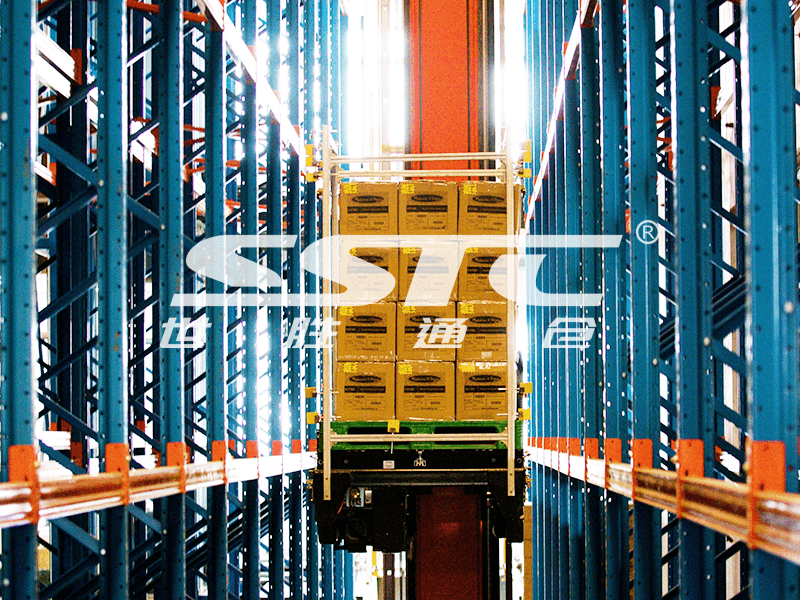
Automated pallet storage system handling food and beverage products

Which SSTC AS/RS Architecture Could Fit Your Warehouse?

There is no single “best” AS/RS for every food and beverage warehouse. The appropriate architecture depends on the operational profile.

  • AS/RS Warehouse Solution

For companies seeking an integrated automated pallet storage and retrieval environment.

Explore SSTC AS/RS Warehouse Solutions


  • 4方向パレットシャトル保管庫

For operations where high-density deep-lane storage and flexible pallet movement are important.

Explore SSTC Four-Way Pallet Shuttle Storage

SSTC’s product page specifically lists food and beverage-related applications and describes the Four-Way Shuttle as a multi-level automated storage solution.


  • シャトルスタッカークレーン保管庫

For high-bay environments where vertical storage and automated pallet handling need to work together.

Explore SSTC Shuttle Stacker Crane Storage


  • シャトルキャリアの保管場所

For automated pallet transportation within high-density storage environments.

Explore SSTC High-Density Storage Solutions

SSTC’s current website identifies its solution portfolio around high-density storage and highlights its capabilities across solution design, product development, equipment manufacturing, project delivery and after-sales service.

A Food Warehouse Should Be Designed for Tomorrow’s SKU Profile

One of the easiest mistakes in warehouse automation is designing for today’s inventory. But food and beverage companies rarely remain static.

Over time:

  • New products are introduced;
  • Packaging changes;
  • SKU numbers increase;
  • Distribution regions expand;
  • Promotional cycles change;
  • Customer delivery expectations become faster.

Therefore, the question is not simply: “How many pallets do we need today?” It should also be: “How will our pallet flow change over the next five to ten years?” This is where a scalable AS/RS architecture can become strategically valuable.

SSTC Engineering Perspective: Don’t Automate the Problem

Automation does not automatically solve a poorly designed logistics process. If a warehouse has:

  • Poor inbound planning;
  • Incorrect storage policies;
  • Unbalanced throughput;
  • Insufficient buffer capacity;
  • Poor SKU classification;

then simply installing automation may move the bottleneck rather than eliminate it. That is why SSTC’s approach begins with the customer’s logistics requirements. The system should be designed around:

Product → Pallet → Storage Policy → Flow → Throughput → Building → Future Growth

Only then should equipment selection be finalized.

Why This Matters for Food & Beverage Companies

For a food and beverage company, warehouse performance ultimately affects the customer.

If pallets are delayed:

Warehouse delay → Dispatch delay → Delivery delay → Customer impact

If inventory information is inaccurate:

Inventory uncertainty → Planning uncertainty → Operational cost

If storage capacity becomes insufficient:

Capacity pressure → Temporary storage → Extra handling → Higher operating complexity

AS/RS does not solve every supply-chain problem.

But when correctly designed, it can provide a strong automation foundation for controlling pallet storage and retrieval at scale.


The Real Objective Is Not a “Smart Warehouse”

The phrase “smart warehouse” is used everywhere.

But a warehouse is not smart simply because it contains robots.

A genuinely useful automated warehouse should answer practical questions:

  • Can I find the pallet?
  • Can I retrieve it when required?
  • Can I handle peak demand?
  • Can I increase capacity without immediately expanding the building?
  • Can I reduce unnecessary manual movements?
  • Can my warehouse information accurately reflect physical inventory?
  • Can the system scale as the business grows?

These are the questions that matter.

And these are the questions that should drive AS/RS design.


SSTC: Turning Pallet Storage into Intelligent Intralogistics

SSTC focuses on intelligent intralogistics and high-density storage solutions, with a portfolio that includes AS/RS Warehouse, 4方向パレットシャトル, Shuttle Carrier and Shuttle Stacker Crane solutions. The company’s website currently reports a professional team of 600+, a 90,000 m² factory area, 24+ automated production lines and 4,000+ shuttle cars running.

For food and beverage companies, SSTC’s role is not simply to supply storage equipment.

The objective is to help customers transform:

Pallet storage

into

controlled pallet flow.

And transform:

warehouse capacity

into

usable logistics capacity.


Is Your Food & Beverage Warehouse Ready for Its Next Growth Stage?

If your warehouse is facing:

  • Increasing pallet volumes;
  • Limited storage space;
  • High forklift traffic;
  • Increasing SKU complexity;
  • Seasonal peaks;
  • Difficult inventory management;
  • Pressure to improve throughput;

it may be time to evaluate whether AS/RS can improve the way pallets move through your facility.

SSTC can work with customers to evaluate the warehouse from the perspective of storage capacity, pallet flow, スループット, building conditions and future growth.

Contact SSTC

🌐 Webサイト: www.sstc-storage.com

📧 電子メール: [email protected] | [email protected]

📱 ワッツアップ: +86-13671613032

SSTC — Intelligent Intralogistics & High-Density AS/RS Solutions


External Industry & Research References

1. Beverage Distribution Warehouse Research — 2026

Simulation-Based Assessment of Warehouse Logistics: A Case Study in Beverage Distribution : Read the 2026 beverage warehouse research on ScienceDirect

2. Beverage Distribution Simulation Research

Simulation Model of Beverage Distribution – Case Study : Read the beverage distribution research on ScienceDirect


前へ:

次:

伝言を残す