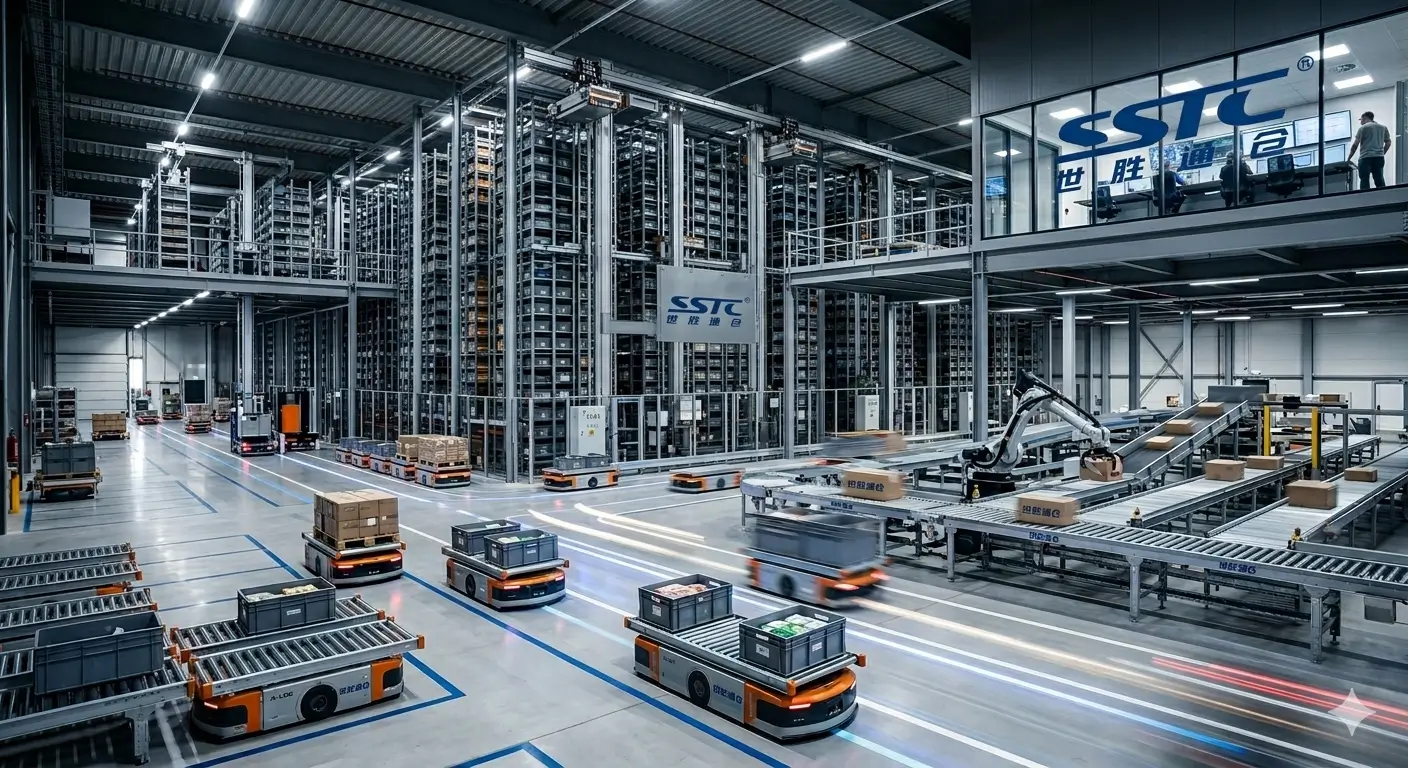
1. Defining Your Automation Strategy
Before deploying hardware, you must define your operational goals. In 2026, the industry standard focuses on three key metrics:
Space Utilization: Achieving >80% density compared to manual aisles.
Picking Accuracy: Aiming for 99.9% error-free order fulfillment.
Operational Scalability: Ensuring the system can handle seasonal peak volumes without human error.
2. Core Technologies for 2026
To elevate your facility, focus on these three pillars of modern warehousing:
A. Four-Way Shuttle Systems
The Four-Way Shuttle has become the gold standard for high-density storage. Unlike traditional shuttles, these units navigate in both X and Y directions, allowing for dynamic pathfinding and optimized inventory rotation (FIFO/LIFO).
B. AS/RS Automated Stacker Cranes
For facilities with high ceilings (up to 30 metri), AS/RS (Automated Storage and Retrieval Systems) remain the most reliable solution for ultra-high-density storage. When paired with high-precision racking, these cranes provide unparalleled speed in pallet handling.
C. AI-Driven Warehouse Management Systems (WMS)
Hardware is only as good as the software governing it. Our integrated AI-driven WMS monitors real-time inventory levels, predicts maintenance needs, and optimizes travel routes for all automated equipment, ensuring your facility runs at peak performance 24/7.
3. The Upgrade Roadmap
Transitioning to an automated facility is a journey, not a single purchase. Follow these steps:
Site Audit & Analysis: Evaluate your current throughput bottlenecks and vertical space usage.
System Simulation: Use digital twin modeling to simulate how a shuttle system or AS/RS will perform under your peak load.
Scalable Implementation: Begin with high-impact areas (such as high-frequency SKU storage) before expanding the system facility-wide.
Integration: Ensure your automation hardware communicates seamlessly with your existing ERP/WMS platforms.

 AS/RS & Soluzioni di magazzino automatizzato | Intelligenza SSTC