 Sistem Rak AS/RS & Solusi Gudang Otomatis | Intelijen SSTC

A Four-Way Pallet Shuttle Storage Solution for Cold Storage is not simply about putting more pallets into a refrigerated building. It starts with a more practical question: how can a cold-chain operator store and manage a large volume of palletized goods when refrigerated space is expensive, the operating environment is extremely cold, and manual pallet handling becomes increasingly difficult?
This was the situation behind a major cold-storage project delivered by Teknologi Intelijen SSTC (Shandong) Bersama., Ltd. for Qingdao Techain in 2021.
The project was designed around approximately 100,000 posisi palet, with the warehouse operating at approximately -25°C. At this scale, cold storage becomes much more than a question of rack capacity. The storage system has to work as part of the customer’s daily pallet logistics: goods arrive, pallets are stored, inventory remains available, and pallets need to be retrieved again without creating unnecessary operational complexity.
SSTC’s response was to develop and implement a Four-Way Pallet Shuttle Storage Solution designed specifically around the customer’s cold-chain storage requirements.
The project is a useful example of an important point in cold-storage planning: the right warehouse solution begins with the customer’s operating problem, not with a piece of equipment.
Why Large-Scale Cold Storage Is Different
Cold storage has constraints that do not exist to the same extent in an ordinary ambient warehouse.
The first is obvious: suhu.
Operating at approximately -25°C changes the working environment. People, peralatan, storage structures and operating procedures all have to function under low-temperature conditions. Repetitive manual activity inside a frozen warehouse can become a significant operational burden, particularly when the facility handles large volumes of palletized goods.
The second issue is space.
A refrigerated cubic meter has a cost attached to it. The building must be constructed, insulated and maintained, while the refrigeration system must continuously maintain the required temperature. Karena itu, increasing storage capacity by simply increasing the building footprint may not always be the most practical answer.
The third issue is pallet movement.
Cold-chain warehouses do not only need to store products. They need to receive pallets, place them into storage, maintain inventory and retrieve them when orders or downstream logistics require them. A storage system that provides high density but makes daily pallet movement unnecessarily complicated does not fully solve the customer’s problem.
The fourth issue is inventory scale.
When the warehouse reaches tens of thousands of pallet positions, manual management becomes increasingly difficult to maintain at the same level of consistency. The larger the inventory, the more important it becomes to have a storage structure and handling process that can support repeatable pallet movement.
These challenges are closely connected.
The warehouse needs to use its refrigerated volume efficiently, but pallets still need to move. The storage density needs to be high, but access to inventory cannot be ignored. The environment needs to remain cold, while unnecessary human activity in that environment should be reduced.
This is where the design of a Four-Way Pallet Shuttle Storage Solution becomes particularly relevant.
Understanding the Customer’s Cold-Chain Challenge
For Qingdao Techain, the requirement was not simply to install a large number of storage locations.
The project required a cold-storage solution capable of supporting a very large pallet inventory under low-temperature conditions.
With approximately 100,000 pallet positions and an operating temperature of around -25°C, several requirements naturally became important during the planning process.
1. Make Better Use of Refrigerated Space
Cold-storage construction and operation represent a significant investment. Every additional square meter of building space also means additional volume that needs to be refrigerated.
For this reason, storage density is not only a warehouse design issue. It can influence the economics of the entire cold-storage facility.
The challenge for SSTC was therefore to use the available warehouse volume effectively and create a storage configuration capable of accommodating a very large number of pallets.
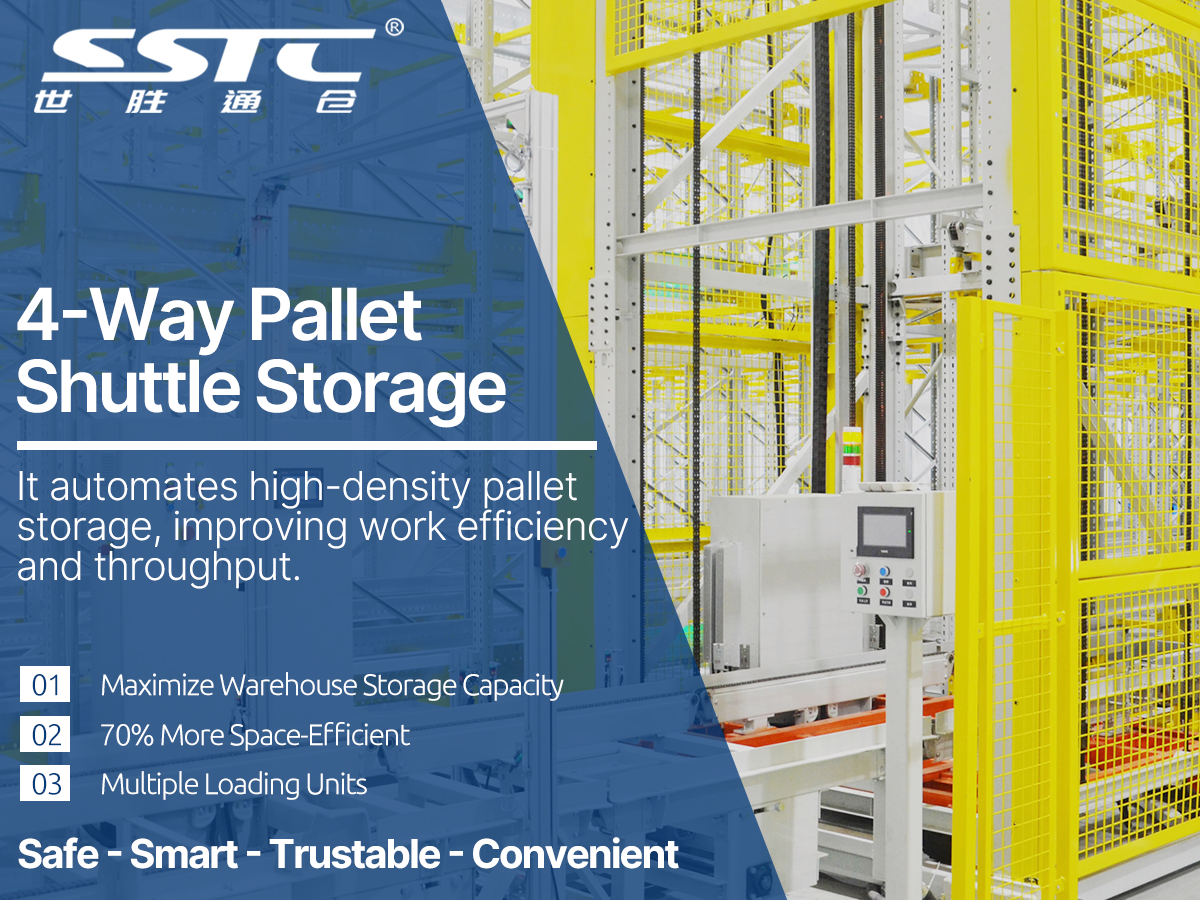
The Four-Way Pallet Shuttle approach provides deep-lane, high-density pallet storage while allowing shuttle vehicles to move within the storage structure. SSTC’s product information identifies cold chain as one of the system’s applicable industries and describes the solution as a high-density automated pallet storage system.
2. Reduce Unnecessary Manual Activity in a -25°C Environment
A cold warehouse is not an ordinary workplace.
When employees repeatedly enter low-temperature storage areas to perform pallet-related operations, the working environment itself becomes part of the logistics challenge.
The objective is not simply to remove people from the warehouse. The more practical objective is to allow people to focus on tasks that require human judgment while automated equipment handles repetitive pallet storage and retrieval operations.
SSTC’s Four-Way Pallet Shuttle Storage System is designed for automatic pallet handling and storage. The system can move pallets within the storage structure and perform storage and retrieval operations according to the warehouse control process.
For a large frozen-storage facility, perbedaan itu penting.
3. Handle Palletized Goods at Large Scale
The project was built around approximately 100,000 posisi palet.
That means the storage system had to be considered as a large-scale pallet logistics environment rather than a small automated storage installation.
Dimensi palet, pallet loads, storage depth, movement frequency, inventory distribution and retrieval requirements all become important when designing a facility of this scale.
SSTC’s current Four-Way Pallet Shuttle specifications state that the shuttle can support pallet loads up to 1,500 kg and that a specialized low-temperature configuration is available for cold-storage environments down to -30°C.
These capabilities provide a technical basis for applying the system to demanding frozen-storage environments.
4. Keep Pallet Movement Practical
High-density storage is useful only when it supports actual warehouse operations.
A cold-storage customer may have pallets entering the warehouse throughout the day, pallets remaining in storage for different periods and pallets leaving according to customer orders or distribution requirements.
The storage system therefore needs to accommodate movement rather than treating storage as a static activity.
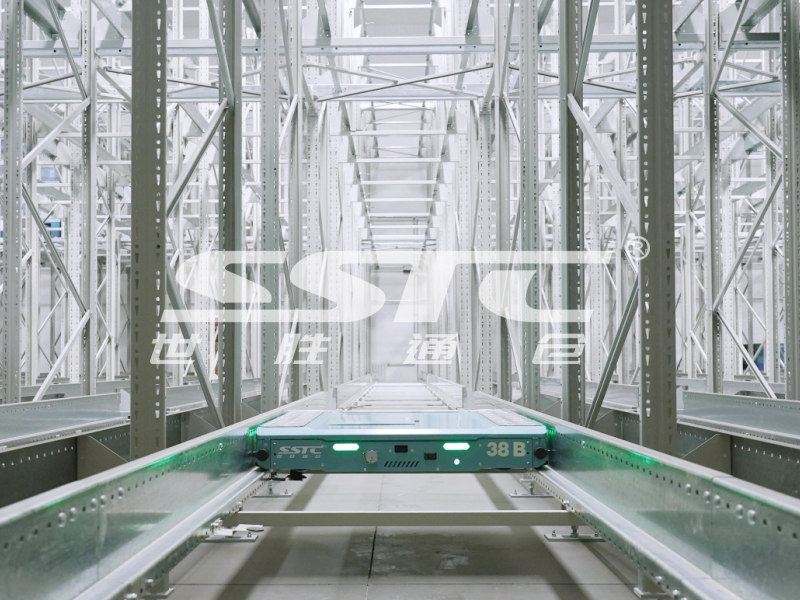
One of the defining characteristics of the Four-Way Pallet Shuttle is its ability to travel in both longitudinal and transverse directions within the storage structure. SSTC describes this multi-directional movement as a way to reduce the restrictions associated with traditional aisle-based storage layouts.
For large pallet inventories, this provides greater freedom when planning storage locations and pallet movements.
Why SSTC Chose a Four-Way Pallet Shuttle Storage Solution
The important part of Qingdao Techain project is not simply that a Four-Way Pallet Shuttle System was used.
The important part is why it was selected for the customer’s requirements.
SSTC approached the project from the perspective of pallet logistics.
The customer needed large-scale storage capacity in a cold environment. The warehouse needed to make efficient use of refrigerated volume. Pallets needed to be stored and retrieved repeatedly. Pada saat yang sama, the amount of manual activity in the low-temperature environment needed to be controlled.
The Four-Way Pallet Shuttle concept offered a way to address these requirements within one storage architecture.
Instead of organizing the warehouse around a large number of conventional aisles, the storage structure can be arranged to create deep storage lanes while shuttle vehicles provide movement within the system.
This changes the relationship between storage density and pallet access.
The objective is not to maximize density at any cost. It is to achieve a useful balance between kapasitas penyimpanan, pallet accessibility and operational requirements.
That distinction is important when designing a cold-chain warehouse.
What Four-Way Movement Means Inside a Cold Storage Warehouse
The term “four-way” can sound like a simple equipment specification, but its practical meaning is more important.
A conventional shuttle movement pattern may be limited by the direction of its track. A four-way shuttle can change its travel direction and move across the storage grid.
For a large storage system, this creates additional possibilities for warehouse layout.
The shuttle can move along a storage lane and then change direction when required. Vertical movement between storage levels can be coordinated with the system architecture and lifting arrangements.
SSTC describes its Four-Way Pallet Shuttle Storage System as a multi-level storage and retrieval architecture using longitudinal and transverse rails, with automated layer-changing supported by vertical lifting equipment.
From the customer’s point of view, the benefit is not the movement itself.
The benefit is what that movement allows the warehouse to achieve.
It can help the storage structure use space more effectively, support deep pallet storage and provide a more flexible route for pallet handling.
High Density Matters More in Refrigerated Warehouses
There is a simple economic reason why storage density matters in cold storage.
The customer is not paying only for steel and warehouse equipment.
The customer is also paying to maintain a controlled-temperature volume.
FAO notes that cold chains are critical to maintaining food quality and safety and that inadequate refrigeration contributes significantly to food loss. Its 2026 information on sustainable cold chains emphasizes the importance of reliable refrigeration infrastructure and appropriate cold-storage systems.
This means that the warehouse itself becomes part of the cold-chain infrastructure.
If more pallet positions can be created within an efficiently planned refrigerated volume, the customer may be able to obtain more value from the facility without continuously increasing its footprint.
That is one reason why high-density pallet storage has particular significance in cold-chain logistics.
For Qingdao Techain project, approximately 100,000 pallet positions created a very large storage requirement. The Four-Way Pallet Shuttle Storage Solution was therefore developed around the need to use the available cold-storage volume effectively.
Automation Should Solve a Warehouse Problem
There is sometimes a tendency to describe warehouse automation using technology first.
Robots. Software. Sensor. Algorithms. Automated movement.
But from a customer’s perspective, these are not the starting point.
The starting point is usually much simpler:
“We have too many pallets.”
“We do not have enough refrigerated space.”
“Our warehouse is becoming difficult to manage.”
“Our operators are spending too much time handling repetitive pallet movements.”
“We need a more predictable way to manage inventory.”
The technology becomes useful only when it addresses one or more of those problems.
This is the approach SSTC took in Qingdao Techain project.
The Four-Way Pallet Shuttle Storage Solution was not selected simply because it was an automated technology. It was selected because its operating characteristics could be matched to the customer’s large-scale pallet storage requirements.
That is an important difference between selling equipment and engineering a warehouse solution.
Working at Approximately -25°C
Low-temperature operation adds another layer of engineering consideration.
A warehouse operating around -25°C requires equipment and operating procedures that are appropriate for the environment.
SSTC’s current product information states that its Four-Way Pallet Shuttle has a specialized low-temperature configuration designed for cold-storage environments down to -30°C.
This gives cold-chain operators a clear reference point when evaluating whether the technology is suitable for a particular temperature range.
Namun, every project still needs to be engineered according to its actual conditions.
Suhu gudang, pallet specifications, beban berat, storage dimensions, operating cycles, required throughput, fire protection requirements and facility layout should all be considered before the final configuration is determined.
This is why SSTC’s role should not be reduced to supplying a shuttle vehicle.
The value lies in matching the Four-Way Pallet Shuttle Storage Solution to the actual warehouse.
The Pallet Is the Starting Point
Cold-chain warehouse automation should ultimately be judged by how well it handles the customer’s pallets.
The pallet contains the customer’s inventory.
The warehouse structure exists to store it.
The shuttle system exists to move it.
The control process exists to know where it is and when it needs to move.
That is why pallet specifications are fundamental to system design.
Load weight, dimensi palet, kualitas palet, product characteristics and storage conditions all influence the engineering process.
For a large project such as Qingdao Techain’s approximately 100,000-position cold-storage system, these details become particularly important because a small assumption repeated across tens of thousands of pallet positions can have a major effect on the overall warehouse operation.
SSTC’s current Four-Way Pallet Shuttle specification supports loads up to 1,500 kg per palet, providing a reference for applications involving substantial palletized goods.
The final design, Namun, should always be based on the customer’s actual pallet and operating requirements.
From Storage Capacity to Pallet Logistics
A cold-storage warehouse should not be viewed only as a collection of pallet positions.
It is a logistics environment.
Pallets enter.
Pallets are stored.
Inventory changes.
Pallets are retrieved.
Pallets leave.
The storage system has to support this cycle consistently.
This is particularly important in cold-chain operations because unnecessary delays can have consequences beyond warehouse productivity. Temperature control remains fundamental to protecting perishable products.
FAO describes cold chain as a temperature-controlled system extending from production through distribution and storage, with reliable temperature management playing a critical role in reducing food loss and maintaining food quality.
The role of a Four-Way Pallet Shuttle Storage Solution is therefore not to replace the cold chain.
It is to provide a more effective pallet-storage and pallet-handling environment inside it.
What Qingdao Techain Project Demonstrates
Itu 2021 Qingdao Techain project provides a useful reference because the scale is substantial.
Approximately 100,000 posisi palet.
Approximately -25°C operating temperature.
A dedicated Four-Way Pallet Shuttle Storage Solution.
And, most importantly, a real cold-chain operation in which the storage system had to work under practical operating conditions.
The project demonstrates how a customer problem can be translated into a warehouse design. The requirement for large pallet capacity led to a high-density storage approach. The low-temperature environment led to the need for an appropriate cold-storage configuration. The scale of pallet inventory led to the need for automated storage and retrieval.
The need to use refrigerated space efficiently supported the selection of a dense storage architecture. The need for practical pallet movement supported the four-way shuttle concept. This is the type of project experience that cannot be understood from a product specification sheet alone. The specification tells you what a system can do. A project shows why those capabilities matter.
Why Real Projects Matter in Cold-Chain Warehouse Planning
When companies evaluate a new cold-storage system, they are rarely looking for technology in isolation. They want to know whether the proposed solution can work in an environment similar to theirs. That is why actual project experience matters.
A system that has been designed around a large pallet inventory and a sub-zero environment provides a more useful reference for customers facing similar requirements. Qingdao Techain project gives SSTC a practical case through which to discuss several questions that frequently arise in cold-storage planning:
How can refrigerated space be used more effectively?
How can a large number of pallets be organized?
How can repetitive pallet movements be automated?
How can a storage system operate in a low-temperature environment?
How should high-density storage be balanced with pallet access?
These are not theoretical questions.
They are warehouse planning questions.
SSTC’s Approach: Start With the Customer’s Constraints
Every cold-storage project has different constraints. One customer may be limited by land. Another may have an existing refrigerated building and want to increase its storage capacity. Another may need to handle tens of thousands of pallets. Another may operate at a particularly low temperature. Another may be facing increasing labor pressure.
For SSTC, the solution should begin with understanding these constraints. The Four-Way Pallet Shuttle Storage Solution can then be configured around the actual requirements. This approach is more useful than starting with a fixed equipment package. It allows the storage structure, shuttle configuration, storage depth, number of storage levels and operational logic to be considered together. The objective is not to make every warehouse look the same. The objective is to make the storage system fit the warehouse.
Designing Around the Existing Cold-Storage Volume
One of the most important questions in cold-storage planning is whether additional capacity must come from additional building area. Sometimes expansion is unavoidable.
But before expanding, it is worth understanding how much of the existing refrigerated volume is actually being used for pallet storage. High-density storage can change the calculation. By using storage height and deep pallet lanes more effectively, the warehouse can potentially create substantially more pallet positions within the same general building envelope.
SSTC’s Four-Way Pallet Shuttle Storage System is designed specifically around this high-density storage principle. The company describes the system as suitable for applications where storage capacity and warehouse-space utilization are important requirements, including cold-chain operations. For cold-storage operators, that makes the technology particularly relevant when the cost of refrigerated space is a major part of the investment.
Why the Video Matters
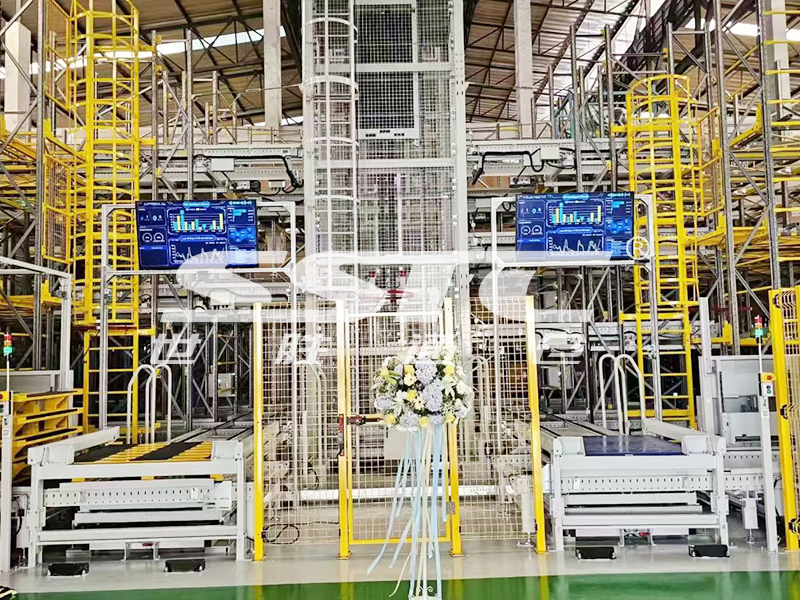
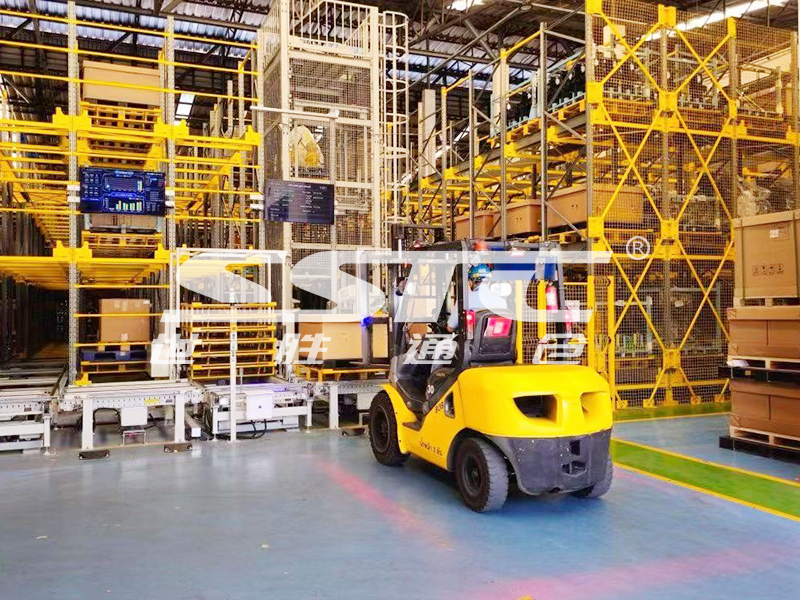
The project video associated with Qingdao Techain case provides something that written specifications cannot. It shows the system as a real warehouse installation. Instead of asking a potential customer to imagine what Four-Way Pallet Shuttle Storage looks like in operation, the video allows them to see the storage structure and shuttle movement directly. This is especially useful for overseas customers who may never have visited the original facility.
For SSTC’s Company News, the video should therefore be treated as part of the case study rather than simply as promotional media. The written article explains the customer’s challenge and the engineering logic. The video provides visual evidence of the solution in operation. Bersama, they tell a much stronger story.
A Practical Reference for Today’s Cold-Chain Customers
Qingdao Techain project was completed in 2021, but the problems it addressed have not disappeared. Cold-storage operators still need to manage expensive refrigerated space. They still need to store large numbers of pallets. They still need to maintain temperature-controlled environments. They still need reliable pallet movement. And they still need to control operational costs as inventory volumes increase.
The technology may continue to develop, but these fundamental warehouse problems remain. That is why a real project from 2021 can still provide useful reference information for cold-chain warehouse planning today. The lesson is not that every cold-storage facility should copy the same design. The lesson is that the storage solution should be selected according to the customer’s actual combination of suhu, pallet volume, available space, storage density and operational requirements.
What Customers Should Consider Before Selecting a Four-Way Pallet Shuttle Storage Solution
A successful Four-Way Pallet Shuttle Storage Solution begins long before equipment enters the warehouse. Customers should first understand their pallet profile.
- What are the pallet dimensions?
- What is the maximum pallet weight?
- What products will be stored?
- What is the required storage temperature?
- How many pallet positions are required?
- How many pallets enter and leave the warehouse each day?
- How much future growth should be considered?
- How much refrigerated space is available?
- What are the existing building dimensions?
These questions help determine whether a Four-Way Pallet Shuttle Storage Solution is appropriate and how it should be configured. For cold-storage projects, temperature is particularly important.
SSTC’s current product information indicates that its specialized low-temperature configuration is designed for environments down to -30°C, while supporting pallet loads up to 1,500 kg. These published specifications can serve as an initial reference, but the final engineering solution should always be based on the actual project.
The Bigger Picture: Cold Chain Is About More Than Temperature
It is easy to think of cold-chain logistics as simply “keeping products cold.” In reality, the cold chain is a sequence of connected activities.
- Products must be cooled.
- They must remain within the appropriate temperature range.
- They must be stored correctly.
- They must be moved efficiently.
- They must be loaded and unloaded without unnecessary delays.
- And inventory must remain available when required.
FAO’s recent cold-chain guidance emphasizes that reliable refrigeration and appropriate cold-chain infrastructure are important to reducing food loss and protecting food quality. Within this larger system, warehouse storage plays a specific role. A Four-Way Pallet Shuttle Storage Solution does not solve every cold-chain issue. It solves a more focused problem:
How can a large quantity of palletized goods be stored and managed efficiently inside a temperature-controlled warehouse?
That clarity is important.
Good warehouse engineering is not about claiming that one system solves everything. It is about solving the right problem well.
SSTC Four-Way Pallet Shuttle Storage for Cold Chain
SSTC’s Four-Way Pallet Shuttle Storage System is designed for high-density pallet storage and automated pallet handling. The system uses four-direction movement to provide flexibility within the storage structure and is listed by SSTC for cold-chain applications.
The current SSTC product information includes several characteristics relevant to cold-storage applications:
- High-density pallet storage
- Four-direction shuttle movement
- Automated pallet storage and retrieval
- Multi-level storage
- Pallet loads up to 1,500 kg
- Positioning accuracy stated at ±2 mm
- Low-temperature configuration down to -30°C
- Application in cold-chain logistics
These specifications should not be viewed separately.
- Their value comes from how they work together within an actual warehouse design.
- For a customer with a large pallet inventory, high-density storage can help make better use of refrigerated space.
- For a customer operating in a sub-zero environment, the low-temperature configuration becomes relevant.
- For a customer dealing with repetitive pallet movement, automated storage and retrieval becomes relevant.
- For a customer with complex storage requirements, four-way movement provides additional layout flexibility.
That is the practical logic behind the solution.
A Case Study Built Around the Customer’s Needs
Looking back at Qingdao Techain project, the sequence is relatively straightforward.
- The customer needed a large cold-storage capacity.
- The operating environment was approximately -25°C.
- The required capacity was approximately 100,000 posisi palet.
- The warehouse needed to manage palletized goods at scale.
- Manual handling alone would not provide the most practical long-term approach for such an environment.
SSTC therefore developed and implemented a Four-Way Pallet Shuttle Storage Solution around those requirements. The result was not simply a larger storage rack. It was a pallet-storage environment designed around the customer’s cold-chain logistics requirements. That distinction is at the heart of SSTC’s approach.
Kesimpulan: Solve the Cold-Storage Problem, Not Just the Storage Problem
The most useful lesson from Qingdao Techain project is simple. A cold-storage warehouse should not be designed around equipment alone. It should be designed around the goods, the pallets, the temperature, the available space and the way the warehouse actually operates.
In this project, approximately 100,000 pallet positions had to be accommodated in an environment operating at approximately -25°C. SSTC’s answer was a Four-Way Pallet Shuttle Storage Solution designed around high-density pallet storage and automated pallet movement. The project shows what happens when warehouse automation starts with the customer’s actual constraints. The result is not technology for technology’s sake.
It is a storage solution with a clear purpose: to help cold-chain operators make better use of refrigerated space while managing large volumes of palletized goods more efficiently. For companies planning a new cold-storage facility, expanding an existing refrigerated warehouse or evaluating higher-density pallet storage, Qingdao Techain project provides a useful reference point.
The right question is not simply:
“Which storage equipment should we buy?”
A better question is:
“What storage system best fits our pallet volume, suhu, space and daily logistics requirements?”
That is where a properly engineered Four-Way Pallet Shuttle Storage Solution for Cold Storage can make a difference.
Explore SSTC’s Four-Way Pallet Shuttle Storage Solution
Learn more about SSTC’s Four-Way Pallet Shuttle Storage System, including its high-density storage concept, four-direction movement, pallet handling capabilities and low-temperature application.
SSTC Four-Way Pallet Shuttle Storage
For more information about SSTC Intelligence Technology and its warehouse solutions:
Related Cold-Chain Resources
For additional background on the importance of cold-chain infrastructure and temperature-controlled storage, see:
FAO – Cooling the chain, cutting the waste
FAO – From farm to fork: how to keep food fresh and healthy, sustainably
These resources provide broader context on why reliable cold-chain infrastructure, refrigeration and appropriate storage practices matter for food quality, safety and loss reduction.
Pertanyaan yang Sering Diajukan
1. What is a Four-Way Pallet Shuttle Storage Solution for Cold Storage?
A Four-Way Pallet Shuttle Storage Solution for Cold Storage is a high-density automated pallet storage system designed for temperature-controlled warehouses. The shuttle vehicle can travel in multiple directions within the storage structure, allowing pallets to be stored and retrieved automatically while making efficient use of warehouse volume.
2. Why is Four-Way Pallet Shuttle Storage suitable for cold storage?
Cold-storage facilities often face limited refrigerated space, large pallet inventories and demanding low-temperature working conditions. Four-Way Pallet Shuttle Storage can address these requirements through high-density pallet storage and automated pallet movement. SSTC’s current system information identifies cold chain as an application and provides a low-temperature configuration for environments down to -30°C.
3. Can Four-Way Pallet Shuttle Storage handle large pallet inventories?
Ya. The system is designed for high-density pallet storage and can be configured for large storage projects. Qingdao Techain project delivered by SSTC in 2021 was designed around approximately 100,000 posisi palet, demonstrating the applicability of the solution to large-scale cold-storage requirements.
4. What temperature can SSTC’s Four-Way Pallet Shuttle operate at?
SSTC’s current product information states that its specialized low-temperature configuration is designed for cold-storage environments down to -30°C.
For an individual project, the actual temperature range, equipment configuration, pallet characteristics and operating conditions should be reviewed during engineering.
5. What pallet weight can the SSTC Four-Way Pallet Shuttle handle?
SSTC currently states a maximum pallet load of up to 1,500 kg for its Four-Way Pallet Shuttle system.
The actual project design should be based on the customer’s pallet dimensions, load distribution and operating requirements.
6. How does Four-Way Pallet Shuttle Storage improve cold-storage space utilization?
The system uses deep-lane, high-density storage and four-direction shuttle movement to reduce dependence on conventional aisle arrangements. This allows the storage structure to make more effective use of the available refrigerated volume.
7. Does Four-Way Pallet Shuttle Storage reduce manual work in cold warehouses?
It can significantly automate repetitive pallet storage and retrieval activities. This can reduce the amount of routine pallet-handling work that needs to be performed manually inside low-temperature storage areas.
8. Is Four-Way Pallet Shuttle suitable for frozen food warehouses?
Ya. SSTC identifies cold chain as one of the applicable industries for its Four-Way Pallet Shuttle Storage System, and its current product information includes a specialized low-temperature configuration for cold-storage applications.
9. Is Qingdao Techain project a real SSTC cold-storage project?
Ya. According to SSTC’s project information, SSTC Intelligence Technology completed a Four-Way Pallet Shuttle Storage project for Qingdao Techain in 2021, with approximately 100,000 pallet positions and an operating temperature of around -25°C.
10. What information should a customer provide when planning a Four-Way Pallet Shuttle Storage Solution for Cold Storage?
Important information includes warehouse dimensions, operating temperature, dimensi palet, maximum pallet weight, required pallet positions, inbound and outbound pallet volumes, storage duration, building conditions and future capacity requirements.
The more accurately these conditions are defined, the more precisely SSTC can develop a storage solution around the customer’s actual operation.
About SSTC Intelligence Technology
Teknologi Intelijen SSTC (Shandong) Bersama., Ltd.
- Situs web: www.sstc-storage.com
- E-mail: [email protected] | [email protected]
- Ada apa:+86-13671613032
For cold-chain warehouse projects, pallet storage requirements and Four-Way Pallet Shuttle Storage Solution planning, please contact SSTC Intelligence Technology.