
 AS/RS & Solusi Gudang Otomatis | Intelijen SSTC

AS/RS untuk Makanan & Pergudangan Minuman becomes more valuable when a warehouse is viewed not simply as a room full of pallet positions, but as a controlled flow of products. A food manufacturer may have thousands of pallets in storage and still experience a shortage of usable capacity. A beverage distributor may add more rack positions and still see trucks waiting at the loading dock. Even with accurate inventory records, the warehouse can lose time if the pallet needed for today’s shipment is difficult to locate or retrieve.
These problems are not always caused by insufficient storage equipment. They often result from a mismatch between storage capacity, pallet movement, inventory policy and operational demand. For food and beverage companies, this mismatch can become more serious because the warehouse must handle high pallet volumes, changing SKU profiles, seasonal demand, inventory rotation requirements and limited floor space at the same time.
SSTC approaches automated pallet warehousing from this broader perspective. The objective is not simply to place more pallets inside a building, but to create a storage environment in which pallets can be received, identified, stored, located, retrieved and dispatched according to a controlled material-flow strategy.
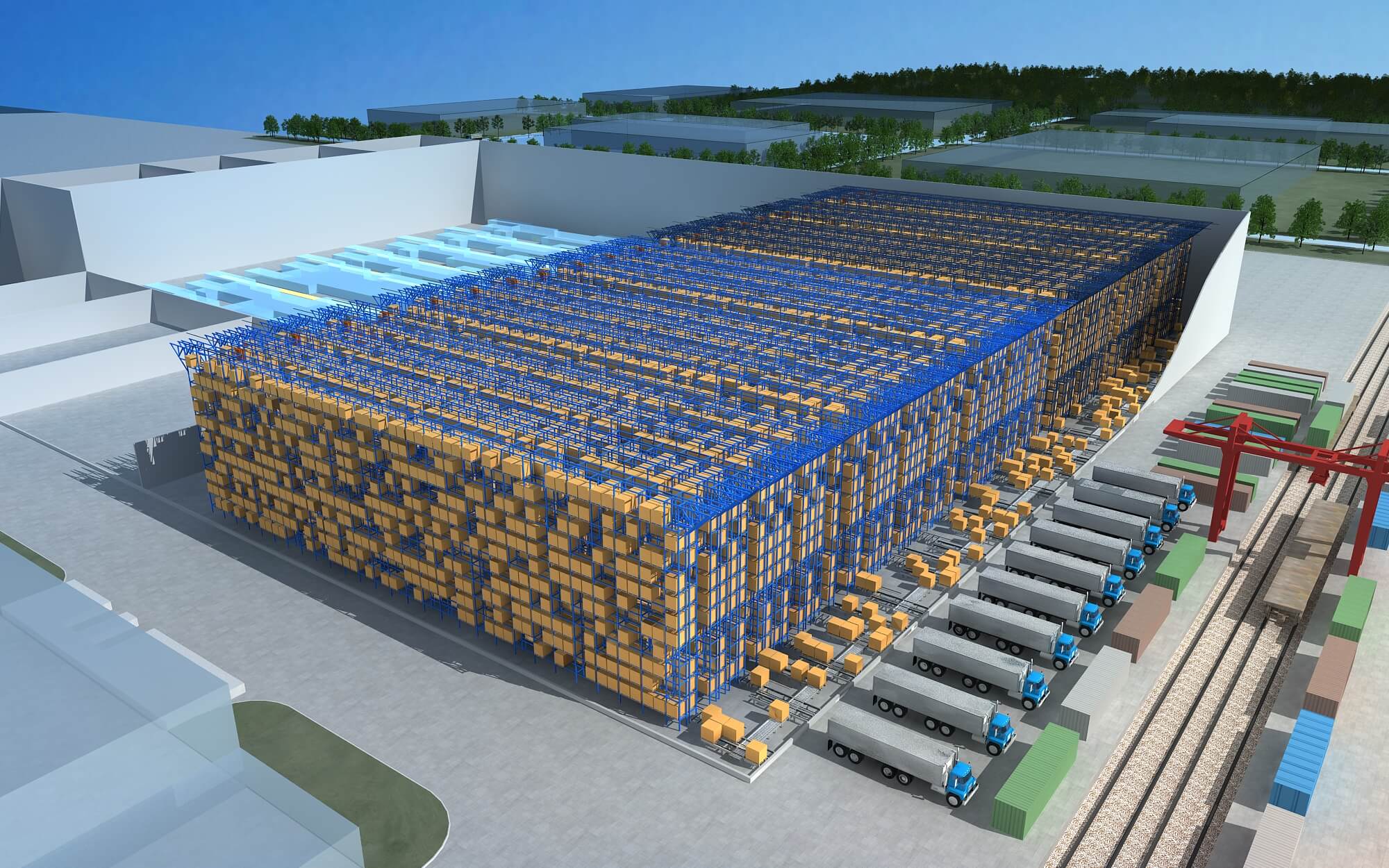
The Warehouse That Looks Full May Not Actually Be Full
Storage capacity is one of the easiest warehouse figures to misunderstand. A facility may have 20,000 posisi palet, but that does not mean all 20,000 positions can be used equally efficiently. Actual performance depends on how the positions are arranged, how products are allocated, how frequently pallets move, how much buffer space is required, how inventory is rotated and what happens during the busiest periods of the year.
A warehouse designed around average daily activity can behave very differently during a promotion, holiday season or production surge. This issue is particularly visible in food and beverage distribution, where demand and SKU turnover can change quickly.
A recent 2026 study, Simulation-Based Assessment of Warehouse Logistics: A Case Study in Beverage Distribution, examined a beverage-distribution operation by considering seasonal demand, product turnover, storage allocation, receiving efficiency, handling distance and warehouse KPIs. The study used simulation to compare alternative warehouse configurations and storage policies rather than assuming that one static layout would perform equally well throughout the year.
The practical lesson is clear: warehouse capacity should be evaluated together with warehouse behavior. Twenty thousand pallet positions do not automatically equal twenty thousand equally useful pallet positions.
Food & Beverage Warehousing Has a Different Rhythm
A warehouse storing industrial components may experience relatively stable demand, while food and beverage operations often face more frequent changes. A product may move slowly for several weeks and then become a fast mover because of a promotion. Beverage demand may change with the season, and a new SKU can suddenly become more important than an established product. At the same time, production may release a large number of finished-goods pallets in a short period while outbound demand follows a different schedule.
Consider a typical sequence: production releases 500 pallets in one shift, the warehouse receives and identifies them, existing inventory is scheduled for dispatch, outbound orders arrive and forklifts move between receiving, storage and shipping areas. The warehouse may have enough rack positions, yet congestion still develops because storage capacity and material-flow capacity are different things.
This is why automated pallet storage should be evaluated as a logistics system rather than simply as a type of racking.
What Should an AS/RS Actually Solve?
When a food or beverage company begins discussing AS/RS, the first question should not be, “How many pallets can the system store?” A more useful assessment asks how many pallets enter and leave the warehouse during the busiest period, how long receiving can remain buffered before congestion begins, which SKUs require the fastest retrieval, which pallets should be stored deeply, how inventory rotation will be controlled, where pallets will wait between storage and shipping and what will happen if the business grows by 30%.
These questions shift the discussion from equipment to warehouse behavior. That is where SSTC’s role becomes more relevant. SSTC describes itself as an intelligent warehousing and logistics automation equipment manufacturer and intralogistics system integrator, with more than 20 years of experience. Its stated product scope includes storage racks, Antar-Jemput Radio, Antar-Jemput Empat Arah, konveyor, lifters, Gudang AS/RS, pallet stacker cranes and WCS/WMS-related systems.
This broader system perspective matters because an automated warehouse is rarely just a rack with a robot inside it.
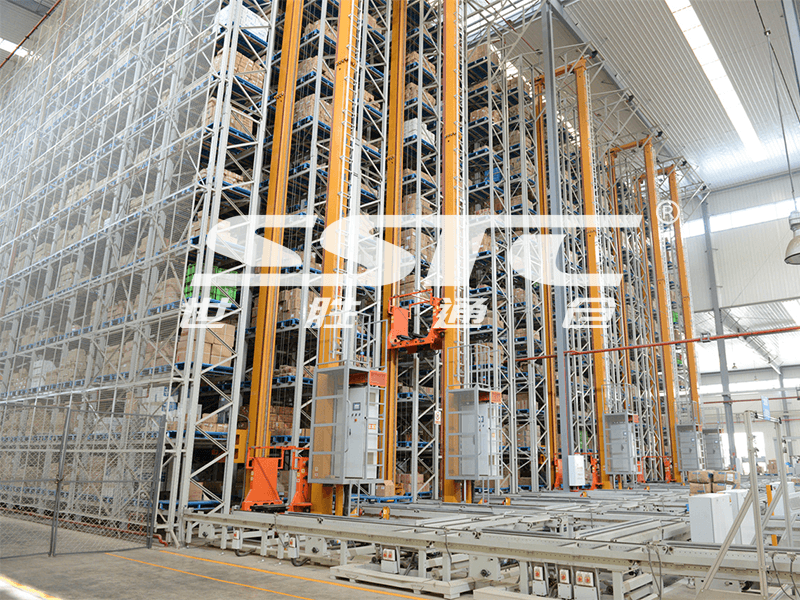
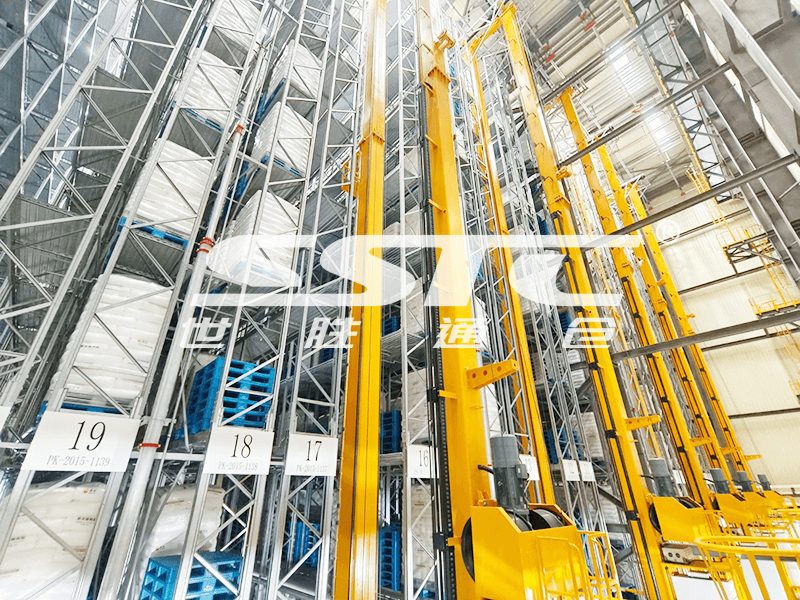
The Pallet Is the Unit That Connects Production With Distribution
Food and beverage logistics often revolves around one physical unit: the pallet. It connects production, penyimpanan, inventory, order fulfillment and shipping. If pallet handling is efficient, the warehouse can maintain a relatively predictable flow. If pallet handling becomes disorganized, problems spread quickly.
A pallet may wait for identification, a storage location, a forklift or an outbound staging position. It may occupy receiving space, block another pallet, become difficult to locate or be retrieved too early or too late. None of these problems necessarily means that the company needs a larger warehouse. Sometimes the company needs a better way to control pallet movement.
This is one of the strongest reasons to evaluate AS/RS at the process level.
Where Automation Can Make a Practical Difference
1. Separating Storage From Forklift Travel
In a conventional pallet warehouse, forklifts often unload trucks, transport pallets, enter rack aisles, retrieve products, deliver pallets to staging and return to storage. As volume increases, these activities compete for the same floor space and create more opportunities for congestion.
An automated pallet-storage system can move some repetitive internal transport away from forklift traffic. This does not mean forklifts disappear. Instead, the warehouse can be designed so that manual equipment operates at defined interfaces while automated equipment performs predictable storage and retrieval movements inside the system.
The objective is not to replace every forklift. It is to use forklifts where human flexibility is useful and automation where repetitive movement is predictable.
2. Increasing Storage Density Without Simply Adding More Floor Area
Land is expensive, building expansion takes time and many existing warehouses cannot easily increase their floor area. One alternative is to make better use of the volume already available.
SSTC’s current portfolio includes AS/RS Warehouse, Antar-Jemput Pallet Empat Arah, Shuttle Carrier and Shuttle Stacker Crane solutions. The Four-Way Pallet Shuttle is particularly relevant to high-density pallet storage because the shuttle can travel longitudinally and transversely within the storage structure, with vertical movement coordinated through lifts. SSTC’s product information also describes automated pallet handling, WMS/WCS communication and multi-directional movement within high-density storage racks.
The important point is not that “four-way” sounds more advanced. Multi-directional movement can change how the storage matrix is designed. Instead of treating every storage lane as an isolated aisle, the system can use a more interconnected three-dimensional storage arrangement, which can be valuable where storage density is a major constraint.
3. Giving Inventory Location a Physical Logic
Inventory accuracy is often discussed as a software issue, but it is also a physical issue. If a system records that a pallet is in Location A while the pallet is physically somewhere else, the software cannot solve the underlying problem.
Automated storage can help establish a stronger relationship between pallet identity, storage location and movement instruction. When warehouse management and warehouse control systems communicate with the storage equipment, the physical movement of pallets becomes part of the digital inventory process.
SSTC’s Four-Way Shuttle documentation describes WMS/WCS communication and the use of identification technologies such as RFID and barcodes for automated identification and intensive storage. This is particularly important when a warehouse contains many similar pallets, such as the same bottle size in different flavors, package configurations or production batches.
The challenge is not merely knowing that 1,000 pallets exist. It is knowing which 1,000 pallets they are, where they are and which ones should move next.
4. Supporting High-Density Storage While Maintaining Access
Deep-lane storage can increase density, but deeper storage can also make selective access more complicated. This creates a basic engineering trade-off between density and accessibility.
The correct answer depends on the inventory profile. If a warehouse stores large quantities of the same SKU and moves pallets in relatively predictable patterns, deep storage can be highly attractive. If thousands of SKUs have low quantities and highly variable access frequencies, a different architecture may be more appropriate.
Misalnya, high-volume homogeneous products may favor deeper storage, while high-SKU environments may require different allocation logic. High-throughput applications may prioritize retrieval cycles, limited building footprints may prioritize volumetric density and temperature-controlled warehouses may require specialized equipment and environmental considerations.
The best system is the one that fits the movement pattern.
5. Preparing for Peak Demand Rather Than Pretending the Peak Does Not Exist
Average throughput is easy to calculate, but peak throughput is what causes operational trouble. A warehouse might average 800 pallet movements per day and then need to handle 1,500 during a promotion or seasonal demand period. Those additional movements affect receiving, penyimpanan, retrieval, buffer areas, konveyor, lift, memanggungkan, loading, labor and vehicle scheduling.
The warehouse therefore needs to be evaluated as a connected system. This is consistent with recent beverage-warehouse research, which considered seasonal demand and turnover patterns when evaluating storage policies and warehouse configurations.
For an AS/RS project, the peak is not a footnote. It is one of the numbers that should influence the architecture.
What Happens If You Automate the Wrong Bottleneck?
Automation does not automatically eliminate bottlenecks; it can move them. Suppose an AS/RS can retrieve 100 pallets per hour, but the outbound staging area can process only 70 pallets per hour. The AS/RS is not necessarily the problem. The interface is.
The same issue can occur upstream if the storage system can receive pallets faster than the production line can provide correctly identified pallets. Kalau begitu, the upstream process is the constraint.
A good AS/RS design should therefore evaluate the complete chain: Receiving → Identification → Buffer → Storage → Retrieval → Staging → Shipping. Equipment must be sized as part of that chain, not independently.
Why Pallet Quality Matters More Than Many Buyers Expect
Automated storage equipment depends on predictable physical characteristics. If pallets are damaged, distorted, overloaded or inconsistent, automated handling becomes more difficult. Food and beverage companies may face pallet-quality variations caused by different suppliers, packaging formats, load heights, moisture, repeated handling, damaged boards and inconsistent wrapping.
An automation project should therefore consider pallet standards before final equipment selection. The question is not only whether the shuttle can carry 1,500 kg, but also whether the customer’s pallets are consistently suitable for the system.
SSTC’s Four-Way Shuttle product information specifies a maximum loading capacity of 1,500 kg for its standard configuration and describes different environmental configurations. This specification should not be interpreted as a universal answer. Actual engineering should still consider pallet type, load distribution, dimensions, rack design and operating conditions.
System design should come before equipment selection.
Food Warehouses Also Have a Temperature Question
Not every food warehouse is a cold store. Some handle ambient products, chilled products, frozen products or mixed-temperature inventory. This distinction affects equipment design.
A frozen-food operation may impose additional requirements on equipment materials, battery performance, sensors, lubrication, electrical components, condensation management, maintenance procedures and operator access. SSTC’s Four-Way Shuttle information identifies a special cold-type configuration for low-temperature applications and lists working-environment ranges for its standard and cold configurations.
An AS/RS should therefore be specified around the actual operating environment rather than a generic product brochure.
AS/RS Does Not Mean One Machine
When people say “AS/RS,” they sometimes imagine a single robot. In reality, a pallet AS/RS can involve multiple layers of equipment and control, including storage racks, shuttle robots, stacker cranes, lift palet, konveyor, transfer equipment, barcode or RFID identification, warehouse control, warehouse management, safety systems, charging systems, monitoring and diagnostics.
SSTC’s current system portfolio reflects this broader approach, covering Four-Way Shuttle, Shuttle Carrier, Shuttle Stacker Crane, AS/RS Warehouse and related storage infrastructure.
The performance of an automated warehouse depends on how these components work together. A fast shuttle cannot compensate for an undersized conveyor, a high-capacity lift cannot compensate for poor outbound staging and a sophisticated WCS cannot compensate for incorrect warehouse logic.
System balance matters.
Antar-Jemput Empat Arah: Where It Makes Sense
SSTC’s Four-Way Pallet Shuttle is designed for high-density pallet storage and automated pallet handling. The company describes the system as suitable for applications including FMCG, obat-obatan, manufaktur, retail and cold chain.
For food and beverage applications, the technology can be attractive when the warehouse needs high storage density, pallets are relatively standardized, deep-lane storage is practical, multiple pallet movements must occur within the storage matrix, the customer wants to reduce dependence on forklifts inside storage aisles and the building volume can support a high-density automated layout.
Namun, another system may make more sense if the warehouse has very high individual-pallet selectivity, limited storage depth or a different throughput pattern. A stacker-crane-based AS/RS or another architecture may deserve consideration.
That is why SSTC’s broader product portfolio matters. The project should determine the technology rather than forcing every customer into one solution.
Shuttle Stacker Crane: When Vertical Throughput Matters
A shuttle-based system is not the only way to build a high-density automated pallet warehouse. In some applications, a stacker crane can provide a strong combination of vertical utilization and automated pallet handling, particularly when warehouse height is significant, throughput requirements are high, storage locations need defined access patterns, vertical space is a major asset and the building layout supports crane aisles.
SSTC lists Shuttle Stacker Crane Storage as one of its system solutions alongside Four-Way Shuttle and Shuttle Carrier systems. The right decision should therefore be based on the project’s numbers rather than on which technology sounds newer.
When AS/RS May Not Be the Right Answer
AS/RS is not automatically the best investment for every food warehouse. A conventional or semi-automated system may remain sensible when storage volume is small, SKU turnover is highly irregular, building height is insufficient, pallet quality is inconsistent, throughput does not justify automation, future demand is uncertain or the operation requires unusually high manual flexibility.
There can also be cases where a hybrid system is better. Misalnya, automated high-density storage + conventional picking + manual staging may be more appropriate than attempting to automate every warehouse activity.
This is not a weakness of AS/RS. It is simply good engineering. The objective is to automate the processes where automation creates measurable value.
A Better Way to Start an AS/RS Project
Before selecting equipment, a food or beverage company should gather information about products, inventory, flow, the building and the business.
Product information
- Number of SKUs
- Pallet dimensions
- Pallet weight
- Load height
- Packaging type
- Temperature requirements
Inventory information
- Average inventory
- Maximum inventory
- SKU turnover
- Slow-moving products
- Fast-moving products
- Seasonal products
Flow information
- Average inbound pallets/day
- Peak inbound pallets/day
- Average outbound pallets/day
- Peak outbound pallets/day
- Required retrieval response time
Building information
- Available floor area
- Ketinggian yang jelas
- Column positions
- Existing structures
- Loading dock location
- Fire and safety requirements
Business information
- Expected growth
- Expansion plans
- Operating shifts
- Labor availability
- Target return on investment
This information turns an abstract automation discussion into an engineering problem that can be modeled.
The Question Is Not “How Much Can We Store?”
The more useful question is: How much useful throughput can the warehouse generate from the space, equipment and labor available?
A warehouse with 30,000 pallet positions may perform worse than a 20,000-position warehouse if the first facility has poor flow. Juga, the warehouse with the highest storage density may not be the best warehouse if retrieval performance is insufficient.
There is always a balance between density, accessibility, throughput, investment and flexibility. The job of warehouse engineering is to find the balance appropriate for the business.
What SSTC Brings to the Discussion
SSTC states that it has more than 20 years of experience in intelligent warehousing and logistics automation, with a focus on storage-system design, system integration and manufacturing of warehouse automation equipment. Its website currently presents a portfolio covering automated storage, Antar-Jemput Empat Arah, Shuttle Carrier, Shuttle Stacker Crane, racking-supported buildings and other pallet-storage technologies.
The company’s website also highlights a professional team of more than 600 people, a 90,000 m² factory area, more than 24 automated production lines and more than 4,000 shuttle cars running. These are company-reported figures and should be understood as such.
For a food and beverage customer, the value of this capability is not simply access to a particular machine. It is the ability to discuss the warehouse as a system, including storage structure, automated movement, vertical transportation, conveying, control, inventory, safety and future capacity.
The final system should reflect the customer’s actual operating model.
A More Useful Definition of a “Smart Warehouse”
The industry has used the phrase “smart warehouse” for years, but a warehouse does not become smart simply because it contains robots. A useful automated warehouse should be able to answer practical questions: Where is the pallet? Why is it stored there? When should it be retrieved? What happens when demand doubles? What happens when one storage area becomes unavailable? Can the warehouse identify the correct pallet without unnecessary searching? Can inbound and outbound flows remain balanced? Can the company understand where its capacity is actually being consumed?
These operational questions are more important than whether a warehouse looks technologically impressive.
The Food & Beverage Warehouse of the Future May Be Less About Robots
The most important part of an automated warehouse is not necessarily the robot. It is the logic behind the movement. The robot is the physical mechanism, the warehouse design is the structure, the WMS/WCS is part of the decision-making layer, operational rules determine what should happen and data tells the system what is happening.
When these elements are designed together, automation can create something more valuable than higher storage density: predictable pallet flow. For food and beverage companies, predictable flow can support production planning, inventory control, order fulfillment and distribution.
That is where AS/RS becomes more than a storage technology. It becomes part of the operating model.
From Pallet Storage to Modern Food & Beverage Intralogistics
The next generation of food and beverage warehouses will not necessarily be the warehouses with the most automation. They will be the warehouses where automation is applied to the right problems.
For some companies, the priority will be storage density. Untuk orang lain, it will be peak throughput, reduced forklift travel, better inventory-location control or reliable operation in demanding temperature-controlled environments. Some will need a combination of these requirements.
That is why SSTC’s approach should begin with the customer’s pallet flow rather than with a predefined machine. The question should not be, “Which AS/RS should we buy?” It should be, “What does our warehouse need to accomplish, and which automation architecture can accomplish it reliably?”
Once that question is answered, equipment selection becomes much easier.
How SSTC Can Help
SSTC provides automated storage and high-density intralogistics solutions for palletized goods, including:
- AS/RS Warehouse Solutions
- Penyimpanan Antar-Jemput Pallet Empat Arah
- Penyimpanan Pengangkut Antar-Jemput
- Penyimpanan Derek Penumpuk Antar-Jemput
- Racking-Supported Buildings
- Radio Shuttle Storage
- Conveying and lifting equipment
- WMS/WCS-related automation systems
You can explore SSTC’s complete system portfolio on the company’s official website: SSTC Intelligent Intralogistics & High-Density AS/RS Solutions
For high-density pallet applications, see: SSTC Four-Way Pallet Shuttle Storage
For companies evaluating different automated pallet-storage architectures, SSTC’s broader high-density storage portfolio can also be reviewed before determining which technology best matches the warehouse’s operational requirements.
Final Thought: Don’t Start With the Machine
Food and beverage logistics makes warehouse problems visible very quickly. A seasonal sales peak exposes insufficient throughput, a new SKU range exposes poor storage allocation, a new production line exposes insufficient finished-goods capacity and a growing distribution network exposes inefficient pallet handling.
A larger building does not necessarily solve these problems, and neither does automation by itself. A more useful approach is to start with the pallet: where it enters, where it waits, where it should be stored, how often it moves, when it should be retrieved, where it goes next and what happens when demand changes.
Once those questions are answered, the warehouse begins to look different. The rack is no longer just a rack, the shuttle is no longer just a robot and the conveyor is no longer just a conveyor. Together, they become part of a controlled material-flow system.
That is the real role of AS/RS untuk Makanan & Pergudangan Minuman: not simply storing more pallets, but moving the right pallet to the right place at the right time with a warehouse designed around the way the business actually operates.
Frequently Asked Questions
What is AS/RS for Food & Pergudangan Minuman?
AS/RS untuk Makanan & Beverage Warehousing is an automated storage and retrieval solution designed to manage palletized food and beverage products through controlled receiving, identification, penyimpanan, retrieval and dispatch. It can connect storage equipment with warehouse management and control systems, helping companies organize pallet locations, reduce unnecessary forklift travel, improve inventory visibility and create a more predictable flow of finished goods.
Can AS/RS handle high-volume pallet storage?
Yes. AS/RS is suitable for operations where large numbers of standardized pallets need to be stored and retrieved repeatedly. A system may combine high-density racking with automated shuttles, stacker cranes, konveyor, lifts and warehouse control systems. Namun, storage volume alone should not determine the design. Inbound and outbound throughput, peak demand, SKU turnover, dimensi palet, load weight and staging capacity must also be considered.
Is Four-Way Pallet Shuttle suitable for food and beverage warehouses?
Four-Way Pallet Shuttle can be a strong option for food and beverage warehouses that require high-density pallet storage and efficient movement within deep storage lanes. It is particularly suitable for relatively standardized pallets and predictable storage patterns. Namun, it is not automatically the best solution for every warehouse. SKU characteristics, pallet turnover, required throughput, storage depth, building height, temperature conditions and inventory-access requirements should be evaluated before selecting the final configuration.
Can AS/RS support seasonal demand peaks?
Yes, provided the system is designed around peak rather than average throughput. Food and beverage warehouses may experience significant demand changes during holidays, promotions or seasonal sales periods. During these peaks, the limiting factor may not be the number of pallet positions but the capacity of receiving, retrieval, konveyor, lifts and outbound staging to work together. An AS/RS project should therefore evaluate peak inbound and outbound movements, buffer requirements and retrieval priorities.
How should a food and beverage company choose an AS/RS system?
The company should begin with its operational requirements rather than selecting a particular machine first. Important factors include the number of SKUs, average and maximum inventory, pallet dimensions and weight, product turnover, inbound and outbound throughput, peak-season demand, required storage density, building height, temperature conditions and future growth. The company can then compare technologies such as Four-Way Pallet Shuttle, Shuttle Carrier and Stacker Crane systems to find the appropriate balance between density, accessibility, throughput, flexibility and investment.
Tentang Intelijen SSTC
SSTC is an intelligent warehousing and logistics automation equipment manufacturer and intralogistics system integrator focused on automated storage, high-density pallet storage and warehouse automation solutions.
For food and beverage manufacturers, distributors, 3PL operators and other pallet-intensive businesses, SSTC can provide system solutions designed around storage capacity, pallet flow, throughput, building conditions and future operational requirements.
Website: www.sstc-storage.com
E-mail: [email protected] | [email protected]
Ada apa: +86-13671613032
SSTC — Intelligent Intralogistics & High-Density AS/RS Solutions
Industri & Research References
Research Reference 1 — Beverage Distribution
Simulation-Based Assessment of Warehouse Logistics: A Case Study in Beverage Distribution, Procedia Computer Science, Volume 277, 2026, pp. 3531–3539.
The study examines a beverage-distribution warehouse and evaluates seasonal demand, turnover-based storage allocation, warehouse layouts, handling distances and operational KPIs through simulation. It is a useful reference for understanding why warehouse design should be based on actual operating patterns rather than storage capacity alone.
Read the beverage warehouse research on ScienceDirect
Research Reference 2 — Google Search / AI Search Content Guidance
Google Search Central’s current guidance states that AI features such as AI Overviews and AI Mode continue to rely on foundational SEO and emphasizes valuable, non-commodity, people-first content with a unique point of view.
Google Search Central — Optimizing for generative AI features