
 COMO/RS & Soluciones de almacén automatizado | Inteligencia CSST

The cold chain industry is entering a period where warehouse capacity has become one of the most important factors affecting business growth. For many food manufacturers, frozen food distributors, pharmaceutical logistics providers and third-party cold storage operators, the limitation is no longer simply refrigeration capability. The bigger challenge is how to store increasing volumes of palletized goods while controlling investment costs, maintaining inventory accuracy and improving the utilization of expensive temperature-controlled space. AS/RS For Palletized Cargo is attracting increasing attention because it provides a different approach to cold storage development: instead of continuously expanding warehouse buildings, companies can improve the efficiency of existing or newly planned facilities through automated pallet storage and retrieval.
In the past, many cold storage projects focused primarily on refrigeration technology, insulation performance and building design. These elements remain essential, but modern warehouse planning requires a broader perspective. A cold warehouse is not only a place where products are kept at a controlled temperature. It is a logistics infrastructure that must support production schedules, distribution networks, customer service requirements and long-term business expansion. When storage capacity becomes insufficient, companies often face difficult choices: construct a new cold warehouse, lease additional external storage space, or redesign the internal storage system to achieve higher capacity.
Each option has different financial and operational implications. Constructing new refrigerated buildings requires substantial capital investment and increases long-term energy consumption. Outsourcing storage may provide temporary flexibility but can reduce operational control. Improving storage density through an intelligent automated system can offer another path by allowing companies to create more usable pallet capacity within the same building footprint.
This change in thinking is why AS/RS For Palletized Cargo is becoming more than an automation project. For many warehouse decision-makers, it is becoming part of a long-term cold-chain investment strategy.
According to market research from organizations studying cold chain development, the global cold chain sector continues to expand due to increasing demand for temperature-sensitive food distribution, pharmaceutical logistics and international supply networks. The growth of this sector is also increasing pressure on warehouse operators to improve capacity, efficiency and reliability. Research from Mordor Intelligence identifies market expansion drivers including food safety requirements, pharmaceutical distribution growth and increasing demand for temperature-controlled logistics infrastructure.
Sin embargo, market growth also creates a practical challenge: more products require cold storage, but building and operating refrigerated space is becoming increasingly expensive.
For warehouse owners and logistics managers, the question is shifting from:
“How can we build a larger cold warehouse?”
a:
“How can we make every cubic meter of refrigerated space generate more operational value?”
This is the business environment where automated pallet storage solutions are gaining attention.
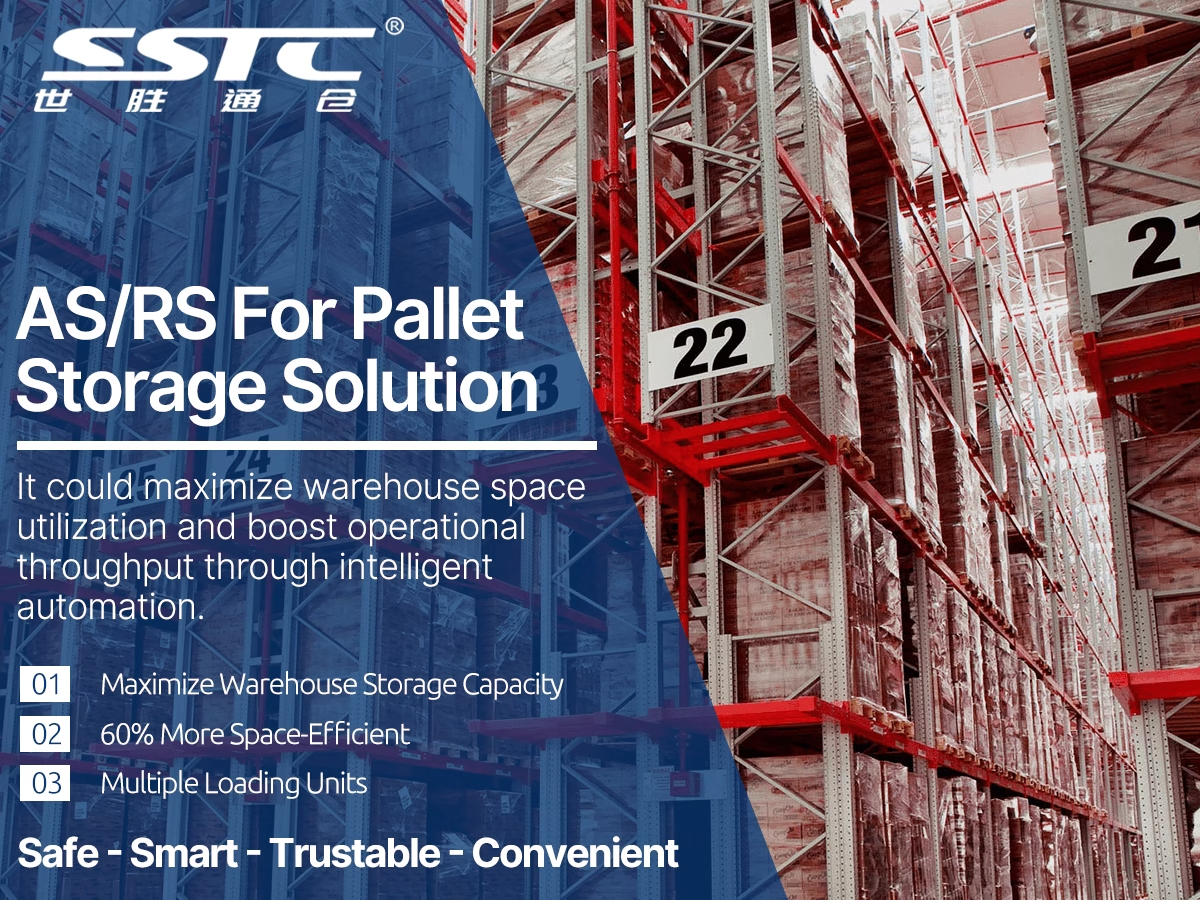
The Real Challenge in Cold Storage Is Not Only Temperature Control, but Space Utilization
A traditional cold storage warehouse usually relies on forklift-based pallet handling combined with selective pallet racks or other conventional storage layouts. This approach remains suitable for many applications because it provides direct pallet accessibility and operational familiarity. Sin embargo, as warehouse capacity requirements increase, companies are discovering that a large amount of refrigerated volume is dedicated not to products, but to movement space.
Unlike ordinary warehouses, cold storage facilities have a unique economic characteristic: unused space still creates operating costs. The building envelope, refrigeration system and energy consumption are designed to maintain the entire internal environment, whether every cubic meter is occupied by inventory or not.
This means warehouse density has a direct relationship with business performance.
A warehouse with poor space utilization may require expansion earlier than expected. Expansion, however, is not always easy. Land availability, construction costs, power requirements and refrigeration investment can make additional capacity extremely expensive. In regions where cold-chain infrastructure is already highly developed, finding suitable expansion space can become a major challenge.
This is why many companies are evaluating whether their existing warehouse volume can be used more effectively.
The objective is not simply to place more pallets into a building. A successful cold storage strategy must balance several factors:
- required pallet capacity;
- inbound and outbound throughput;
- inventory rotation requirements;
- product traceability;
- disponibilidad de mano de obra;
- energy management;
- future business growth.
An automated storage system provides a method to improve this balance by combining high-density storage design with controlled pallet movement.
Research published in Applied Thermal Engineering has explored the relationship between logistics activities and energy management in industrial cold storage environments. The study highlights that cold storage performance is influenced not only by refrigeration technology but also by operational factors related to warehouse activity.
Although refrigeration energy savings depend on many project-specific factors, this research supports an important industry direction: cold storage design should consider logistics operations and temperature management together rather than treating them as separate systems.
For companies planning future cold storage facilities, this means storage architecture has become an important part of overall warehouse efficiency.
Why Automated Pallet Storage Is Becoming Important for Cold Chain Decision Makers
The value of AS/RS For Palletized Cargo is not simply that it replaces manual pallet movement. The more important change is that it creates a controlled connection between physical storage and digital warehouse management.
In a traditional warehouse, pallet movement depends heavily on operator experience. Forklift drivers need to locate storage positions, follow warehouse rules and coordinate with inventory information systems. Skilled operators can manage these activities effectively, but as warehouse scale increases, complexity also increases.
A large cold storage facility may contain thousands or even tens of thousands of pallet positions. Many products may have similar packaging, different production batches and different expiration requirements. Under these conditions, maintaining complete visibility of every pallet location becomes increasingly important.
AS/RS changes the operating model by introducing a more structured process.
The system manages where pallets are stored, how they are retrieved and how storage activities are coordinated with warehouse management software. Instead of relying primarily on manual searching and movement, the warehouse operates through defined digital instructions.
For cold-chain operators, this creates several practical advantages.
First, inventory visibility becomes stronger. The company can better understand where products are located and how inventory should move through the warehouse.
Second, warehouse operations become more predictable. Repetitive storage and retrieval activities follow a controlled process rather than depending entirely on manual coordination.
Third, future expansion becomes easier to plan. When warehouse performance is supported by accurate operational data, companies can make better decisions about additional capacity, process improvement and investment.
Tecnología de inteligencia SSTC (Shandong) Co., Limitado. provides automated storage solutions designed for palletized cargo applications, integrating storage equipment, automation technology and intelligent warehouse management concepts to support modern intralogistics requirements.
The SSTC AS/RS Warehouse Solution can be found here:
https://www.sstc-storage.com/product/as-rs-warehouse
The purpose of an AS/RS project is not simply to install automation equipment. The real objective is to create a warehouse environment where storage capacity, pallet movement and inventory information work together.
For companies investing in cold-chain infrastructure, this difference is important.
Automation should not be viewed as a machine purchase.
It should be viewed as a long-term logistics capability.
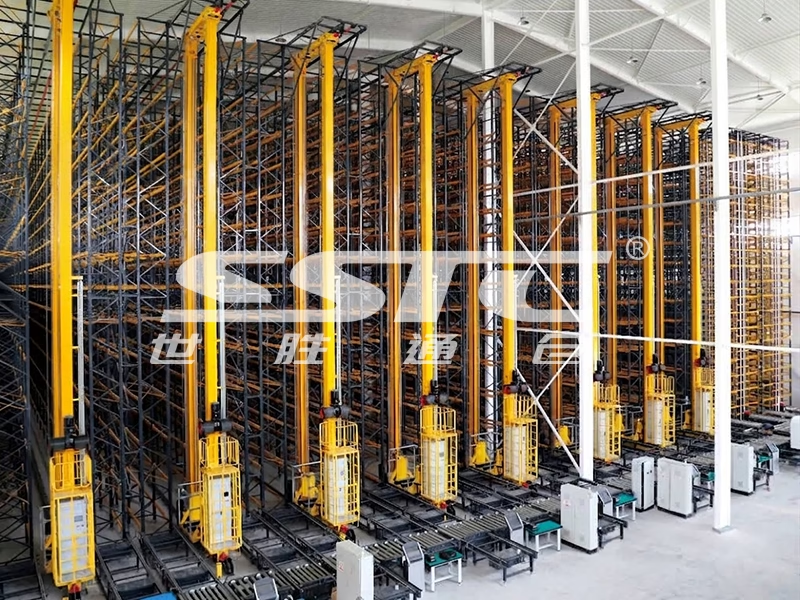
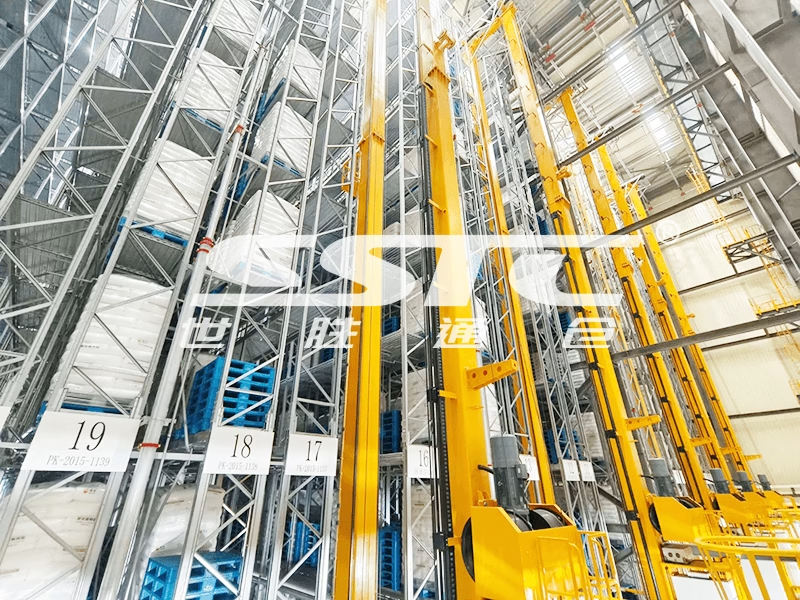
From Storage Capacity to Supply Chain Reliability: Where AS/RS For Palletized Cargo Creates Real Value in Cold Chain Operations
For cold-chain companies, the decision to invest in automation is rarely caused by a single problem. In most cases, it is the result of several operational pressures appearing at the same time: increasing pallet volumes, limited warehouse space, rising labor costs, stricter product traceability requirements and growing customer expectations for faster delivery.
A warehouse that was considered sufficient several years ago may no longer support current business growth. Food producers may experience seasonal inventory peaks, pharmaceutical distributors may need stricter inventory control, and third-party logistics providers may need flexible capacity to serve multiple customers with different storage requirements.
Under these circumstances, AS/RS For Palletized Cargo becomes valuable because it addresses the broader warehouse challenge rather than solving only one individual problem.
The purpose of an automated pallet storage system is not simply to replace manual operations. The greater value comes from creating a more controlled logistics environment where storage capacity, pallet movement and inventory information are connected.
This is particularly important in cold storage because every operational decision has a relationship with the physical environment. A pallet that remains unnecessarily in a staging area occupies refrigerated space. A forklift traveling long distances inside a freezer consumes operational time. A misplaced pallet creates additional handling work. A warehouse that lacks accurate inventory visibility can experience unnecessary product movement and reduced efficiency.
Por lo tanto, modern cold-chain warehouse planning is increasingly moving from a simple storage question toward a complete logistics management question:
How can companies protect products, improve capacity utilization and maintain reliable pallet flow at the same time?
Alimento, Beverage and Pharmaceutical Cold Chains Are Driving Higher Requirements for Pallet Storage
Among industries using cold-chain logistics, food and beverage, pharmaceutical and healthcare products represent some of the most demanding applications because product quality depends directly on storage conditions and inventory control.
In food distribution, companies often manage large quantities of frozen meat, seafood, dairy products, prepared foods and other temperature-sensitive goods. These products usually require reliable storage conditions, efficient inventory rotation and fast response during demand fluctuations.
For pharmaceutical logistics, warehouse operations may involve even stricter requirements. Temperature-sensitive products, including vaccines, biological materials and other healthcare-related products, require controlled handling procedures, accurate tracking and dependable storage processes.
The common requirement across these industries is clear:
The warehouse must do more than hold pallets.
It must provide a reliable logistics environment.
This is where automated pallet storage becomes increasingly relevant. By integrating storage equipment with warehouse control systems, AS/RS allows companies to create a more structured relationship between physical inventory and digital information.
For example, when a pallet enters the warehouse, the system can assign a storage location based on predefined rules. These rules may consider product type, storage duration, inventory rotation requirements and operational priorities. When the pallet is required for shipment, the system can retrieve the correct inventory according to warehouse instructions.
The result is not simply faster movement.
The result is greater operational consistency.
This distinction is important because cold-chain businesses are not only competing on storage capacity. They are competing on reliability.
A customer receiving frozen food products, pharmaceutical goods or temperature-sensitive materials expects the warehouse to maintain product integrity throughout the entire logistics process. A well-designed automated storage system supports this objective by reducing unnecessary manual intervention and creating clearer control over pallet movement.
Why Warehouse Expansion Is Not Always the Best Answer
When companies experience capacity pressure, the traditional response is often to build a larger warehouse. Sin embargo, in the cold-chain sector, expansion is not always the most practical or economical solution.
A new refrigerated warehouse requires significant investment:
- land acquisition or leasing;
- insulated building construction;
- refrigeration infrastructure;
- electrical systems;
- maintenance resources;
- additional operational management.
In many locations, available industrial land is becoming more limited, especially near major distribution centers and urban consumption markets. At the same time, companies increasingly need warehouses closer to customers to support faster delivery requirements.
This creates a difficult balance.
Businesses need more storage capacity, but expanding physical buildings may increase both capital investment and operating costs.
Improving the utilization of existing warehouse volume has therefore become an important strategy.
High-density automated pallet storage allows companies to evaluate their current warehouse from a different perspective. Instead of looking only at floor area, they can consider the entire cubic volume of the building.
The question changes from:
“How many square meters do we have?”
a:
“How much productive storage capacity can we create from our available warehouse volume?”
This approach is particularly relevant for cold storage because vertical space often represents a significant unused opportunity.
An intelligently designed AS/RS solution can utilize warehouse height more effectively while maintaining controlled pallet handling processes.
For procurement managers and warehouse investors, this creates another important consideration: the total cost of ownership.
The initial investment of automation is only one part of the decision. A complete evaluation should also consider:
- additional warehouse construction costs avoided;
- long-term labor requirements;
- inventory accuracy improvement;
- operational stability;
- future scalability.
A warehouse solution should be evaluated based on its entire lifecycle value, not only the initial equipment price.
The Importance of Data Before Choosing an AS/RS Solution
One common mistake in warehouse automation projects is selecting equipment before fully understanding operational requirements.
A successful AS/RS project begins with data.
Before designing an automated pallet storage system, companies should analyze:
- current pallet quantity;
- future pallet growth expectations;
- pallet dimensions and weight;
- SKU distribution;
- inbound and outbound volume;
- peak operating periods;
- reglas de rotación de inventario;
- required storage temperature;
- building height and available space.
These factors determine whether an automated storage configuration is suitable and how the system should be designed.
For example, a warehouse storing large quantities of similar products with predictable inventory patterns may have different requirements from a distribution center handling thousands of different SKUs with frequent individual pallet retrieval.
The objective is not to maximize automation at any cost.
The objective is to create a warehouse system that matches the company’s actual logistics model.
This principle is especially important for cold-chain applications because mistakes are expensive. Changing the layout of a normal warehouse can already create disruption. Modifying a frozen warehouse after construction is much more complicated because refrigeration systems, insulation structures and operational procedures are closely connected.
Professional planning before investment can significantly reduce future operational risks.
How AS/RS Supports the Future Development of Cold Chain Warehousing
The future of cold-chain logistics will be influenced by several long-term trends.
The first is continued growth in temperature-sensitive product distribution. Global food supply chains are becoming more international, while consumers increasingly expect reliable availability of frozen and fresh products throughout the year.
The second is increasing pressure on warehouse efficiency. Energy costs, labor availability and real estate limitations are encouraging companies to improve the productivity of existing infrastructure.
The third is the development of intelligent logistics systems. Warehouses are becoming more connected through digital technologies, allowing companies to make decisions based on real-time operational information.
According to industry analysis from cold-chain market research organizations, investment in cold-chain infrastructure is expected to continue as companies respond to changing consumer demand, food safety requirements and pharmaceutical distribution needs. Mordor Intelligence Cold Chain Logistics Market Report
At the same time, academic research continues to explore how warehouse operations, energy management and logistics planning interact within temperature-controlled environments. Research published through Elsevier’s Applied Thermal Engineering has examined logistics-aware approaches for improving industrial cold storage operation, highlighting the importance of considering logistics activities together with refrigeration management.
These developments indicate an important direction:
Future cold warehouses will not only be colder.
They will be smarter.
They will rely on better integration between physical storage infrastructure and digital management systems.
Tecnología de inteligencia SSTC: Supporting Modern Pallet Logistics Development
As companies evaluate cold-chain warehouse modernization, choosing the right technology partner becomes an important part of the investment process.
Tecnología de inteligencia SSTC (Shandong) Co., Limitado. focuses on intelligent storage and intralogistics solutions for palletized cargo applications. The company’s approach is based on understanding customer warehouse requirements first and then developing an appropriate automated storage solution.
The SSTC AS/RS Warehouse Solution integrates automated storage technology, pallet handling systems and warehouse management concepts to support different industrial applications.
Official product information:
SSTC AS/RS Warehouse Solution
https://www.sstc-storage.com/product/as-rs-warehouse
For cold-chain operators, the value of AS/RS is not only measured by the number of pallet positions created.
The more important question is whether the warehouse can operate with greater control, better visibility and stronger long-term scalability.
A modern cold warehouse should support today’s requirements while preparing for tomorrow’s growth.
This requires more than storage equipment.
It requires a complete logistics strategy.
Building the Next Generation of Cold Chain Warehouses: Why Intelligent Pallet Logistics Will Become a Long-Term Competitive Advantage
The development of cold chain warehousing is moving toward a new stage where storage capacity, operational control and digital visibility must work together. In the past, companies could often solve warehouse challenges by adding more labor, expanding buildings or increasing forklift operations. Sin embargo, as cold chain networks become larger and more complex, these traditional approaches are becoming increasingly difficult to maintain.
Modern warehouse operators are facing a combination of pressures that require a different approach:
more temperature-sensitive products entering global supply chains;
higher expectations for delivery speed and accuracy;
increasing costs associated with refrigerated buildings;
greater demand for inventory traceability;
and a stronger need for flexible logistics infrastructure.
Under these conditions, AS/RS For Palletized Cargo represents more than an automated storage technology. It represents a shift in how companies think about warehouse investment.
The future cold warehouse will not simply be a larger building filled with more racks. It will become an intelligent logistics platform where physical storage, automated handling and digital management operate together.
This transformation is particularly important because cold chain warehouses are long-term assets. A warehouse built today may need to support business requirements for the next 10, 15 or even 20 años. Por lo tanto, companies should not only consider current storage demand but also evaluate whether their warehouse infrastructure can adapt to future changes.
A flexible and scalable storage strategy can become an important competitive advantage.
The Role of Digitalization in Future Cold Storage Operations
Automation and digitalization are increasingly connected.
An AS/RS system creates the physical foundation for automated pallet movement, but its full value depends on how effectively it communicates with warehouse management processes.
Future cold warehouses will increasingly rely on:
real-time inventory visibility;
automated storage location management;
data-driven operational decisions;
warehouse performance analysis;
and better coordination between production, storage and distribution.
For example, when a company understands exactly where each pallet is located, how long it has been stored and when it should be dispatched, warehouse decisions become more accurate.
This is especially important for products with strict inventory requirements.
In food and beverage logistics, inventory rotation can directly influence product quality and commercial value.
In pharmaceutical logistics, traceability and storage accuracy are critical parts of supply chain management.
In third-party cold storage operations, visibility helps companies provide better service to multiple customers with different requirements.
Por lo tanto, the value of AS/RS For Palletized Cargo is not only mechanical automation.
The deeper value is the creation of a more transparent and controllable warehouse environment.
What Companies Should Consider Before Investing in AS/RS For Palletized Cargo
Although automation provides significant opportunities, choosing an AS/RS solution requires careful evaluation.
A successful project should begin with warehouse requirements rather than equipment selection.
Companies should evaluate several key questions:
How many pallet positions are required today?
How much growth is expected in the next five to ten years?
What types of products will be stored?
What are the pallet dimensions and load characteristics?
What are the daily inbound and outbound requirements?
What inventory rotation principles must be followed?
What temperature conditions will the system operate under?
How should the automated warehouse connect with existing ERP or warehouse management systems?
These questions determine whether the final system will provide real business value.
For example, a cold storage facility with large volumes of similar palletized products may prioritize storage density and stable throughput. A distribution center handling many different products may place more emphasis on inventory flexibility and retrieval frequency.
There is no universal warehouse design.
The best solution is the one that matches the company’s actual logistics model.
This is why professional system planning is essential before investment.
Why SSTC Intelligence Technology Focuses on Customer Warehouse Challenges
Para muchas empresas, warehouse automation is not simply a technology decision.
It is a business decision.
The selected solution must support operational goals, customer requirements and future development plans.
Tecnología de inteligencia SSTC (Shandong) Co., Limitado. approaches AS/RS projects from this perspective.
The company focuses on developing intelligent intralogistics solutions that help customers improve pallet storage efficiency, warehouse management capability and long-term logistics performance.
Rather than providing a standardized system without considering customer conditions, SSTC works around practical warehouse requirements, incluido:
warehouse layout;
pallet characteristics;
storage capacity targets;
operational processes;
and future expansion plans.
The SSTC AS/RS Warehouse Solution provides automated pallet storage capabilities for industrial applications and can be configured according to different warehouse requirements.
More information:
SSTC AS/RS Warehouse Solution
https://www.sstc-storage.com/product/as-rs-warehouse
For companies evaluating cold-chain warehouse modernization, the goal should not simply be to install automation equipment.
The goal should be to create a warehouse that supports reliable product handling, efficient pallet flow and sustainable business growth.
A Strategic Investment Direction for Future Cold Chain Warehousing
Cold storage will continue to play an essential role in global supply chains. As demand for frozen foods, temperature-sensitive products and reliable distribution networks increases, companies will need warehouse solutions that provide both capacity and operational control.
The traditional approach of continuously expanding warehouse buildings may not always be the most practical answer.
A smarter approach is to improve how existing and future warehouse space is used.
By combining automated pallet handling, high-density storage planning and intelligent warehouse management, AS/RS For Palletized Cargo provides companies with a pathway toward more controlled and scalable cold-chain operations.
The future of cold storage is not only about keeping products cold.
It is about managing every pallet more intelligently.
Preguntas frecuentes (Preguntas frecuentes)
Q1. What is AS/RS For Palletized Cargo?
Answer:
AS/RS For Palletized Cargo is an automated storage and retrieval solution designed for palletized goods. It combines storage structures, automated handling equipment and warehouse control systems to manage pallet storage and retrieval processes. In cold storage applications, it helps companies improve space utilization, increase operational consistency and create better control over pallet inventory.
Q2. Why is AS/RS For Palletized Cargo suitable for cold storage warehouses?
Answer:
AS/RS For Palletized Cargo is suitable for cold storage because refrigerated warehouse space is expensive and every cubic meter has operational value. Automated pallet storage can help companies utilize warehouse volume more efficiently, reduce unnecessary internal movement and improve inventory visibility. The final system design should always consider temperature requirements, pallet characteristics and operational conditions.
Q3. Can AS/RS For Palletized Cargo improve cold chain warehouse efficiency?
Answer:
Sí, AS/RS For Palletized Cargo can improve warehouse efficiency by creating a more structured pallet storage and retrieval process. It can help reduce manual searching, improve location accuracy and support better coordination between physical inventory and warehouse management systems. The actual improvement depends on project design, operational requirements and warehouse conditions.
Q4. What information is needed before designing an AS/RS cold storage solution?
Answer:
Before designing an AS/RS cold storage solution, companies should provide information including pallet dimensions, pallet weight, storage temperature, required capacity, daily inbound and outbound volume, SKU distribution, inventory rotation rules and warehouse layout. These factors allow engineers to develop a solution that matches the company’s real logistics requirements.
Q5. How can companies evaluate the investment value of AS/RS For Palletized Cargo?
Answer:
Companies should evaluate AS/RS investment based on total lifecycle value rather than only initial equipment cost. Important factors include storage capacity improvement, avoided warehouse expansion costs, labor requirements, inventory accuracy, operational stability and future scalability. A well-designed AS/RS solution should support long-term business development rather than only solve short-term storage pressure.
About SSTC Intelligence Technology (Shandong) Co., Limitado.
Tecnología de inteligencia SSTC (Shandong) Co., Limitado. is a professional intelligent warehousing solution provider specializing in automated storage systems and modern intralogistics solutions.
Through advanced warehouse automation technologies, engineering capability and project experience, SSTC helps customers improve pallet storage efficiency and develop more reliable logistics infrastructure.
The company provides solutions for industries requiring efficient palletized cargo management, including cold chain logistics, food and beverage, pharmaceutical, chemical, manufacturing and other industrial applications.
Website:
www.sstc-storage.com
Correo electrónico:
[email protected] | [email protected]
WhatsApp:
+86-13671613032